


 Francais
 Deutsch
 Italiano
Refine Your Search
Dayton Ohio USA 1947 stock footage and images
- Showing 4099 to 4104 of 25603 results more
more Hide
Hide
Preparations for aerial crop dusting of cotton fields; preparing aircraft for crop dusting
Men sign a contract for crop dusting airplanes in United States. Men seated in chairs outside a house. Trees in the background. They sign the contract and discuss. A dog sits near them. Crop dusting airplanes parked on ground. Two airplanes needed for spreading crop dusting poison or insecticde. Pilots of the airplanes. Men stand near the aircraft. A mechanic and an entomologist also needed. Men inspect the field and repair the plane.
Airplane dusts poison on a field and men discuss in United States.
Airplanes used for dusting poison (pesticide) on a farm field in United States. Man talks on an early model telephone in his house. Airplane parked on ground. Pilot comes out of a house and boards the plane. Other men stand nearby. The airplane takes off and in flight. Trees in the background. The airplane dusts poison in the field. Men stand on the cotton field and discuss.
The cotton yield per acre increases due to poisoning in United States.
Airplanes used for dusting poison on the fields in United States. The yield per acre increases due to the use of poison. Man walks and inspects the cotton in the field. Trees in the background. Men and women arrive and pick the cotton. A house. Man stands near the piles of cotton. He compares the yield of the poisoned and untreated fields. Airplanes in formation dusting poison over a field. High altitude view of the airplanes dusting poison. Isom and Jim fishing.
Army Documentary "The Big Picture", history of the U.S Infantry discussed and views of historic sites shown.
Sergeant James Mansfield hosts the program 'The Big Picture', the series depicting the combat infantrymen in United States. History of the United States Infantry is discussed.Scenes include: large formation of U.S. infantry on parade field; statue of minuteman; Concord Bridge; memorials at Wide shots of revolutionary War sites such as Valley Forge, Bunker Hill, Fort Ticonderoga,Trenton, Monmouth, and Yorktown. View of Manhattan Island and tall skyscrapers of New York City seen. View of Lake Champlain.
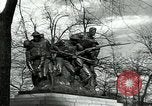
History and contributions of the U.S. Army infantryman to development of the United States of America
Memorial statue in Central Park, New York, to the 7th U.S. Army Regiment of World War I (World War 1, WWI, First World War). American infantrymen run with rifles from C-47 transport planes. U.S. soldiers in battlefield in Europe, and parading in tanks and marching,along the Champs Elysee,in Paris, France, with the Arc de Triomphe behind them. Soldiers march with flags. People watch. Korean War era U.S. soldiers march with rifles. West Point cadets march in New York City. Houses and buildings along the sides of the street. U.S. Army soldiers in various modes of operation: riflemen, artillerymen, paratroopers,ski troops, and Army engineers building bridges. One scene shows a woman soldier working as a mechanic. Soldiers training on an obstacle course, traversing a polar region with dog sleds. A gun emplacement in Hawaii and U.S.troops parading in the Philippines. A ship traversing the Panama Canal. View of U.S. Army tent Camp in Puerto Rico. A U.S. soldier sentry standing guard beside the ocean, in summer, in Iceland. An American soldier poses on a hill in New Jersey, silhouetted against backdrop of the Manhattan skyline with tall skyscrapers of New York City seen behind him. Sergeant James Mansfield talks about Colonel William Wilson Quinn. Colonel William Wilson Quinn on the show discusses the blue badge of the combat infantryman. The badge framed on a wall. He says that the badge has a blue background which is the color of the infantry. Copy of a rifle on the badge is surrounded by a circle with a star.
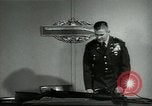
History of 1st Infantry Division, or Big Red One, focusing on deployment and action during Operation Torch in North Africa
Colonel William Wilson Quinn introduces an episode of "The Big Picture" that tells about the history of the 1st Infantry Division of the United States, called the "Big Red One." We see the boots and the shoes that 1st Infantry soldiers wore beginning with the Revolutionary War, through the Civil War, the First World War and the Second World War. Recruits are shown in training during World War 2 before deploying overseas in Operation Torch and the invasion of North Africa. Commanding General of the 1st Infantry Division, General Terry Allen, is seen during the Division's deployment to North Africa in World War II. Soldiers relaxing aboard troop ship. Naval barrage at night followed by amphibious assault on coast of Algeria. Animation shows the target areas of the division as they capture Oran. German counter attack is seen with bombers, tanks (including brief view of a German Tiger I tank), and artillery. American soldier standing with rifles shooting at low-flying German aircraft that are bombing their position. Scenes of German and American gun crews firing. Nazi German General Rommel seen in his staff car. Animation shows route of the Division with others towards the North. Heavy nighttime gunfire is seen. American soldiers meet and greet British troops of General Montgomery's 8th Army.
CRITICALPAST.COM: About Us | Contact Us | FAQs - How to Order | License Agreement | My Account | My Lightboxes | Shopping Cart | Advanced Search | Featured Collections | Website Terms & Conditions | Privacy Policy ©2026 CriticalPast LLC.
License Agreement |
Terms & Conditions |
Privacy Policy
©2026 CriticalPast LLC.