


 Francais
 Deutsch
 Italiano
Refine Your Search
Eboli Italy 1944 stock footage and images
- Showing 55 to 60 of 7969 results more
more Hide
Hide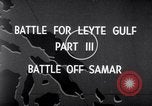
The Battle off Samar near the island of Leyte in the Philippines on 25th October 1944.
Shows the Battle off Samar which was the central action of the Battle of Leyte Gulf. It took place in the Philippine Sea off Samar Island near the island of Leyte in the Philippines on 25th October 1944. Animated map shows advancement of U.S. armed forces on Leyte Island. An Allied fleet of destroyers and escorts shown on map. USS Fanshaw Bay is their flagship. Signal-man intercepts Japanese communication relays in a Combat information center. Shows naval battle between Allied and the Japanese armed forces. (World War II period).

President Roosevelt returns to Washington DC after winning a 4th term in the 1944 presidential election.
President Roosevelt returns to Washington after winning a 4th term in the 1944 presidential election. President Roosevelt, Harry Truman, and Henry Wallace ride down Pennsylvania Avenue. Secrete Service Agents ride on running board of the automobile. Scenes of Armistice Day Ceremony at the Tomb of an Unknown Soldier. (World War II period).
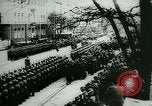
German Colonel General Heinz Wilhelm Guderian is celebrated following his appointment as Army Chief of Staff, in July, 1944, during World War II
Film opens showing German Colonel General Heinz Wilhelm Guderian, who was appointed Chief of Staff of the Army, by Adolf Hitler, on 21 July 1944, in World War 2. He is being feted as the New Army Chief. He reviews a large Honor Guard of German troops who line both sides of a street, in Germany. Local people cheer him from the sidewalks, and he is greeted by several German Youth girls. He steps into a building where other officers greet him and present him with a scale model of what appears to be a Panther Ausf. G tank. He looks closely as another officer points out the model's features. He then writes his name in the city's book of distinguished visitors. Complete change of scene shows General Guderian visiting members of his family, who greet him with kisses at the entrance to their house in Goslar, Germany. Inside their home Guderian shares coffee and cake with them at their dining room table. He and family members then look together through albums of photographs and memorabilia, of his career in the military, including one photograph of General Guderian with Adolf Hitler.

Destruction in coastal northeast USA from the 1944 "Great Atlantic Hurricane" (First example of a named hurricane in the US)
Views of The Great Atlantic Hurricane lashing at northeast United States areas (after having already hit the North Carolina Outer Banks), and views of the aftermath and early cleanup following the storm. Regions shown include Atlantic City, Long Island (where it came ashore as a category 3 hurricane on September 15, 1944), New York City suburbs, and parts of New England. High surf flooding boardwalks and coastal cities. Trees bent over and snapped in high winds. People walking with difficulty in the high winds. Streets of towns submerged in water. Coastal docks destroyed and large boats scattered high onto shore areas. Trees, poles, and wires downed over roads and homes. Entire homes moved off of their foundations and placed down the street. The "Great Atlantic Hurricane" was the first example of a named hurricane by the Miami Hurricane Warning Office, which later became the National Hurricane Center. The name was meant to reflect the hurricane's size and intensity.
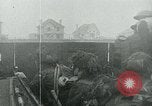
Canadian troops wade ashore from landing craft on Juno Beach in Normandy, France, June 6, 1944.
View of Canadian troops on D-Day huddled in a landing craft approaching Juno beach in Normandy, France, during Operation Overlord, June 6, 1944, in World War 2. The landing craft reaches the beach and all the Canadian infantry leave the boat, two or three at a time, and wade ashore during the invasion of Europe by Allied forces. Steel obstacles placed by the German forces can be seen on the beach. Several houses, stand along the beach. Two other landing craft with Canadian soldiers arrive near beach and soldiers wade ashore. The troops advance on the beach.
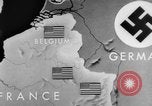
American advance in France and Belgium is stopped by German counterattack in December 1944. U.S. loses 78 thousand troops (WW2)
German forces smash into the U.S. First Army positions along a 45-mile front and advance deep into Luxemburg and Belgium, in Battle of the Bulge during World War II. Animated maps show Germany, France, and Belgium. German Panzer V "Panther" tank with several German soldiers riding on it approaches on road behind a large tree. German tanks, tank destroyers, troops, and artillery in transport on roads and then seen in action against American Army positions. Vehicles of a United States convoy wrecked and burning along road, as German troops advance past the burning vehicles. Fire and smoke rise from U.S. tanks, Jeeps, and trucks. U.S. soldiers captured as prisoner of war are marched on a town road. Frozen dead bodies of U.S. soldiers, victims of the Malmedy massacre, some with hands and feet tied, being placed army truck. Dead bodies of Belgian civilians being placed in large common grave. View of German officer ordering a firing squad to shoot. German troops smoke American cigarettes taken from dead U.S. troops. American troops in retreat and burning and destroying war materiel that could not be brought with them. American defenders firing artillery, including antiaircraft guns fired level, as antitank weapons. Skies streaked with contrails and dogfights between American and German airplanes. American aircraft bombing German positions after weather clears. American troops patrol in snow covered wooded areas. General Eisenhower talks with soldiers. German soldiers advancing. Newspaper headline reads: "Russians Smash Last Nazi Line." Another newspaper headline reads: "40 Jap Ships Sunk." Another reads: "3rd Army Deep in Germany." Narrator cautions against complacency, reminding of 78 thousand American soldiers lost during the Christmas holiday, in 1944. Views of dead U.S. Army soldiers following battles with Germans. Narrator offers closing public service war propaganda message: "If you have a War Job, Stick to it" and " If you Haven't, Get one!"
CRITICALPAST.COM: About Us | Contact Us | FAQs - How to Order | License Agreement | My Account | My Lightboxes | Shopping Cart | Advanced Search | Featured Collections | Website Terms & Conditions | Privacy Policy ©2026 CriticalPast LLC.
License Agreement |
Terms & Conditions |
Privacy Policy
©2026 CriticalPast LLC.