


 Francais
 Deutsch
 Italiano
Refine Your Search
Eboli Italy 1944 stock footage and images
- Showing 1777 to 1782 of 7968 results more
more Hide
Hide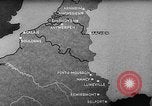
German forces defending against Allied advances toward Germany during WW2.
Map highlighting France, Belgium, and low countries, and German border city of Aachen during World War II. Soldiers riding on German Panther tanks camouflaged with foliage. They pass infantry walking along the side of the road. A Panzer IV with side track protectors. Commander of the German 5th Panzer Army, General Hasso von Manteuffel, conversing with officers of the 116th Panzer Division, September 1944. German tanks and infantry moving across a field. German soldier firing from prone position in a field. Knocked out American M3 halftracks. Captured American jeep and M3 halftrack. A very young German boy soldier escorting two ambulatory wounded American soldier prisoners of war. A small group of American prisoners of war. German field artillery firing and smoke rising from their shells exploding in distance. German troops entering town of Moncel-Les-Luneville, in Northeast France. Fire burning in the town. The Moncel-les-Luneville building after bombing in Luneville, France, at 15 Rue des Tuiliers, 54300 Moncel-lès-Lunéville, France. A Panzer tank enters Luneville. A huge smoke column rising in background.

Red Devil paratroopers of British 1st Airborne Division, drop into Holland to outflank the German Siegfried Line in World War II
At start, the film shows a formation of American C-47 transport aircraft with paratroopers starting to jump from them during World War 2. Viewed moments later from the ground, the sky is filled with trooper' open chutes, descending. An animated map shows Netherlands, Belgium, Luxembourg, and Germany. It shows location of the Allied paratroopers drop in Holland, intended to spearhead a drive around the Main River into Germany. The map then shows German forces encircling the paratroopers and the Second British Army heading North to the rescue. Next, a huge number of American Soldiers are seen assembled out of doors in England. Closeup of General Dwight D. Eisenhower speaking in a microphone to the assembly. Closeups of soldiers including some who are American Army Air Corps pilots, and other aircrew members, mostly Lieutenants. Senior Paratrooper officers stand at attention in front of formation of troopers with American flag beside them.(Narrator says these were the men who made up the "lost division," heroes who fought alone for seven terrible days.) General Eisenhower makes his way between close ranks of the paratroopers. He is followed by Brigadier General and a Colonel. Lieutenant General Lewis H Bereton also makes his way through the ranks. Scene shifts to a base in England where many British Airspeed AS.51 Horsa gliders are seen with paratroopers heading across the airfield to board. American C-47 aircraft are seen in the background. All aircraft are painted with D-Day stripes. Several British and American paratroop officers review a map together. At a tent camp, A military policeman and two U.S. paratroopers checking their weapons and ammunition. Some troopers sharpen their knives. A trooper is issued Dutch and German money. A British and and American trooper in camouflaged helmets, pose before a glider with a huge British roundel on its side. British paratroopers boarding a Horsa glider, named "Gertie." A Horsa glider moving as it is towed by a British Whitley twin-engine bomber. View from side of runway as the bomber takes off with its towed glider behind. (Narrator comments: "Destination, Holland.") Formations of tow planes and gliders in flight. View of pilot in cockpit of a Whitley bomber. Formations of fighter aircraft in flight overhead. View from inside an aircraft as paratroopers exit through a side door. Sky filled with paratroopers in chutes descending. (Note: This Allied thrust into Holland to launch a drive around the German Siegfried Line was known as the Allied joint American-British "Operation Market Garden," which took place 17 to 25 September 1944, the 7 days referred to by the film Narrator. )
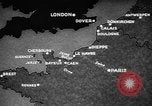
German Army fights Allied infantry and tanks while retreating from the Western Front in Europe, during World War II.
German Army fights with the Allied infantry and tanks on the Western Front in France and England, during the summer of 1944 in World War 2. Animated maps show English and French invasion coastlines. During Battle of Caen, German soldiers load ammunition on a camouflaged truck. The truck driven on roads. A German soldier on truck observes American bombers in sky overhead. Truck parks to the side and German antiaircraft guns fired. Night view from ground of bombs being dropped and buildings burning in the distance in Caen, France. German military trucks move at night on roads passing by burning fires. View from inside cabs of moving German vehicles. Daytime view of heavily bombed and destroyed city of Caen with ruins of houses and shops; German infantry walk through the streets of the destroyed and empty city. German soldiers fully loaded with their weapons ready for a battle. Close views of their faces with determined expressions. German tanks, armored vehicles, and infantry move on roads. Among them are two Borgward IV remote-controlled demolition vehicles (Schwerer Ladungsträger Borgward B IV, or heavy explosive carrier Borgward B IV) each driven by one man. Soldiers of German Army observe approach of U.S. Army forces. A German soldier arranges shells for artillery to fire as they fire on Allied positions. Wehrmacht infantry soldiers advance cautiously along roads. German soldiers take cover and prepare to attack as American tanks pass through a village. German soldiers fire on U.S. Army tanks. German soldiers direct an unmanned, remote-controlled small armored vehicle laden with explosives across a field and detonate it near U.S. Army vehicles (it is known as a Goliath Tracked Mine, or Leichter Ladungsträger Goliath (Sd.Kfz. 302/303a/303b); also known as a "beetle tank" to Allied forces, or a German robot tank). Large explosion as the remote-controlled demolition vehicle is detonated. Dead U.S. Army soldier along a road side, and injured German soldiers are aided by other German soldier
Scenes of Czechoslovakia beginning in 1918 and gradually moving into the era of World War II
Close-up images of a slide projector as it is turned on and as its Kodak zoom lens moves forward. A picturesque Czech town is seen with numerous historic looking buildings. View of Červená Lhota (Red Village) Castle in South Bohemia. (It has bright red roof tiles, not seen in black and white photos.) A town square and buildings nearby, including one that appears to be a cathedral. A bucolic hillside scene with sheaves of wheat stacked in groups and a village in far background. Farmers moving loaded wagons with teams of oxen. Farming scenes. Local people gathered around a church building, in a rural setting. Closeups of several young girls with their heads covered. A priest conducting mass at a section of the church with altar and backdrop open to the outdoors. Many women are attending and most have their heads covered. Closeup of a woman drinking from a bottle and girls at a marketplace. Girls and a man dressed in traditional costumes. A couple in traditional costumes. Glimpse of bridge over the River Vitava in Prague, Czechoslovakia. Glimpse of isolated church spire in area near city. Pedestrians and horse-drawn carts and wagons moving over the Charles bridge in Prague. Woman with baby in carriage and other pedestrians walking past Statue of Francis Borgia. on the bridge. View from bridge overlooking Wenceslas Square and statue of St Wenceslas, Prague. A tram moves below. Time moves to 1937. Police directing traffic and pedestrians at a busy corner in Prague. People at a flower stall. Glimpse of Adolf Hitler and Hermann Goering. People boarding and riding on trams. Children holding bouquets of flowers. A heavy gun barrel being raised. A backyard with line of wash and children playing in the field. Year is now 1938. German soldiers move a large artillery piece into position on a road. Agreements being signed related to the German annexation of the Sudetenland, portion of Czechoslovakia containing Germans who were incorporated into Czechoslovakia after World War I ). German troops moving into the Sudetenland. Czechs and Germans signing Munich Agreement documents, German forces driving into a city. Hitler meeting with Czech officials. Hitler heading a group including Hermann Goering and other high ranking German officials, as they walk along a road in a Sudetenland city where citizens welcome them enthusiastically. Momentary glimpses of persons being mistreated. Sudden change of scene to persons posing, including some in concentration uniforms. Hitler being overwhelmed by flowers. Empty street scene with flowers discarded on the road. Year advances to 1942. Concentration camp inmates pose behind barbed wire. Year, 1943. A young Jewish woman is seen with Jewish Star of David and word "Juden" displayed on her jacket and the number 671 on a tag around her neck. Year advances to 1943-1944. View of inmates crammed into a concentration camp barracks room.

U.S. task force underway for Peleliu (Palau) Invasion during World War II.
Opening slate reads LST 554, and date 8-13. Views of U.S. invasion task force vessels underway toward Peleliu Island (Palau), during World War 2. A 110 foot wooden Subchaser, number SC 633 is seen close, to starboard of camera boat (LST-554) and refueling lines are stretched between the LST and the Subchaser. Ensign Maynard K. Ross of Philadelphia, PA, directs the take-up of slack in the refueling lines while a Navy Commander on the LST bridge oversees the operation. (Note: SC 633 ended up running aground during the invasion.) Break in sequence and scene shifts to glimpse of slate reading August 20, 1944, and then view aft on LST 554. On the bridge, 21-year-old Ensign Charles Kahler, of Schenectady New York, uses a sextant to shoot sun lines. Another officer is seen taking relative bearings with a pelorus. Sailors are resting on deck. A series of splashes are created in the water by gunners testing their weapons. LST 557 is cruising to starboard. Puffs of black FLAK smoke appear overhead as antiaircraft weapons are tested.
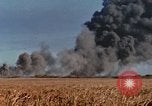
Accidental fire destroys LSTs at Pearl Harbor, Hawaii during World War II.
An accident at the West Loch ammo pier in Pearl Harbor destroyed six LSTs on May 21, 1944, during World War 2. Immense smoke arises from the burning ships. Men file on muddy roads. A pile of shrapnel on the ground. A partly sunk Landing Ship Tank (LST) burning in the water and a DUKW sails out of its bow doors. Two LSTs burning fiercely give outdoor immense clouds of smoke. A fireboat approaches and sprays water on them. Sailors rush to put out fire at the harbor.
CRITICALPAST.COM: About Us | Contact Us | FAQs - How to Order | License Agreement | My Account | My Lightboxes | Shopping Cart | Advanced Search | Featured Collections | Website Terms & Conditions | Privacy Policy ©2026 CriticalPast LLC.
License Agreement |
Terms & Conditions |
Privacy Policy
©2026 CriticalPast LLC.