


 Francais
 Deutsch
 Italiano
Refine Your Search
Eboli Italy 1944 stock footage and images
- Showing 1783 to 1788 of 7968 results more
more Hide
Hide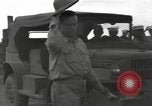
Bob Hope and his USO Troupe visit a U.S. Navy base on Mios Woendi island, Schouten Islands, Papua New Guinea, during World War II.
Bob Hope and members of his USO troupe ride on a PT boat during visit to entertain U.S. Navy personnel during World War 2. In opening scene, Bob Hope doffs his pith helmet as he strolls past the camera to climb aboard a PT boat (PT-331) of U.S. Navy Motor Torpedo Boat Squadron 21, where several naval officers greet him. Members of Hope's USO troupe, Patty Thomas, and Francis Langford, step from jeeps to board the PT boat. Next, the two are seen in the cockpit of the boat next to its captain, Lieutenant Kermit W. Montz, USNR, as the boat speeds along in the water. Among sailors occasionally glimpsed behind them is Radioman 1st Class bill Thielen. In change of scene, Bob Hope climbs out a hatch, holding onto his pith helmet to keep it from blowing off. The boat's number, 331 is clearly displayed on superstructure behind him. Various Navy sailors on deck. (Note: Squadron 21 received a Presidential Unit Citation for outstanding performance during the Huon Peninsula Campaign against Japanese forces from October 1943 to March 1944.)
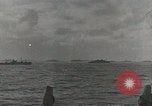
United States 1st Infantry Division soldiers land at Normandy, France during D-Day invasion of France in World War II.
The role of United States 1st Infantry Division (Big Red One) in various campaigns during World War II. Allied ships underway in the Atlantic Ocean. Soldier of United States 1st Infantry division practice an amphibious landing during training in England. Naval guns being fired on D-Day, June 6th , 1944. Troops of 1st Infantry Division climb down landing nets onto a landing craft. Soldiers land at Normandy Omaha beach in France on D-Day. Some soldiers drop to ground, shot crossing the beach. Troops move inland. Tanks being fired among hedge rows. Troops fire guns from dugouts and provide medical aid to a wounded soldier.
Governor Dewey being elected as the Presidential candidate at Republican party convention in Chicago, Illinois.
Republican national convention of 1944 in Chicago, Illinois. A banner in support of Governor Bricker of Ohio as a Republican Vice Presidential candidate. Pictures of Governor Thomas Dewey for the Presidential nomination. Representative Joseph Martin, Chairman of the Convention. Statesmen eat and discuss around a table before the convention. Wendell Willkie at desk. Cars outside the convention hall as people arrive. Delegates from various states across United States arrive at the convention. Newsmen at typewriters as they send out news about the convention. Cameramen record the proceedings at the convention. National Chairman Harrison E. Spangler opens the convention and invites Governor Earl Warren of California for delivering a keynote. Governor Thomas E. Dewey of New York at desk as he is elected as the Republican Presidential candidate.
President Roosevelt signs the Servicemen's Readjustment Act as a center serves war veterans to return to a civilian lifestyle (WW2)
United States President Franklin D. Roosevelt signs the Servicemen's Readjustment Act of 1944 at the White House in Washington D.C. during World War II. President Roosevelt at desk as he signs the Servicemen's Readjustment Act. Officials stand in the background. President being greeted by the officials after he signs the bill. The act ensures free education, federal loans, job insurance for war veterans and soldiers. American soldiers enter a center helping the soldiers to adjust to civilian lifestyle. Soldiers getting a massage, read books in a library, draw sketches and work at a farm.
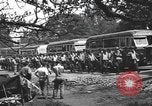
Allied forces assemble in England and depart for the invasion of Normandy in World War II
American paratroopers of the 82nd Airborne Division, boarding hired British commercial buses that take them to a marshaling point, in preparation for the invasion of Normandy, France, in World War 2. Views from below of U.S. Army Air Forces C-47 transport aircraft in formation, carrying paratroopers toward Normandy, France, on June 5, 1944. Aerial view of British and American invasion ships en route to rendezvous off the Isle of Wight. U.S. Army Air Forces B-26 and B-17 bombers in flight. B-17 dropping bombs on lines of communications in Normandy, to hinder German movements of reinforcements. Allied warships and transports beginning their move toward the coast of Normandy. British landing craft underway under cover of barrage balloons.
Allied troops capture the island of Hollandia, Indonesia under the leadership of General MacArthur during World War II.
Allied troops invade Hollandia, Indonesia during World War II. United States ships underway in the Pacific Ocean on April 22, 1944 to attack Japanese positions in Hollandia. The ships underway as United States Army General Douglas MacArthur looks at the convoy from United States cruiser USS Nashville (CL-43). Radars on alert in case of enemy attack. A United States destroyer transfers mail aboard the USS Nashville. Troops being briefed aboard a ship. Naval guns fire at the coast during night and flaks burst. American carrier planes bombard Japanese position on the island. Allied ships underway as planes fly overhead. Troops in landing crafts as they head for the beach. Allied troops disembark from the crafts and advance inland. Trucks, tanks and troops unload from landing crafts. Allied soldiers walk through mud as they advance. General MacArthur gets off Nashville and inspect an airfield under construction on the island.
CRITICALPAST.COM: About Us | Contact Us | FAQs - How to Order | License Agreement | My Account | My Lightboxes | Shopping Cart | Advanced Search | Featured Collections | Website Terms & Conditions | Privacy Policy ©2026 CriticalPast LLC.
License Agreement |
Terms & Conditions |
Privacy Policy
©2026 CriticalPast LLC.