


 Francais
 Deutsch
 Italiano
Refine Your Search
Eboli Italy 1944 stock footage and images
- Showing 1861 to 1866 of 7968 results more
more Hide
Hide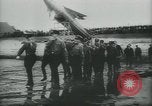
Montage of German rocketry scenes from 1930s through World War II. Nazi surrender. Atomic bomb. Japanese surrender
German rocket pioneer, Gerhard Zucker, attempting to develop postal rockets in the 1930s. Location is Wadden Sea off Cuxhaven, on April 9, 1933, where Zucker follows Nazi Sturmabteilung (also called SA or Stormtroopers) carrying the mail rocket across wet sands. The rocket is set up on a launch stand. Zucker and an assistant ignite the 8 side rockets and the mail rocket takes off. It noses up and loops over backwards, falling to the sand. German Stormtroopers lift up the damaged device. Next, is seen a later, more modern, rocket trial ending in failure. Two German engineers display a model similar to the pulse-jet-powered "buzz bomb" (V-1) employed by the Nazis in World War 2. A brief glimpse of similar American machine on sand flat, as narrator states German acknowledgement of knowledge gleaned from Dr. Robert Goddard's work. A German V-1 flying bomb (aka Doodle Bug) being launched in 1944, during World War 2. View of British houses of Parliament, London, England; an air raid shelter sign in City of Westminster. Londoners waiting out a raid in the shelter. Scenes of fire and destruction during German bombing of London, as narrator speaks about the more advanced German V-2 ballistic missiles employed later in the war. Londoners trudging through debris amongst bombed out buildings. Change of scene to U.S. infantry and armor advancing deep into Germany. Narrator refers to them overrunning rocket bases and other vital war-making facilities, near the end of the war. Glimpse of large number of German prisoners of war. Documents of military surrender being signed by Field Marshal Wilhelm Keitel, in Berlin, May 8, 1945. Closeup of Keitel. Scenes of American forces operating in Pacific theater. Aerial view of atomic bomb explosion. Japanese surrender ceremony on September 2, 1945, aboard the battleship USS Missouri. U.S. soldiers and other service personnel return home and greeting loved ones at end of war. Aerial view of Pentagon building and surrounding area in Arlington Virginia near Washington DC. U.S. troops boarding a ship in San Francisco, bound for war again, this time in Korea (1950).
German troops pass under Brandenburg Gate during Chancellor Adolf Hitler's 55th Birthday celebrations in Berlin.
Celebrations during 55th Birthday of German Chancellor Adolf Hitler on 20th April, 1944 during World War II. A German Eagle statue on a base with inscription to the effect that our walls may be broken but not our hearts. A youth raising a Nazi flag on top of a building. People and troops march through the Brandenburg Gate in Berlin. People set up Nazi flags amidst rubble, and a woman sets up a sign reading that our walls may be broken but not our hearts. Demolished building in the background. People buy newspapers at a newsstand.
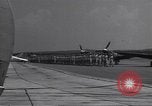
U.S. Major General William O. Butler gives address on third anniversary of Tuskegee Army Airfield, during World War II.
Final segment of "Army Air Forces special film project 151" known as "Wings for This Man". Third anniversary of United States Army Tuskegee Army Air Field being celebrated in August, 1944 during World War 2. Tuskegee Airmen U.S. African American cadets march. Commanding General U.S. Army Air Forces Eastern Flying Training Command addresses the cadet soldiers, families and spectators assembled. Cadets march at the ceremony. P-40 airplanes seen parked at the airfield. Several P-40s taxiing. (note: narrated by Ronald Reagan)
Japanese bomber makes a suicide attack on USS Franklin (CV-13) underway in the Pacific during World War II.
Japanese suicide bomber plane crashes on deck of USS Franklin (CV-13) underway in the Pacific Ocean on 30th October 1944 during World War II. Japanese kamikaze plane approaches in flames. Planes burns on flight deck of Franklin due to suicide crash. Men fight fire that breaks out on deck and among the on deck aircraft. Smoke billows up through flight deck from fire on hangar deck. Men fight fire on hangar deck. Injured man. Crew with fire hoses directed at hole on flight deck. Body of burned crew man. Navy crew fight the fire. Crew push a destroyed aircraft off the carrier into the ocean.
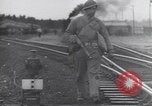
Troops board trains with war equipment and other supplies en route to ports of embarkation from the United States during World War II.
Plans underway in the United States in 1944 for participation in the invasion of France during World War 2 by Allied forces. A U.S. Army sentry of the Army Service Forces (ASF) patrols a rail line, where military men and equpment are being transported abroad., during World War 2. ASF soldiers drive DUKWs (amphibious vehicles) up a ramp for loading into railroad box cars. A long line of DUKWs being driven for loading. Many men load 55 gallon drums of petroleum products into rail cars. An M3 Stuart light tank being driven on an open rail car. Soldiers loading motorcycles on a train. An Army M3 Half-track Amored Personnel Carrier (APC) driving onto a railroad train. (Narrator notes that it requires 75 trains to transport a single Armored Division by rail.) Men loading a 105 mm Howitzer Motor Carriage M7 (Called Priest, by the British) onto a flat rail car and securing it in place with wooden supports. Army personnel that would participate in an invasion are shown. Paratroopers with their packs. Women's Army Corps (WACs) fill their duffel bags with clothing and other items, and are then seen climbing aboard an open stake truck. An Army band plays and marches giving troops a sendoff at a train station. U.S. soldiers board passenger railroad trains, carrying their field packs and weapons. A steam locomotive pulling a troop train. A train load of Sherman M4 medium tanks and other equipment, including a caterpillar tractor, is seen underway. Unidentified tanks being fastened to rail flat car. Many Army trucks and heavy equipment on train passing a town train station. Military equipment moving on trains over bridges. Two ladies under hair dryers at a salon, discussing boys in service going overseas. United States Army troops bound for the war front are seen boarding railroad trains and also changing trains, monitored by Army military police (MPs) at night. Soldiers inside a moving train car occupy themselves by playing cards; shooting craps; An African American porter watches a game. An Army chaplain talking with some of the soldiers. A soldier reading a magazine. His seat partner keeps falling asleep against him. American civilians at a newsstand. Newspaper headline reads: "London expects invasion of Europe at any hour."
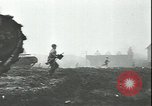
The U.S. Army Signal Corps in War and Peace. Descriptions and demonstrations of VT (proximity-fused) munitions
Opening scene shows troops of the U.S. Army 101st Airborne Division engaged at Bastogne, Belgium, during the Battle of the Bulge, in 1944, during World War II. They advance through fires and set up defenses in buildings, firing rifles from apartment windows. Outside, riflemen fire from behind a concrete barrier. Closeup of one firing his M1 Garand rifle. Glimpses of infantry firing mortars and walls falling to mortar fire. Gun crews firing heavy field artillery pieces, some under camouflage nets and others in the open. Intervening slate reads: "VT." and introduces postwar discussion of Signal Corps-developed proximity fuse, using animated cartoon. Shows how it proximity shells increase their explosive envelope compared to regular time fused munitions. U.S. Army gunner fire a number of proximity shells that burst above ground targets in the distance. A cartoon shows the proximity fused munition being used by a fighter aircraft. A Republic P-47 fighter plane is seen firing VT munitions from guns in its wings. Aerial bombs falling. A line of VT bombs exploding above ground.
CRITICALPAST.COM: About Us | Contact Us | FAQs - How to Order | License Agreement | My Account | My Lightboxes | Shopping Cart | Advanced Search | Featured Collections | Website Terms & Conditions | Privacy Policy ©2026 CriticalPast LLC.
License Agreement |
Terms & Conditions |
Privacy Policy
©2026 CriticalPast LLC.