


 Francais
 Deutsch
 Italiano
Refine Your Search
Eboli Italy 1944 stock footage and images
- Showing 2029 to 2034 of 7968 results more
more Hide
Hide
Villagers of Bande, Belgium, massacred by Nazis on Christmas Eve, in retribution for deaths of three German soldiers, in World War II
A sign identifies the village of Bande, in Belgium, during World War 2. View of snow-covered village rooftops from a distance. Closeup of a cafe in the village. Bodies of 34 young men from the village are seen lying in the cellar of the cafe. All had been executed on Christmas Eve, by a unit of the Nazi SD (Sicherheitsdienst) affiliated with the SS (Schutzstaffel) in retribution for the deaths of three German soldiers killed by Belgian maquis (Resistance fighters) on September 5, 1944. (Bande had been occupied by U.S. forces soon thereafter, but was retaken by German forces in the December Ardennes offensive, setting the stage for the massacre.) British troops that re-occupied the village on January 10th, 1945, are seen removing the bodies from the cellar and placing them on the snow-covered street. Wooden coffins are stacked up at the side of the building. Some closeups of the victims are seen. Scene shifts to a snowy field where the bodies are on the ground and men wrap them in sheets and place them in coffins. Closeup of British soldiers placing cover on a coffin and affixing an identification tag on it. Next, the Village Priest presides over a mass funeral for the victims, as villagers stand along the line of coffins. Women in black grieve over the victims. British soldiers carry the coffins to army trucks.The villagers follow behind the trucks as they proceed to the graveyard for burial. The coffins are placed on the ground at the cemetery.
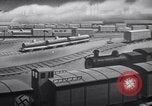
Allied bombing missions to destroy railroads and marshaling yards in occupied France and Germany during World War II
Cartoon representation of German rail yards and war factories, opens the film. Cities of : Anklam; Bremen; and Frankfurt are highlighted as critical factory and railroad junctions. Animated map shows Allied air strikes against French marshaling yards in Spring of 1944 in preparation for the invasion at Normandy. In February, 1945 Allied officers use large wall map to discuss and plan the destruction of all railroad operations in the Ruhr and surrounding areas. View of U.S. bombers in formation (with fighter cover overhead) on bombing missions in Operation Clarion, against all small and medium rail junctions in Germany. View from Allied bomber of Bombs falling and exploding at a rail junction. More aerial views of bombs exploding in numerous places during this operation. An American B-17 Flying Fortress bomber dropping bombs on a railroad marshaling yard. Aerial view of bombs exploding on targets in Essen. Views of wide destruction wrought at German railroad facilities. A US Army Air Forces P-51 fighter plane descending to strafe a target. Gun camera views of aircraft strafing lines of communication in Germany, including road and barge traffic. Closeup of runs firing from P-51 aircraft. Railroad trains being strafed and dramatic explosions at target rail sites.

The Philippines gains independence from the United States on July 4, 1946; also scenes from 1941 Japanese invasion WW2
The Philippines are established as an independent nation. Crowds of Filipinos gathered at Rizal Park (Luneta Park) in Manila on the July 4, 1946. View of Independence Grandstand (a temporary structure built in front of the Rizal Monument) with American flag and Philippine flags on tall flag poles.. View looking down on General Douglas MacArthur at a podium, speaking into microphones. Camera pans over various segments of the audience. A map shows the Philippine Islands in context of its neighbors in the Pacific Ocean. Camera pans closeup across faces of many Filipinos gathered at the independence event. View of the Jones Bridge over the Pasig River in downtown Manila. Heacock’s Department Store on the Escolta. The Legislative Building. (later the National Museum of the Philippines). Ocean going ships in a harbor. Cargo being offloaded from a ship onto smaller boat. An industrial complex with eight tall smoke stacks emitting smoke. Steel and petroleum plants. Filipino workers in an assembly plant. The Legislative building with people coming and going. Air raid sirens sounding and people running in streets of Manila at onset of Japanese invasion of the Philippines in December, 1941, at start of World War 2, in the Pacific. People running across the Jones Bridge, seeking shelter. Others boarding a bus. Smoke rising from Japanese bombing. Glimpse of Japanese tanks entering Manila during attack and invasion. Japanese infantry climbing a hill. Bodies of persons killed during the Japanese invasion. Glimpse of Japanese troops occupying Corregidor. U.S. General Wainwright negotiating the surrender of Corregidor with Japanese General Homma. View of an American warship firing during the U.S. campaign to defeat the Japanese on islands in the Pacific. An American landing ship carrying U.S. troops who storm ashore. General Douglas MacArthur striding ashore with a retinue of officers, at Leyte, Philippines, on October 20, 1944. as he keeps his promise to return to the Philippines. Views, back again, to MacArthur speaking at the Independence Day ceremony in Manila on July 4, 1946. Also seen at the ceremony are: U.S. Senator Millard Tydings, (co-sponsor of the 1934 Tydings–McDuffie Act, which provided independence to the Philippines after a 10-year transition under a limited autonomy), and Paul V. McNutt, U.S. High Commissioner of the Philippines, who read President Truman's proclamation of Philippine Independence to the assembly. Camera pans over the gathering which includes many U.S. Service personnel in uniform. The oath of office is administered to the elected President of the Philippines, Manuel Roxas. At the conclusion, the American flag is lowered by Paul McNutt, as President Roxas raises that of the Republic of the Philippines. A celebratory parade in Manila includes a float with signs reading: "Let's Produce and Rebuild," among other things. Other floats represent "Mountain Province," and "The City of Manila," "The University of the Philippines," and "The Division of City Schools." One float, sponsored by the Chamber of Commerce, contains a huge replica machine gear, and models of an aircraft and a ship. It's message is about turning the gear that helps make the nation great. American and Filipino soldiers march, carrying their respective national flags. A white-helmeted military band plays for the marchers. Final scene shows large loose formation of military aircraft in flight very high above the Independence Grandstand, at Rizal Park.
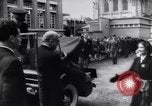
Renaming of Paris Street in honor of Général Philippe Leclerc de Hautclocque
French official arrives by car to officiate at ribbon-cutting ceremony renaming the Avenue d'Orleans as Avenue du General Leclerc, in honor of Général Philippe Leclerc de Hautclocque, who formally liberated Paris, entering along this street, at the head of his French 2nd Armored Division, in 1944. The French official is greeted by a young woman wearing a sash. Members of the French 2nd Armored Division are seen holding unit flags. The official unveils the new street sign on the corner of a building decorated with tricolor bunting. A member of the French 2nd Armored Divison poses on top of a sherman tank, parked in the square. The official cuts a ribbon..
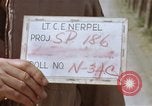
Liberated United States airmen prisoners at Stalag 7A in Moosburg, Germany (WW2)
Liberated United States prisoners (mostly military airmen) at POW camp called Kriegsgefangenen-Mannschafts-Stammlager (Stalag) VII A, located just North of Moosburg, Germany during World War II. The airmen cook food. Several are seen sunning themselves. Airmen seen shaving, shining shoes and cleaning clothes. A group of airmen around sign 'I Wanted Wings' and 'Luft 3'. These are some of the prisoners who were originally held at Stalag Luft III, in German Province of Lower Silesia, near the town of Sagan (now in Poland). (Note: Stalag Luft III is famous because the "Great Escape" took place there in March, 1944. Prisoners were forced to march from Sagan to Spremburg during the coldest winter in Germany in 50 years. There, they boarded a train of boxcars for a 3 day trip to Moosburg in January 1945, because the Russians were closing in. The addition of these prisoners to Stalag 7A, at Moosburg, led to serious overcrowding of the camp. On May 1, 1945, the New York Times reported that "The Fourteenth Armored Division liberated 110,000 Allied prisoners of war at Stalag 7A at Moosburg." This corrected an earlier report that 27,000 prisoners had been liberated.)
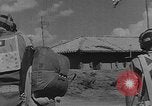
1st American Volunteer Group attacks and shoots down Japanese planes in Kunming, China.
United States Army Air Force operations against the Japanese in China in 1944. United States Army Air Force 1st American volunteer Group pilots look at a map. A pilot in a cockpit with a sign on the plane as it reads 'Pilot R.T. Smith' Soldiers are briefed and a man puts an insignia on the collar of a soldier. An animated map shows the transportation of supplies across the Himalayas to China. Chinese troops. Planes in flight. Aircraft take off and fly in formation. American Fighters in flight. Japanese plane burns and descends. Another plane explodes in mid air and falls. Men look at wreckage of crashed aircraft. Allied Officers confer. Animation shows location of Chinese towns. U.S. Army Air Force aircraft take off for attacking the Japanese positions. (World War II period).
CRITICALPAST.COM: About Us | Contact Us | FAQs - How to Order | License Agreement | My Account | My Lightboxes | Shopping Cart | Advanced Search | Featured Collections | Website Terms & Conditions | Privacy Policy ©2026 CriticalPast LLC.
License Agreement |
Terms & Conditions |
Privacy Policy
©2026 CriticalPast LLC.