


 Francais
 Deutsch
 Italiano
Refine Your Search
Eboli Italy 1944 stock footage and images
- Showing 2041 to 2046 of 7968 results more
more Hide
Hide
U.S. Army Air Forces P-47 aircraft operating in Belgium during World War II
USAAF P-47 Thunderbolt fighter planes operating at Florennes/Juzaine Airfield (A-78), Belgium, during World War 2. Identifiable units include the 411th Fighter Squadron (U9); the 373rd Fighter Group; the 387th Fighter Squadron (B4) and 388th Fighter Squadron (C4) of the 365th Fighter Group. A number of P-47s, (mostly bubble canopy D models) seen taxiing. (The second one's tail number looks like 42-26571, but that aircraft was downed in October 1944. So it is probably 26579.) Crew chiefs ride the wings of most P-47s to guide the pilots during low speed taxi when they would otherwise have to zig-zag to see ahead. Destroyed building silhouetted against the sky.Two flights of four P-38s circle overhead and peel off for landing.View through breached wall of a jeep towing a bomb cart past a parked P-47. Airmen walking across the field. Clear view of 388th Fighter Squadron P-47 taxiing. Another P-47 taxiing past a small damaged building

Internees from Brussels at the Buchenwald concentration camp interviewed in Germany.
Internees at a concentration camp in Buchenwald, Germany. Jean Blume, leader of socialist national movement against occupation in Belgium, shares his experiences of the days spent as a prisoner at Breendonk concentration camp in Belgium. He expresses joy at being liberated by American Army from Buchenwald concentration camp. (Note: Jean Blume was a Resistance Leader during the Nazi occupation in World War 2. The Gestapo arrested him on January 19, 1943 and he was imprisoned in Breendonk. In May 1944, he and many others, were sent to Buchenwald. They were released on April 11, 1945.)
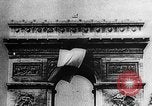
Montage of scenes illustrating the final stages of World War II in Europe
Liberation of Paris August 22, 1944. Tricolor flying from Arc de Triomphe. Crowds celebrate. Young people dance in street. Tanks firing guns. Bombs dropping on Germany. American tanks firing in Cologne, Germany. Spires of Cologne Cathedral loom above destruction and rubble in streets of Cologne. German civilian refugees on the streets. Germans in front of air raid shelters. Animated map showing Soviet advance from East.Formation of Ilyushin Il-2 aircraft. Soviet tanks in farm field. Silhouetted German soldiers surrendering. Wounded and dead German soldiers. Destroyed German military equipment. A long line of surrendered German soldiers. Allied forces driving into Germany beyond the Rhine River. Suffering German civilians and refugees including men, women, and children in desperate circumstances after the devastation of war. German refugees walking on roads, including babies in carriages or prams.
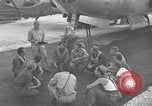
Major Robert Morgan, Aircraft Commander, briefs his B-29 crew as they sit on the tarmac prior to takeoff on a mission
Major Robert Morgan (well-known as the pilot of the B-17, "Memphis Belle," first to complete 25 missions over Germany, in the European Theater and now a B-29 Aircraft Commander with the 73rd Bomb Wing) briefs his crew. They sit on the tarmac near their aircraft, the B-29, "Dauntless Dotty," which was lead aircraft on the first B-29 bombing mission over Japan, on November 24, 1944. The Crew enters the aircraft after the briefing. (World War II period).
United States troops landing and fighting with Japanese troops in Leyte, Philippines (WW2)
U.S. Third Fleet underway at sea, heads for Leyte in October 1944 during World War II. Warships fire heavy guns at Leyte. Ships advance under naval bombardment. Explosions on ship. U.S. troops aboard landing crafts. Japanese troops and defense during the barrage. They take positions and begin to attack. U.S. landing crafts attacked. Dramatic close up views of faces and expressions of many U.S. soldiers as they prepare for the invasion. U.S. troops leave landing craft and wade through water on to beaches. Japanese troops firing at incoming American forces with rifles and machine gun fire. American soldier raises American flag on island. Artillery fired and U.S. Army tanks advance. Wounded U.S. soldiers carried on litters. U.S. Army soldiers staying low and crawling on beach to avoid enemy fire. U.S. Army soldiers advancing, using rifle fire, hand grenades, and flamethrowers to attack entrenched Japanese enemy positions. Dead Japanese soldiers. Smoke arising from explosions in jungle.
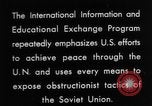
Events of World War 2, and creation of United Nations Organization following the surrender of Germany and Japan
Summary of World War II events and formation of the United Nations Organization. Soviet troops on Eastern Front of Europe fire artillery on German positions in 1944. Russian troops advance. German soldiers come out of buildings and surrender. Allied Forces land in France on D-Day. Allied troops and tanks fight Germans on streets in towns and villages of France. U.S. Army tanks fire at German positions. Various groups of German prisoners of war march along roads and are herded into prison camps operated by American and British forces. In 1945, the Allied leaders meet at Yalta on the Crimean Peninsula to discuss Allied military strategy in the final months of WWII. Leaders included British PM Winston Churchill, U.S. President Franklin D Roosevelt and Soviet Premier Joseph Stalin. The meeting of U.S. and Soviet Russian troops at the Elbe River. German Nazi Swastika symbol blown up in explosion atop Zeppelinfeld Nazi party rally grounds in Nuremberg. Aerial view of Berlin in ruins, as seen from low-flying aircraft flying directly over the Unter den Linden boulevard and the Brandenburg Gate. Wrecked and bombed German buildings seen everywhere. German officials signing surrender instrument at Rheims. U.S. President Harry S Truman, Winston Churchill and Joseph Stalin at Potsdam Conference. U.S. Marines battling on beaches of Pacific Islands. Iconic shot of U.S. Marines raising the American flag on Mount Suribachi at Iwo Jima. Aerial view of bombed and ruined city of Tokyo, Japan. The Japanese surrender to MacArthur aboard the battleship USS Missouri. General MacArthur speaks aboard Missouri. Victory celebrations all across the world, with some scenes from earlier V-E Day (Victory in Europe) day in May 1945, including crowds celebrating in Paris, France, and some scenes on V-J Day (Victory over Japan day) in August 1945. Crowds on streets celebrate. Happy crowds jam streets. Delegates of Nations, among them Andrei Gromyko and Vyascheslav Molotov meet in San Francisco and create a United Nations organization. Truman arrives at signing of UN charter. Various delegates sign charter. U.S. troops disembark troop carrier ships at U.S. ports and are discharged after completing military service in World War 2. Group of U.S. Army soldiers exits a church (the Chapel at Fort Dix, New Jersey), waving their discharge papers in hand.
CRITICALPAST.COM: About Us | Contact Us | FAQs - How to Order | License Agreement | My Account | My Lightboxes | Shopping Cart | Advanced Search | Featured Collections | Website Terms & Conditions | Privacy Policy ©2026 CriticalPast LLC.
License Agreement |
Terms & Conditions |
Privacy Policy
©2026 CriticalPast LLC.