


 Francais
 Deutsch
 Italiano
Refine Your Search
Eboli Italy 1944 stock footage and images
- Showing 2131 to 2136 of 7968 results more
more Hide
Hide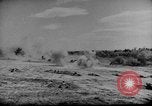
U.S. Army Quartermaster Corps prepare mortars, fire anti aircraft guns, and provide supplies during World War II.
Clip opens with brief World War I scene, circa 1917, of new American army recruits receiving army uniforms being issued by a U.S. Army Quartermaster. Clip then covers U.S. Army Quartermaster Corps' combat operations in various Theaters of Operations during World War II. Quartermaster Corps soldiers with rifles under the cover of a military truck during battle. Troops in trucks. An aircraft in low flight over a field. A U.S. Army truck. A Quartermaster fires an anti aircraft gun. Explosions occur and smoke rises. A British tank in a field. Soldiers beside a truck. Cans and barrels stacked on the ground. An enemy German tank in a field. Soldiers take cover. Quartermasters with guns in a trench. They come up the trench in prone positions. Dramatized battle scene with several Quartermaster corps casualties beside a wire fence. Soldiers prepare a mortar gun. An anti aircraft gun on an army truck. A soldier takes aim and fires a rifle during training. The Quartermaster flag hoisted on a pole. Actual footage shows aerial view of Bataan, and then ground views of groups of remaining U.S. Army soldiers around time of surrender of Bataan in April 1942. American soldier seen with their hands up and under guard of Japanese soldiers during Bataan surrender. Landing crafts arrive at a beach in North Africa. Supplies being offloaded at various battle fronts of World War 2. Soldiers and supplies off-loaded on the beach. Quartermasters seated on supplies boxes. Landing crafts arrive at a beach in the South West Pacific. Troops move across the beach. Troops disembark from landing crafts and move across a beach in Sicily, Italy. The Quartermasters unload boxes of supplies during various beach landings. They unload supplies and fire artillery on a beach head in Italy. Troops in trucks. A convoy of trucks loaded with supplies. Ammunition, ration and personnel in trucks move from Algeria to the front in Tunisia. Explosions occur and smoke rises. Trucks advance through smoke at night and in difficult conditions. Quartermaster General Major General E. B. Gregory speaks about the Quartermaster Corps. He says that the Quartermasters distribute goods to the army during training and combat. The movement of the Corps should be so regulated so as to deliver the goods at the right time in the right quantity.
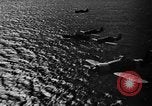
German and Italian aircraft dive through intense flak to bomb a British convoy underway in the Strait of Sicily.
A naval-air battle in the Strait of Italy during World War II. A formation of Italian and German bombers over the Strait of Italy. Ships of a British convoy underway. British ships fire antiaircraft guns at Italian aircraft. Flak bursts in the sky. Italian bombers bomb the ships. Explosions near and on the ships. British ships are heavily bombed by a large number of Italian bombers. Many ships sink after exploding. Smoke billows up from the ships afire. Italian MASs (torpedo armed motorboats) head for a British convoy. British ships are torpedoed. Smoke rises after explosions on the ships. The bombing of the convoy continues at night. Interiors of an Italian submarine shows its crew members at work. A list of claimed British losses includes HMS Furious (47), HMS Eagle, HMS Manchester (C15), HMS Cairo (D87) and HMS Foresight (H68). Victorious Italian MASs underway and Italian aircraft in flight overhead. View of letter from Mussolini congratulating the Axis forces, read by narrator. View of Italian attack boats moving at high speed in ocean.
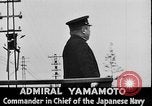
Axis powers vision for conquest at onset of World War II
Invasion plans of the Axis power in the European Theater during World War 2. Film opens, ostensibly, showing Japanese Admiral Isoroku Yamamoto speaking at a podium. (There is some question whether this is actually Yamamoto.) The U.S. Capitol and the Pennsylvania Avenue in Washington DC, with marching Axis troops superimposed as if marching in conquest. Axis troops parade in Berlin, Germany. Animated diagram shows 'divide and rule' ambitions of the Axis powers. Animation showing radio signals emanating from radio towers with propaganda and "LIES". A German speaker delivers a propaganda message from a broadcast studio in Germany. Young women are seen gathering in groups. A woman in Italy receives an award for having many sons. Group of young men and women in Italy walking arm in arm which narrator describes as an effort to boost marriages and encourage having children. Cover of "Der Hammer" magazine in which German Dr. Willband Hentschel writes: "Round up a thousand German girls. Isolate them in a camp. Then let them be joined by a hundred German men. If a hundred such camps were set up, you would have 100,000 thoroughbred children in one stroke." Next scene shows a maternity ward with many (perhaps 30 or more) newborn infants laying on a large surface and being powdered, diapered, and swaddled by a team of German nurses. Narrator states: "Of course the children from this assembly line belong to the State, to be scientifically claimed for conquest."
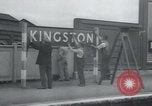
Workmen take down station signs off a platform in London, England during World War II.
Views in London, England after the declaration of war by Italy during World War II. Workmen take down 'KINGSTON' station sign off a platform. A train passes in the background. The workmen take down another sign. A workman paints out another sign. A sign of Quaglino's restaurant being put up after the declaration of war by Italy.
Italians boarding the SS Cristoforo Colombo to New York City
An American and an Italian journalist talking about U.S.-Italian relations while waiting at the airport. A Middle East Airlines Vickers Viscount plane lands in Rome Ciampino Airport (Via Appia Nuova, 1651, 00040 Ciampino RM, Italy). An Italian journalist chats with an American in Italian while waiting near their boarding gate. Americans on board a ship approaching an Italian port. Italian people cheering upon arrival of ship. People waving from ship. An Italian old woman waving. Italians board the ship. Italian ocean liner SS Cristoforo Colombo sailing to the United States. Sailors on a dinghy beside the SS Cristoforo Colombo near New York harbor. A woman holding flowers and her daughter cheers upon the arrival of the SS Cristoforo Colombo. Passengers from Italy disembark with their luggage from the SS Cristoforo Colombo. A car is being lifted from the SS Cristoforo Colombo. Two women hugging after their reunion in New York Harbor. A smiling blond woman waving.
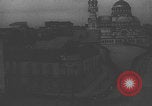
King Boris III funeral in Sofia, Bulgaria (during WW2)
Funeral of King Boris III of Bulgaria after his death from an apparent heart failure in Sofia during World War 2. Large crowds in black line up to attend the funeral outside the Alexander Nevsky Cathedral (pl. "Sveti Aleksandar Nevski", 1000 Sofia Center, Sofia, Bulgaria). Mourners move in a line to view King Boris III lying in state. Mourners pay their respects to the departed king lying in state. King Boris III lying in state. The widow and consort of King Boris, Queen Giovanna of Italy (Ioanna Savoiska), arrives at the Alexander Nevsky Cathedral for the funeral service. The queen is wearing a black veil and mourning dress. Honor guards salute the queen upon her arrival. The German delegation arrives at the funeral, with Grand Admiral Erich Raeder as Adolf Hitler’s representative. Grand Admiral Erich Raeder shake hands with a Bulgarian official. German troops bring large funeral bouquets to the funeral service. Funeral bouquet with the Nazi Swastika sign. Queen Giovanna, children Princess Marie Louise and Simeon II of Bulgaria, and Prince Kiril of Bulgaria (brother of King Boris II), come out of the cathedral. Bulgarian woman cries. The coffin of King Boris III is mounted on a gun carriage. Soldiers march during the funeral procession of the Bulgarian king. Bulgarian mourners cry during the funeral procession. Queen Giovanna and Prince Kiril lead the state funeral procession. Behind Queen Giovanna and Prince Kiril are the representatives of Axis powers and Bulgaria’s allies- Admiral Raeder, General Begetsch (Croatia), Prince Adalberto, the duke of Bergamo (Italy), and the Japanese Ambassador to Bulgaria. A marching band plays music. Bulgarian honor guards marching during the funeral procession. Honor guards leading a horse. Coffin of King Boris III is mounted on a gun carriage. The House of Saxe-Coburg and Gotha coat of arms is draped over the coffin. German troops on a horse carriage with guns attached being pulled.
CRITICALPAST.COM: About Us | Contact Us | FAQs - How to Order | License Agreement | My Account | My Lightboxes | Shopping Cart | Advanced Search | Featured Collections | Website Terms & Conditions | Privacy Policy ©2026 CriticalPast LLC.
License Agreement |
Terms & Conditions |
Privacy Policy
©2026 CriticalPast LLC.