


 Francais
 Deutsch
 Italiano
Refine Your Search
Eboli Italy 1944 stock footage and images
- Showing 25 to 30 of 7969 results more
more Hide
Hide
U.S. shuttle-bombing of German positions and military installations under Operation Frantic during World War II.
Film title slate indicates "Operation Titanic" but it, in fact, depicts "Operation Frantic" with U.S. shuttle bombing operations over Germany from bases in Great Britain, Italy and Russia during World War II. United States Army Air Force B-17 Flying Fortresses in flight. Aerial view of bombers in flight with several aircraft flying in formation leaving behind contrails. View inside bomber aircraft with bombardier preparing to drop bombs. View of bomb bay door opening and closeup of hand near bomb drop switch. Bombs awawy view as bombs are dropped from American aircraft. German defenses are bombed along the invasion coast of France (just prior to D-Day) on June 2, 1944. Aerial views of B-24 and B-17 bombers also in flight bombing German military installations in German-occupied northwestern Europe. Aerial view of a target area. Smoke rising up from bombardment. Two different U.S. Army Air Force B-17 Liberator aircraft are seen falling from the sky toward crashes after being hit by German enemy fire. One of them has smoke trailing from it, and the other is in a free fall. Railroad and marshaling yards are also bombed over Debrecen, Hungary on June 2, 1944, with aircraft continuing on (shuttle bombing) rather than returning to base. United States Army Air Forces B-24 Liberator flying in formation on June 21, 1944. Aerial view as they bomb the Focke-Wulf Fw 190 engine aircraft factory near Basdorf, Germany. German factories are bombed. B-17 aircraft on the same date are seeing in formation and bomb railway stations, freight yards, and factory targets, along with the Nazi German Ministry of War, Ministry of Propaganda, and Gestapo headquarters in Berlin, Germany. Heavy flak bursts seen in the air near the aircraft. Dogfight scenes as several German airplanes are shot down. Machine gunners aboard U.S. bomber aircraft firing at German fighter aircraft and shooting down 43 of them, according to narrator. Aerial view of ball turret rotating below bomber and firing guns at German fighter aircraft. The B-17s and B-24s bombing the targets. Synthetic oil plants and refineries are bombed at Ruhland Germany, east of Leipzig. Planning for the operation was done on December 7, 1943. A document about the operation is typed. Animated map shows Nazi positions and method of shuttle-bombing, allowing American aircraft to bomb from Soviet bases, and allies broadly to bomb German targets from bases in the United Kingdom, Italy, and Soviet Ukraine.
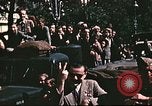
American soldiers greeted by celebrating civilians in Lyon, France, and Rome, Italy, during World War II
American soldiers in jeeps are part of a traffic jam in Lyon, France, following its liberation by French forces in September, 1944. An air of celebration permeates the scene, Several French women ride with U.S. soldiers in American jeeps. A Blue vehicle displaying "FFI Police" (Free French of the Interior) and the Cross of Lorraine, is caught in the jam. A small black sedan displays "FFI" in white letters.Local civilians crowd the streets and ride on every possible spot on the various vehicles. Crowds of pedestrian spectators are restrained behind rough wooden fences. Camera views from vehicle crossing the Rhone River, show the destroyed Wilson bridge, and parts of city in background. Complete change of sequence to Rome, Italy. The Flag of Italy flying on an official building. Italian women surround American soldiers, Sergeant Lester Koenig and another NCO as they sit in a jeep. They all laugh and talk. Several Italian soldiers (one a medic) and women pose for the camera.
German armored vehicles,tanks and trucks destroyed by U.S. tactical aircraft supporting French forces in Italy
Destroyed German equipment, including some captured American armor, lines the edge of a road near Esperia, Italy during World War II. The German armored vehicles, tanks, antitank guns and trucks were destroyed by U.S. fighter bombers of the 12th Army Air Forces, on May 16, 1944, while supporting the French Expeditionary Force assault on the German Gustav line in that area. French troops stand on the side of a road. Troops examine some of the destroyed armor.
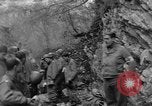
U.S. Army forces assault the German Winter Line of Defense during the Italian campaign of World War II
American troops of the 45th Infantry Division, are seen in mountains after breaking through the first segment of the German Winter Line, near San Pietro Infine, Italy, in World War 2. It is Christmas Day, 1943 and they occupy Mount Lungo. They receive Christmas dinner in their individual mass kits and sit down on the ground to eat it. On December 28th, they employ pack mules and also use stretchers to retrieve remains of fallen 3rd Division defenders down the steep mountain trails of Mount Lungo. They place the carefully wrapped remains at the base of a bullet pock-marked stone structure. Scene shifts to Mount Sammucro where American troops take advantage of a brief lull in fighting. On 1 January, 1944, Second Corp reinforcements have arrived and Americans commence a new assault on the German Winter Line defenses, with an artillery barrage on German positions guarding San Vittore del Lazio. View of smoke rising from that town. Shelling of Mountaintop flanking Highway 6held by Germans. Groups of American troops firing mortars from valley below. Shells exploding on German positions. Closeup of American gun crew loading and firing a 155mm long tom field gun. Soldiers holding their ears when gun fires. Bombs dropped from American warplane aircraft explode near roads in the valley. Glimpse from U.S. warplane flying overhead, of smoke rising from German positions in the Winter Line. Soldiers of the 168th Infantry Regiment firing a recoiless rifle from wooded area. Shells striking at base of mountain. Troops of the U.S. 137 Infantry Regiment advancing on San Vittore. view in the Italian town on 7 January, 1944, when street fighting has ended. American soldiers are seen mingling with the civilian inhabitants. German military equipment destroyed and burning during the American Winter Line offensive. Captured German soldiers being taken into custody, searched, and processed as prisoners of war.
Montage of U.S. World War II combat scenes focusing primarily on the foot soldier (Infantry)
U.S. Army infantry soldiers patiently making their way on foot at various places in Europe and the Pacific during World War 2. Troops under fire during an amphibious assault. Others employing small arms in fire fights. American soldier firing a Browning 30 caliber light machine gun from a protected position. The American flag planted at a beachhead on a Pacific island. Landing craft in the background. Infantry moving widely spread out across a field. A line of soldiers standing side-by-side firing their rifles toward an enemy position. Closeup glimpse of soldier with fixed bayonet on his rifle. Flamethrower being employed. A soldier throwing a hand grenade. Another firing a bazooka from prone position in woods. Other infantrymen employing weapons, including: machine gun; mortar; a light howitzer artillery piece. A soldier sharpening his knife on a ground stone. Aerial view of amphibious assault underway below. Closeups of infantry in fast moving landing craft Views of many wading ashore from landing craft in a shallow bay. Lines of infantry wading ashore from a Landing Craft Infantry Large (Number 747) in a Pacific campaign. Closeups of soldiers reaching shore. A formation of Waco CG-4A gliders in flight, and then some seen landing in plowed fields of Normandy on D-Day, 1944. One noses over and remains tail upright after a rough landing. Infantry moving under fire. Some cluster for protection next to a Sherman tank. Lieutenant General Mark W. Clark briefing officers with pointer and very large tactical map, in the open, in Italy in 1944. U.S. infantry moving under fire in rugged terrain of Italy. Troops moving casually past a fallen enemy soldier. Closeups of individual soldiers making their way past the camera and taking a break. One of their wounded seen on a litter in the background. Infantry moving along a dusty road and then slogging through a muddy stretch. A soldier with numerous cans of combat film, at a War Department repository. An army Signal Corps clerk reviews caption sheets that accompany the combat films. Infantrymen gathered at side of a hill and later digging foxholes in fields. Lines of infantry moving forward in rugged terrain, with pack horses behind them. Infantry moving in concert with advancing armor. Individual soldiers moving under heavy enemy fire. A grenade explodes and American soldier fires his rifle, striking fleeing enemy soldier who falls. Soldiers firing a 75mm M1 Pack Howitzer; rifles; and a flame thrower. Infantry seated in a line of DUKW amphibious trucks. A soldier in heavy cold weather gear, eating from his mess kit at a fox hole he prepared in snowy area. his trenching tool sits next to him. In contrast, soldiers are seen helping civilian refugees moving through rice paddy area somewhere in the Pacific. One carries a small child. A shift change at a U.S. war plant, shows thousands of workers . Lines of miners heading to work. Men and women war production workers punching time clocks as they leave after their work shift. Closeups of American men and women engaged in war production work of various kinds. A worker building machine gun triggers. Other workers building various war materiel. Workers standing by a line of machine gun barrels. African American woman war production worker using a factory machine. Workers machining parts, using industrial drills and other equipment. Men on an assembly line for military vehicle chassis. Split screen shows war plant workers on one side and formations of soldiers on the other. Cemetery with grave stones of fallen American service personnel. One is marked "Unknown." Animated chart showing rising war production against backdrop of factories emitting smoke from chimneys.

U.S. soldiers being hit by shell fragments and their recovery after surgery in Naples during World War II.
A film titled 'Soft Tissue Wounds' shows U.S. soldiers being hit by shell fragments and their recovery after surgery in Naples during World War II. Bombs stacked on a field. U.S. sailors work around. A battleship's gun firing salvo. Fragments are removed by surgery from battle casualties. Reports of four cases handled in the Italian campaign of January 1944. The first case shows a soldier hit by a shell fragment. U.S. troops carry the soldier hit by the shell fragment in Italy. A truck moves ahead on a road. Wounded being carried into an evacuation hospital tent. A wound just below the buttock of a soldier. Primary infusion is given to the patient. The bleeding is controlled. The wound is dusted. Dressing completes an operation. The healing of the wound after a few weeks of the operation. The patient walks after healing. A U.S. soldier shows a scar under scapula. A U.S. LST (Landing Ship Tank) fires towards Anzio Harbor. [Note: script refers to British Hospital Carrier Leinster (#37) although footage appears to be of (British) Hospital Ship St. David (#27), later sunk by the Germans at Anzio in January, 1944]. A wounded soldier is carried on a stretcher aboard the hospital ship. Surgery is performed on the wounded soldier. The soldier on a bed after the operation. A ship underway at sea. A Red Cross ambulance and a truck transport the wounded soldiers to a hospital in Naples. The wound after one week of injury. The wound margins are refreshed. The wound edges are stitched. Removal of stitches after eight days. The soldier smokes a cigarette after recovering.
CRITICALPAST.COM: About Us | Contact Us | FAQs - How to Order | License Agreement | My Account | My Lightboxes | Shopping Cart | Advanced Search | Featured Collections | Website Terms & Conditions | Privacy Policy ©2026 CriticalPast LLC.
License Agreement |
Terms & Conditions |
Privacy Policy
©2026 CriticalPast LLC.