


 Francais
 Deutsch
 Italiano
Refine Your Search
Egypt 1953 stock footage and images
- Showing 301 to 306 of 1095 results more
more Hide
Hide
Guns on USS Missouri firing coastal targets during Korean War, Korea.
Focuses on Korean War (1950-1953). USS Missouri off the coast of Korea. Guns mounted on USS Missouri. The UN flag is raised on battleship. Admiral Allan Smith and other officer salute. Gun barrels swing. Gun crewmen handle bombs aboard USS Missouri. Bombs are transferred by elevator. Officer looks into periscope. Guns on USS Missouri fire coastal targets. Bursts in water. Explosions on coast.
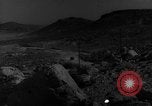
Resident-General of French Morocco , Lieutenant General Pierre Boyer de Latour visits Berber tribes in mountains of Morocco
French Resident-General of Morocco, Lieutenant General Pierre Boyer de Latour, in exercise of diplomacy, visits Berber Tribes in middle atlas region of Morocco ( el mars boulmane ). He arrives in a 1953 Oldsmobile convertible automobile, driving up a rugged dirt road. The General greets several tribal leaders and converses with them. The tribal leaders escort General de Latour to a large tent, where he sits and converses with the most senior leaders. They talk and eat inside the tent. Crowds of tribesmen observe from around the tent, at some distance, outside. Mountains seen in the background. Tribesmen play musical instruments. Women in decorative costume dance.
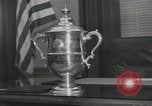
U.S. Major General LeMay takes the oath of office of USAF Vice Chief of Staff in the United States.
U.S. Major General Curtis LeMay in the United States. General Nathan Twining presents the Daedalian trophy to General LeMay at his office on August 17, 1953. General Reginald C Harmon, Judge Advocate General stands on the stage. The Advocate General administers the oath of office of USAF Vice Chief of Staff to General LeMay in 1957. Various dignitaries in the background. General LeMay in the cockpit of a U.S. Air Force KC-135 aircraft during his non stop and non refueled flight from Westover Air Force Base, Massachusetts. People look towards the sky as the aircraft takes off for Buenos Aires.
Reporter interviews George Van Tassel at the Giant Rock in Mojave Desert, California.
Television broadcast shows the controversies regarding UFO (Unidentified Flying Object) in the United States. Various books written by scientists. Comic book 'Flash Gordon'. Site of Giant Rock in Mojave Desert, California. Reporter interviews a self-proclaimed Contactee named George Van Tassel at the Giant Rock. VanTassel describes the interior of the spaceship in which he says he rode on August 24, 1953.
Life under Soviet domination in Eastern Europe following World War II
Legislators entering a hall in Czechoslovakia, in 1948. Inside,an image of the Small Coat of Arms of the Republic of Czechoslovakia (1920) dominates the scene. New scene shows Gustav Husak, acting Prime Minister, delivering an address urging support for the Communist Party. The next sequence shows violent Communist-led demonstrations, as armed trade unionists riot in the Prague streets, attacking the offices of the political opposition. Police attempt to restore order. On February 25, 1948, the communists achieve a Czechoslovak coup d'état. On February 27th, Czech President, Edvard Benes, receives a delegation including communist Premier Klement Gottwald and the 12 new members of the cabinet, at the Presidential Palace. He is seen signing documents accepting the communist cabinet. Change of scene shows Czech Foreign Minister, Jan Masaryk, giving a speech rejecting the change. (He remained in office, but died under suspicious circumstances on On March 10, 1948.) View of Masaryk in his casket. Mourners at his funeral.The Czech Parliament Building with flag at half staff. President Benes seen strolling, using a cane, accompanied by his wife, Hana Benes, in the garden of their summer home, Benesova vila, in Sezimovo Usti. Narrator notes that he refused to sign a new constitution drawn up by the communists. He died of natural causes at his villa on September 3, 1948. Scenes of his funeral and of him in his casket. Views of Benes' state funeral, with mourners lining the streets. View of British Prime Minister Winston Churchill. Narrator describes circumstances using Churchill's term "Iron Curtain." A communist parade in an Eastern European city. A person who was roughed up on the street. View of East German uprising in 1953, being suppressed with Soviet tanks. Uprising in Poland in 1955 being put down by local police and Russian soldiers. Polish musicians playing and examples of Polish political cartoons permitted under relaxed communist rule.
Czechoslovak coup with Communists coming to power; anti-Communist demonstrations in various European nations over 10 years
U.S. propaganda piece about threats by communists against various European countries. The Czechoslovak coup and demonstrations. Czech citizens moving on a street in Czechoslovakia during a strike forcing conservative elements to resign from the cabinet. Scenes of police brutality and beatings against strikers. Communists take over the police. Czech President Edvard Benes with conservative politicians in a government building. Huge crowd on a street. Police clashing with crowd. Czech Prime Minister Klement Gottwald with officials. President Edvard Benes, facing possible civil war or invasion by the Soviet Union, accepts a Communist cabinet. He is seen signing documents to that effect on February 25, 1948. Other officials beside President Benes during the signing. View of the first President of Czechoslovakia Tomas Masaryk's son, Jan Masaryk, who remained the Foreign Minister, and did not agree to the new government. Two days later Jan Masaryk is discovered dead. The body of Jan Masaryk in a coffin. Edvard Benes, who resigned in June 1948 after refusing to sign the communist constitution, is seen walking slowly outside the Parliament using a cane. A guard saluting Benes. View of the body of Edvard Benes, who died in September 1948, laying in a coffin. Mourning citizens offering flowers and cry. Officials bearing the coffin. Shift several years later to street strikes in East Germany in 1953. People during a strike and riot in Poland in 1956. Russian tanks moving on a street and Soviet soldiers are seen. Elevated view of panic and Polish citizens fleeing soldiers. October 1956: Student demonstrators on street in Budapest Hungary during the Hungarian Uprising of 1956. Soviet Russian red star is toppled by crowds from a building roof in a sign of defiance. Russian troops respond with tanks on the streets in Hungary. Crowd fights back. Russians retreat. Crowd overwhelms local police. Imre Nagy, Prime Minister of Hungary, ascends steps. Hungarian crowd on streets burn communist books and papers. Russian tanks invade Hungary to crush revolt. Tanks fire guns on Hungarian street. Imre Nagy's execution announced June 17, 1958.