


 Francais
 Deutsch
 Italiano
Refine Your Search
Egypt 1953 stock footage and images
- Showing 307 to 312 of 1095 results more
more Hide
Hide
Surrealist jewelry collection and art pieces by Salvador Dalí on display in Spain
An art pieces and jewelry exhibition in Spain. "The Persistence of Memory" (1949) by Salvador Dalí as jewelry made of gold, diamonds, enamel and a clock with Jaeger LeCoultre 426 mechanism. Women look at the surrealist jewelry designed by Salvador Dalí which is displayed at the exhibition. Leaf-veined hands made of sculptured gold, rubies and emeralds, designed by Salvador Dalí. A brooch designed by Dalí. “The Royal Heart” (1953). Art pieces by Dalí made with pearls, gems and precious metals are on display.
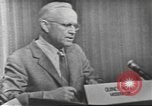
Vice President Nixon gives his closing statement during the fourth presidential election debate held in New York, U.S.
The fourth presidential election debate held between Democratic nominee Senator John F. Kennedy and Republican nominee U.S. Vice President Richard Nixon in New York, United States on 21st October 1960. ABC news correspondent Quincy Howe speaks during the debate and asks Vice President Richard Nixon to give his closing statement. Vice President Nixon opposes Senator Kennedy's statement that American is standing still. He says more houses and classrooms have been built, there has been a progress in civil rights and progress in field of slum clearance in Eisenhower's Administration which is more than in the previous administration. He says the United States should extend freedom to the world. He says that there were eleven dictators in Latin America in 1953 and now there are only 3 left. Nixon also talks about free government in Africa. He says that America will move ahead with the kind of leadership that we can provide in these years ahead. Correspondent Quincy speaks. He says that the opening statements by both candidates ran eight minutes each. The closing statements ran four minutes, thirty seconds. The order of speaking was reversed from their first joint appearance, when they followed the same procedure. A panel of newsmen questioned each candidate alternately. The first discussion dealt only with domestic policy. This one dealt only with foreign policy. As members of a new political generation, Vice President Nixon and Senator Kennedy have used new means of communication to pioneer a new type of political debate.
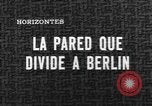
Scenes of Berlin divided by newly built Berlin Wall; Unrest in the years after division into East and West Berlin, Germany
The divided city of Berlin, Germany caused by the erection of the Berlin Wall. Shows early scenes of the Berlin Wall being built. Opening scene shows camera pan from Brandenburg Gate down to street level where East German construction workers are using a jack hammer and hand digging a trench across the middle of the street to serve as foundation for the Berlin Wall. A Soviet guard watches over the construction workers. East Germans and Soviet Russians walking with a spool of razor wire, putting up barbed wire barricades along other sections of the dividing border. German citizens gathered along the wall as it is built in a field area. Several young men in suits being pushed and harassed by a guard on the East German side of the Berlin Wall. View of a railroad train track that has been cut, and workers digging a deep trench at the site to build the wall right through the run of railroad track. East German refugees walking through a checkpoint area, desperate to leave east Germany before total closure of the border occurred. Refugees gathered in crowded shelters with mattresses on the ground. Young German children and babies sleeping on mats. Views of barbed wire crossing railroad track runs. Animated map showing routing of aircraft for the Berlin Airlift in response to the Berlin Blockade by the Soviet Union in 1948. Views of various aircraft flying overhead, bringing supplies to citizens during the blockade. Relief supplies and food being unloaded at airport for citizens. People waving white handkerchiefs in the air to express thanks as a Berlin Airlift airplane passes overhead. Scene changes to 1953 riots on the streets of East Berlin, Germany, with crowds of protestors throwing rocks at a Soviet tank and views of a building on fire with smoke pouring from its windows. Next scenes show West Berlin scenes as a juxtoposition of the East Germany scenes. Views of successful German industry and commerce in West Berlin. People working in West Berlin. Newly built tall buildings in West Berlin. German people shop in stores. A boy adds a bar of chocolate to a shopping basket. Men working in large industrial plants and factories. Large Siemens equipment in use in an electrical transmission component factory. A scientist or engineer looking through a microscope like device.
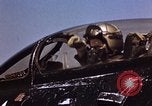
U.S. Navy locates a missing pilot using photographs and rescues him from behind enemy lines during Korean War.
Glimpse of a U.S. Navy pilot in the cockpit of an airplane, during the Korean War. He is pointing down at something. Next, a parachute is seen drifting rapidly in the wind as it descends. Pilot in aircraft hears about a pilot bailing out behind enemy lines. He is instructed to photograph the area. Next, a Navy 9F9 Panther aircraft is seen in the air. It has tail code "PP" indicating it is from the aircraft Carrier USS Essex (CV 9) with Carrier Air Wing Five (CVW-5) and Composite Squadron 61 (VC-61) from June 1951 to March 1952. . Glimpse of Navy ships in formation. View of Landing Signal Officer bringing in several 9F9 Panther aircraft to land on deck of the USS Essex. These aircraft carry tail code "M" of Squadron VF-23 with Air Task Group 2, aboard the Essex from June 1952 to February 1953. Next, several Navy A-4 Skyraider aircraft come in to land. They display "S" tail codes of Squadron VF-54. They are followed by another 9F9. Scene shifts to photo interpreters and pilots studying the photographs for clues to where their parachuting pilot might be located. They discover a parachute in the photos, and circle it. Ship loudspeaker is seen as helicopter crews are alerted for rescue mission. A Sikorsky HO3S-1 helicopter takes off from the flight deck. Other pilots wait anxiously as the Helicopter returns to land on the Essex flight deck. The missing pilot is aboard and they help him from the helicopter, place him on a litter and cover him with blankets. His friend takes his picture.
Armistice signing ceremony ending Korean war, 1960s Seoul South Korea street scenes
The armistice ending the Korean War is signed July 27, 1953. South Korean refugees walking down train tracks at the end of the Korean War. Heavily damaged buildings in Seoul, South Korea. Residents of Seoul picking through trash looking for food. 1960s a bulldozer is seen in front of a new high rise building in Seoul. Construction supplies carried by laborers to construction site from water. Pedestrians on Seoul street wearing traditional Hanbok robes. Market place in Seoul, picking crabs at market stall. Women with Korean children. Korean children in front of temple. Children eating on street with balloons nearby. Korean children playing volleyball. Korean children in school uniforms. Korean women looking in store front in Seoul. Streets in Seoul show bicycles and carts overloaded with supplies.
Iraqi soldiers question suspects on a street after a revolt in Iraq; also Jordanian soldiers and Israeli soldiers.
The results of a revolt in Iraq. Soldiers in jeeps and other vehicles move about on the streets after riots in Iraq. Iraqi Officers and leaders on review stand. A soldier salutes. Houses damaged as a result of the riots. Soldiers stand near a tank. A soldier works on a jeep and he shows the bullet marks on the vehicle. An officer questions a suspect as he takes down notes. Another officer looks on. Jordanian soldier loads a rifle and mans an outpost. Group of Jordanian soldiers holding rifles and being inspected. Israeli Defense Forces soldiers (IDF) soldiers loaded into an open railroad car. Israeli soldiers traveling in an armored truck. They get off, holding rifles. IDF soldiers advance across a field. They check the papers of civilians and search them. A man puts up a poster on a wall. Civilians cheer as they demonstrate outside a building in Cairo, Egypt.