


 Francais
 Deutsch
 Italiano
Refine Your Search
Elizabeth New Jersey 1952 stock footage and images
- Showing 631 to 636 of 8484 results more
more Hide
Hide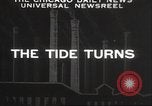
Workers work at a machine manufacturing factory, a washing machine factory and collect onions from fields in the U.S.
Thousands of workers get back to work in the United States. A group of workers works on equipment inside a machine manufacturing plant in New Jersey. The workers welding inside the factory. Workers collect onions from fields in Kenton, Ohio. Workers increase the production of washing machine in Chicago.
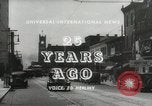
Damaged bridges, houses and property due to the floods in the various rivers of the United States in 1936.
Flood damage in the United States in 1936. The Kennebec River, Maine: men stand on blocks of ice and view a broken bridge due to flooding. Ice jams loosened on the Penobscot River threaten towns near Bangor, Maine. View of giant ice flows and downed utility poles The Housatonic River, Connecticut: Broken electrical towers on the blocks of ice. Men walk on the ice blocks. Men clear the ice from road. Passaic River, New Jersey: the water of the river flows above limits over a bridge. Lake Conemaugh, Pennsylvania: View of submerged houses from flooding. The destoyed houses due to flood. The people stand on a bridge and heavy flow of water under the bridge. Ohio River: the submerged buildings from flooding are seen. Men on boats in front of the submerged shops. People on bridge run. The damaged cars,trains and trams lie on the streets. The streets filled with water. From a 1961 newsreel recounting events 25 years earlier.
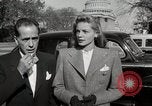
Hollywood stars visit Washington, DC, to voice their objections about proceedings of the House Unamerican Activities Committee (HUAC)
Hollywood stars (members of the newly formed, Committee for the First Amendment) visit Washington D.C. to express their objections to the actions of the House Unamerican Activities Committee (HUAC). Opening scene shows movie stars Humphrey Bogart and Lauren Bacall on a sidewalk at Indendence Avenue in Washington, DC, Southeast of the Capitol building which is seen behind them. A police car is parked at the curb and an officer is standing in the street. Next, they are seen posing with Hollywood personalities, including Danny Kaye and June Havoc, among others. Views of the group from different angles, and from behind a group of photographers taking pictures. Then they begin to walk towards the location of the HUAC hearings, with Bogart and Bacall in the lead. They proceed up the steps of the building. Scene shifts to the hearing room inside, where Screen writer, John Howard Lawson, is being sworn in. He begins to testify. During his testimony, the Chairman, Representative John Parnell Thomas, of New Jersey, finds it neccessary to gavel for order and appears to berate the witness. Lawson leaves the witness chair and departs. Another view of the hearing room.
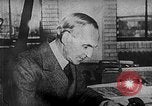
Henry Ford's work in the area of historic preservation. Construction of Ford Museum and Historical Greenfield Village
Henry Ford works on historical preservation project. McGuffey readers are seen. Sketch of Ford family farm in Springwells, Michigan. View of homestead at the farm, that Ford restores. He examines the farm's steam engine. The historic Wayside Inn, in Sudbury, Massachusetts, which Ford purchased to construct a community of historic buildings. View of the restored Botsford Inn,Detroit, Michigan, that Ford bought in 1924.View of Eagle Tavern, in Clinton, Michigan,before,and,after its purchase and restoration by Henry Ford. Concerned about need for additional buildings to house artifacts, Henry Ford consulting with Detroit architect,Robert O. Derrick (with mustache) and two other men. Derrick's plan for the Henry Ford museum is unrolled. It borrows from Independence Hall, Congress Hall, and the old City Hall in Philadelphia.Views of the Clock Tower and museum, as completed in 1929. A pictorial map of the Edison Institute Museum and Historical Greenfield Village, in Dearborn, Michigan. View of construction begun in 1927. Thomas A. Edison laboratory in Menlo Park, New Jersey, that Ford acquired for Greenfield Village. On a windy September 17, 1928, Thomas A. Edison steps from a car, and pauses before entering the doorway of his restored laboratory, in Greenfield Village. Henry and Mrs.Ford step from their car to quickly join him in the building.Edsel Ford and his wife, also follow. Inside the building, Edison officially open the site by starting a steam engine in the laboratory. Ford and Edison converse (Ford speaking close to Edison's ear, because he is hard of hearing). Later, Edison, in a cornerstone ceremony, imbeds, a shovel contributed by Luther Burbank, and then writes in cement of the cornerstone.Newspapers show coverage of the formal dedication of the museum and Greenfield village, October 21, 1929. Workers rushing the Village toward completion for that event. The Smithcreek Railroad depot is moved to the Village. Workers preparing installation of the depot.
A man takes measurement of Private John's big feet to make Army shoes in San Francisco, California.
A U.S. Army soldier having big feet in San Francisco, California. The soldiers march in a squad. Private John from New Jersey wearing sandals while marching. A drill instructor speaks to him. The long feet of the soldier. The soldier gets a desk duty. John seated at a desk. 'US Army' written on his uniform. A close up of the soldier having big feet. A man takes measurement of his feet for making Army shoes.
Luis Martinetti, Gymnast and contortionist, photographed at Edison studio, as he performs on flying rings.
A performance on the flying rings, by Gymnast and contortionist, Luis Martinetti of the Martinetti Brothers. Filmed on October 11, 1894, in Edison's Black Maria studio, West Orange, New Jersey, United States.
CRITICALPAST.COM: About Us | Contact Us | FAQs - How to Order | License Agreement | My Account | My Lightboxes | Shopping Cart | Advanced Search | Featured Collections | Website Terms & Conditions | Privacy Policy ©2026 CriticalPast LLC.
License Agreement |
Terms & Conditions |
Privacy Policy
©2026 CriticalPast LLC.