


 Francais
 Deutsch
 Italiano
Refine Your Search
Elizabeth New Jersey 1952 stock footage and images
- Showing 6421 to 6426 of 8468 results more
more Hide
Hide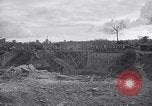
U.S. 5th Army vehicles traverse bridges at Volturno River near Mignano, Italy, in World War II
U.S. 5th Army vehicles cross two small bridges across the Volturno River, near Mignano, Italy, during World War 2. An MP (Military Policeman) monitors and directs traffic from side of the muddy road. Army engineers repair another bridge and use compressed air gun to drive fasteners. Closeup of the new bridge boards and construction work. Jeeps, trucks, personnel carriers, and other vehicles are all on the move. A destroyed civilian vehicle is seen at side of road.
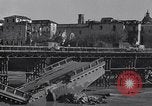
Bomb wrecked bridge over Volturno River in Capua, Italy
Bridge over Volturno River built by 1st battalion 343rd Engineers in Capua, Italy. Old bridge demolished. Vehicles cross the bridge. Germans retreat the bridge, which was blown up. 343rd engineers credit sign on new bridge. Building collapsed. Bomb wrecked homes. Excessive home damage testified to poor marksmanship of the German fliers. (World War II period).
Allies demand the unconditional surrender of Japan in World War II. Entry of Soviets and use of atomic bomb ends the war.
Representatives of three nations, seated around table at Potsdam Conference held at Cecilienhof in Potsdam, Germany. British prime minister, Clement Attlee; President of United States, Harry Truman; and representative of Soviet Union, Joseph Stalin at the Potsdam Conference, July 1945. They deliver an ultimatum of unconditional surrender to Japan. Swarms of B-29 bombers and Aircraft Carrier Task Forces destroy Japanese homeland. Planes on carrier decks.Navy Grumman carrier-based TBF aircraft dropping bombs.. Destruction of ships at sea. Mushroom cloud due to atomic bombing. Chart depicts the power of one atomic bomb. Britain's 'grand slam' bomb, most destructive conventional bomb ever produced. Doctor Ernest Orlando Lawrence, inventor of the cyclotron (atom smashing machine). A man works at the Cyclotron at the University of California, Berkeley. General Leslie Groves, head of the project speaks. He is seated with Dr Vannevar Bush, government director of science and research, and Dr Richard Tolman, technical expert. Quantities of uranium shipped from Alberta, Canada are used in bombs. The atomic bomb process (Manhattan Project) is developed in widely separated areas; scenes from Hanford Project plant in Richmond, Washington. Project personnel exit cars and enter into the search area before starting their work day. Lieutenant colonel Franklin T Matthias with the army corps of engineers, appointed to the Hanford Project. Sign of 'Oak Ridge' in Tennessee. Largest of the three atomic bomb plants located near the Tennessee Valley Authority (TVA) dam. Employed personnel in atomic bomb plants are seen going to work. Man and woman employees at the plan read and smile at a Knoxville Journal newspaper in August 1945 with news headline "Power of Oak Ridge Atomic Bomb hits Japs" after the atomic bomb was dropped in Hiroshima. View of dense prefabricated home communities to house large number of Oak Ridge plant workers. View of families setting up their houses in trailer towns after the prefabricated homes were full. People come out from the Henebry's Jewelers and supermarket, among stores setup to meet the needs of the quickly built city. Scenes changes to show view of Soviet leader Joseph Stalin at conference. Russian artillery and troops in a parade at Red Square in Moscow, Russia (these parade scenes are from the May 1, 1945 May Day parade, just days before Germany's surrender). President Harry Truman reports on the latest developments regarding the war with Japan. He states that the United States is prepared to destroy every productive enterprise in Japan and the U.S. shall completely destroy its power to make war. He warns of an attack by the U.S. due to the rejection of the July 26th ultimatum at Potsdam. He warns that Japan "should expect a rain of ruin from the air; the like of which has never been seen on this earth." Truman notes that it will be followed by an unprecedented sea and land invasion of Japan.

General Eisenhower as a World War II officer and as the U.S. President.
Scenes from life and career of Dwight D Eisenhower, 34th President of United States. U.S. Air Force plane lands and the President disembarks the plane in India, in 1959. He is greeted by the Indian President Dr Rajendra Prasad and other dignitaries. Emblem of 'Panama'. Sign of 'welcome Ike Crusader'. Large crowd welcomes Eisenhower. Motorcade goes through the city's street. Milestones in General Eisenhower's life and the international esteem with which he is held. Lt Col Eisenhower concerned about U.S. isolationism in 1940 as World War 2 is underway. Explosions in Europe due to bombing by German aircraft. Eisenhower and other officers in the General Staff study a map. Eisenhower plans the strategy as the commander of Operation Torch (he is shown talking to General George C. Marshall and Winston Churchill). President Eisenhower visits 4 continents and meets several leaders. Large crowds welcome him. General Eisenhower prepares for D-Day Invasion of France during World War 2. June 5, 1944: The Allied forces including troops, artillery, equipment, ammunition, aircraft and ships prepared. June 6, 1944: The Allies invade Normandy. Troops wade through the water during D-Day Normandy beach landings, while under enemy fire. German soldiers surrender. May 7, 1945: Nazi General Alfred Jodl signs the unconditional surrender of his government. General Eisenhower returns to the U.S. He receives a hero's welcome in New York during a parade. He visits his hometown in Kansas. Pictures of his family, childhood and college days. Eisenhower on his visits to various countries as President.
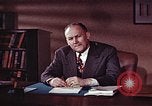
Doctor Harrison Flippin talks about penicillin therapy and its three basic principles in United States.
Doctor Harrison Flippin talks about new knowledge of penicillin therapy in a laboratory, and that no change should be made in anticipating penicillin therapy. He talks about three basic principles of penicillin: The organism must be susceptible to penicillin, the organism must be reached by penicillin in adequate concentration and the organism must be eradicated or suppressed.
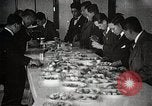
Crab canning and shipping of cargo in Japan.
Technical experts inspect crab. Exterior of factory of Three Diamond Brand. Labeling and Repacking: Japanese workers lacquer and label the tin cans of crab in a factory. Experts inspect the tins. Sign board of 'Fancy Crab Meat, New York'. Four different grades of Japanese Canned Crab Association, Yokohama for export: Fancy (Red), Choice (Indigo), Fair (Blue), and Passed A (purple). Logo of Three Diamond on cargo. Workers bring the cargo for shipping. Cargo boats are loaded and taken to Yokohama. Supervisors inspect the cargo. Steamer Olympia Maru loaded. Flag of Three Diamond Brand at steamer.
CRITICALPAST.COM: About Us | Contact Us | FAQs - How to Order | License Agreement | My Account | My Lightboxes | Shopping Cart | Advanced Search | Featured Collections | Website Terms & Conditions | Privacy Policy ©2026 CriticalPast LLC.
License Agreement |
Terms & Conditions |
Privacy Policy
©2026 CriticalPast LLC.