


 Francais
 Deutsch
 Italiano
Refine Your Search
Elizabeth New Jersey 1952 stock footage and images
- Showing 6835 to 6840 of 8468 results more
more Hide
Hide
Private cars, motor trucks, buses, trailers and horse carts move on roads, in United States.
Various types of vehicles use the road, in United States. A number of parked cars at a public parking lot. Vehicles move on a busy street outside a motel. Motor truck and a trailer moves on a road. Flatbed car carrier truck parked on side of road with several new Ford automobiles on it. Two women leave their house, sit in a car and drive away. Cars, trucks, buses and a horse cart on a road. An early Greyhound Bus bound for Washington approaches on a highway. A late 1920's or early 1930's automobile passes a horse driven cart at high speed.
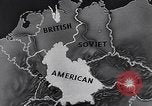
Military and German Police try to stop gun runners and black marketing and conduct free elections in Germany after World War 2
A map shows the United States, British and Soviet occupied zones in Germany after World War II. American and French police checks papers and belongings of Germans entering their zone. They chase and capture a gun runner car and remove a weapon from the back seat. Scene in a building depicts young Nazi die hard followers in a "werewolf gang" meeting in secret to plot how to continue Nazi Germany. German civilians gathered exchanging items in black market activity. U.S. occupation soldiers sell cigarettes in black market to German civilians. German police raid a black market exchange area and arrest many German citizens, rounding them up and loading them onto a truck. A captured German woman cyring. German de-nazification trials at a court in session. At a news conference, U.S. Army General Lucius D. Clay speaks about measures to build democratic processes in Germany, starting with local elections. A leader speaks at a political party meeting. German civilians vote at first free elections after World War II. A German man acts with servility before a U.S. officer and looks vindictively in direction of officer after leaving his room. Narrator describes German people post-war as egotistical people.

16 million men register themselves in United States for the WWII draft, and President Roosevelt addresses from White House.
As World War II heats up, 16,500,000 men between ages 21 to 36 register themselves throughout the United States, signing up during the first peacetime conscription in U.S. history. (This was triggered by passage of the Selective Training and Service Act of 1940, also known as the Burke-Wadsworth Act, the genesis of "Selective Service.") Opening scene shows men lining up to register for the draft before the United States entered World War 2. Views of men filing out their registration forms. At 00:22 famous prize fighter, Barney Ross, is being registered. (He jokes that the registrar shaking his hand has too strong a grip.) At 00:34 Hollywood cowboy Gene Autry is seen registering. Close up view of street signs at Chinatown intersection of Bayard Street and Mott Street in New York City. Sign below it notes "School Street. Drive Slowly. Make no unnecessary noise." Line of many registrants of Chinese-American descent waiting in line, and processing paperwork. Scene changes to another area of the city, where a line of mostly African American men wait outside a registration building. Some cheer and wave for the camera. A police officer at the entrance hustles them inside, pulling some of them along. View of the exterior of the White House in Washington DC. United States President Franklin D Roosevelt addresses the nation's men of draft age, telling them that the call up of 800,000 men for training in year one, and less than one million men in each subsequent year, is a program of defensive preparation only. Roosevelt says to the registrants that "Democracy is your cause. The cause of youth." ( Note: clip is silent except for President Roosevelt speaking at the end.)
USDA documentary titled 'Terracing in the Northeast' depicts terracing techniques for soil control and improved farming
From a U.S. Department of Agriculture documentary titled 'Terracing in the Northeast.' Depicts soil problems in farming and solutions via terracing. Trees near farm land. Withered, irregular plants on poor soil. Healthy crops ready for harvest in a large terraced farmland. Trees and barns at the end of field. A farmer plows field with a tractor. Crops in the farm land. Two men walk on the field. Farmers care for growing plants. A man checks the black soil suitable for the growth of crops. Water flows through a channel to irrigate the crops. Two farmers operate a hand plow. A man plows hardened soil of field standing on a horse-drawn plow. From an H.W. Wilson Company listing in 1940 of its Educational Film holdings: This is a Soil conservation service film. As beautiful scenes of the countryside unfold the commentator tells us that much of America's oldest farming land is in the Northeast. The serious soil erosion situation is frequently taken care of by terracing. We learn how terracing is done, its advantages and see land so cultivated. Terracing is used successfully for growing potatoes, tobacco, truck farming and for fruit culture. Cover crops are planted and when turned under add fertility to the soil. It is necessary to inspect the terraces regularly and to keep the channels of the outlets clear. An informative picture showing construction and uses of terraces and other erosion control measures as applied to northeastern part of United States. New Hampshire.
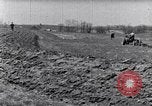
Farmers practicing terracing in the northeast of the U.S. for improved farming output
On terraced farming in the northeastern United States. Various farming equipment and techniques for improving soil and crop output. Various plows and tractors with disc for improving soil. Preparing a field for new planting. Tractor pulling plow with tines. A plowed field ready for sowing seeds with even furrows. Different tractor on a field. A tractor starting work on an unimproved field. Improved, terraced fields. Men walk on the fields. Road to a farmhouse lined by trees.
Japanese American doctors, nurses and dentists work at relocation centers in the United States during World War 2
Japanese- American surgeons at an operating theater at a relocation center (internment camp) during WW2. A dentist and his assistant take care of a patient. A Japanese American woman lab technician examines a specimen using a microscope. New born babies taken care by Japanese-American nurses. Student nurses learn lessons at the hospitals.
CRITICALPAST.COM: About Us | Contact Us | FAQs - How to Order | License Agreement | My Account | My Lightboxes | Shopping Cart | Advanced Search | Featured Collections | Website Terms & Conditions | Privacy Policy ©2026 CriticalPast LLC.
License Agreement |
Terms & Conditions |
Privacy Policy
©2026 CriticalPast LLC.