


 Francais
 Deutsch
 Italiano
Refine Your Search
Elizabeth New Jersey 1952 stock footage and images
- Showing 6889 to 6894 of 8468 results more
more Hide
Hide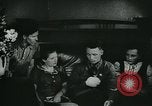
A Russian pilot who rammed a German bomber, tells his family about it. Small children being tended for parents during World War II
Film opens showing a wounded Soviet army aviator lieutenant, at home on leave, surrounded by family members. He holds a microphone with his bandaged right hand. According to narrator, he is telling his sister and a girl he went to school with, about his recent experience. He was at 4 miles altitude intercepting a German bomber on its way to Moscow. He chased and fired at the bomber until he ran out of ammunition and the blast from his machine gun had burned his hand. So he accelerated and rammed the German aircraft, bringing it down. His mother is seen telling that she had heard the news, on the radio, of her son ramming a German airplane. She kisses her son. Change of scene shows small children in a play ground under the care of several women Next, children are seen seated at tables for a meal, as Girl Scouts attend them. Later, the children are tucked into bed for the night, and Two Girl Scouts make soft toys for them.
Kharkov locomotive in soviet Union
Kharkov locomotive,a new type diesel locomotive constructed in Soviet Union. People get onto it.

American civilians realize their war obligations and contribute to the war effort (WW2)
A World War II-era film shows Americans realize their war time obligations after the attack on Pearl Harbor and Fall of Corregidor in the Philippines. Crowds watch a marching band and newly enlisted soldiers in parade. A smiling woman waves at the marching soldiers. Women in car watch the parade. Tents in camp. Soldiers perform mass calisthenics and train with outdated tanks. Enlisted men learn how to fire machine guns and mortars. United State Army soldiers board a ship for their deployment. A ship departs for the Philippines. Soldiers arrive in the Philippines, a United States commonwealth in Asia. Japanese bombers drop bombs over Pearl Harbor. Civilians running on the streets during a Japanese aerial bombardment. United States Navy sailors firing machine guns and howitzers from ships. A ship explodes from Japanese bombing. A little girl runs to her father washing the car to tell the news about Pearl Harbor. The little girl runs across the street to tell her neighbor about Pearl Harbor. A woman writes a letter. A woman bakes a cake. People leave a church after service. An American soldier is shot by Japanese soldiers in the Philippines. A man reads a telegram. The man drives to a farm house, accompanied by a church minister. The man and minister tell the elderly couple living in the farm that their son was killed in action. Women selling war bonds on the street. A man silences his alarm clock and goes back to sleep. Cars racing on the street. Soldiers and civilians evacuating Manila. Japanese bombardment of Manila. A girl turns on the radio before Christmas dinner. Men and women congratulates a woman outside a law office. More civilians receive telegrams. Dead soldiers in the battlefield. A woman opens the Bible and writes the names of the dead. United States soldiers retreat in the Fall of Bataan. A woman shakes her head in disbelief after being told of a rumor her son was killed in action. A man hangs the United States flag on his porch. A bomb explodes near a makeshift tent hospital. Woman fixes bed. A woman eating on the dinner table alone. A soldier swats a mosquito from his neck in the Philippines. Forlorn men and women. Soldiers fighting in Corregidor. Soldiers surrender to the Japanese forces at Corregidor. A captured American soldier harasses a Japanese soldier while frisking him. He was apprehended by Japanese soldiers on guard. Despondent American civilians struggling after the Fall of Corregidor. A man despondently smokes from his bed. A depressed woman struggles to cut vegetables. A doctor treats civilians for shock and depression. A baseball game. A horse race. Boys playing on the beach. United States and Filipino soldiers march with United States and Philippine flags. People line up for blood donations. Civilians donate old rubber and hats. Men line up to punch their time in at work. Boys helping on the farms. Male teachers volunteer to fix civilians’ appliances and cars after school. A welder working at the shipyard. Civilians walking instead of using cars. An Allied plane landing. A woman sewing. A man opens a package of binoculars. People line up to buy war bonds. A majorette leading a marching band. Newly enlisted men with suitcases marching in parade.
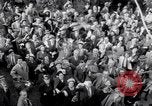
Ceremony at Jewish Agency office in Washington DC, on occasion of United States recognition of Israel as an independent state.
Crowd gathered around 6:00pm on May 14, 1948, outside the Washington DC office of the Jewish Agency, at 2210 Massachusetts Avenue, NW, Washington DC. View of happy, waving crowd from camera position in an upstairs window. View on building steps of dignitaries including Eliahu Elath (later the first Israeli Ambassador to the United States), Rabbi Novak of the Washington Mizrachi leaders, Sumner Welles, and New York Congressman Sol Bloom. View of a boy (Oren Zinder, son of Zvi and Honda Zinder) standing in the upstairs window, preparing to unfurl the flag of Israel in front of the building. View of the flag in position, and the crowd waving.
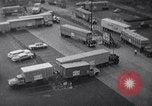
United States monitoring Cuba and enforcing Kennedy's shipment quarantine order during the Cuban Missle Crisis
Community fallout shelters being stocked. Lorries and trucks on road carry supplies. View of Red Ball trucking line truck. Aerial, exterior view of United Nations Building in New York City. View inside United Nations building. United Nation Ambassador Stevenson asks the USSR delegate whether there are missile bases on Cuba. President Kennedy signs Quarantine order on what materials may be shipped to Cuba, to begin 10am on October 24, 1962. B-52 bombers take off, taking 24 hour missions. Interceptors and fighters take off. Views on aircraft carriers with fueling and takeoff operations on flight deck. Radar dishes and radio communications. U.S. battleship at sea. U.S. intercepts Soviet tanker and allows her to proceed. Reconnaissance aircraft over Cuba. Views of White House. SAC bombers and anti aircraft missiles on 5 to 15 minute alert to handle any critical situation. Interiors of control room inside the Headquarters of American Air Defense Command.
Russia dismantles missile sites from the island of Cuba.
Population worldwide shown waiting for news about the Cuban Missile Crisis. Groups of people watching televisions and listening to radios. Press announcement in front of White House that President Kennedy has received message from Nikita Khrushchev, Secretary of Communist Party of the Soviet Union, saying that Russia will dismantle missile sites in Cuba. Views of various ships in United States fleet. Military band playing at port as wives and children of U.S. military service men return to Guantanamo, hug and greet the service men, and celebrate. View of a small church and citizens entering the church. Americans going to work. Reconnaissance photos showing missiles dismantled, and showing shadow of the photographing aircraft, itself. Soviet ships carrying missiles out of Cuba. American men, women, and children pedestirans walking on sidewalks in the downtown area of a town, past shops and stores. A man entering a building beside a fallout shelter sign. Department of Defense logo is shown at end of film, followed by on screen text, "If our country should ever be attacked by nuclear weapons, people at ground zero would be lost. But millions more, outside these areas of complete destruction, would be spared, only to be imperiled by radioactive fallout. Today, the nation is better prepared to meet this threat, as the community fallout shelter program goes forward. But much work still remains to be done. Cuba may not be the last crisis we'll be called on to face. But let it be the last we'll face unprepared.
CRITICALPAST.COM: About Us | Contact Us | FAQs - How to Order | License Agreement | My Account | My Lightboxes | Shopping Cart | Advanced Search | Featured Collections | Website Terms & Conditions | Privacy Policy ©2026 CriticalPast LLC.
License Agreement |
Terms & Conditions |
Privacy Policy
©2026 CriticalPast LLC.