


 Francais
 Deutsch
 Italiano

Refine Your Search
Elizabeth New Jersey 1952 stock footage and images
- Showing 6961 to 6966 of 8486 results more
 Hide
Color Sound
Busy city street with 1920's era automobiles; also Kerosene and by-products obtained from distillation of crude petroleum in US
Slate indicates that 200 million gallons of gasoline are used annually in the United States for power (in 1925). View of a busy city street, possibly New York City, circa 1925 with motor vehicle traffic, pedestrians and many tall buildings. Many early automobiles seen. A worker tests flash point of kerosene. Lighted candle in stuck block of paraffin (wax) showing wax or parrafin as a byproduct of petroleum. Slate indicates that petroleum provides motor fuel, common light, a lubricant for machinery and other important by-products.
Production of petroleum at oil refineries and its transportation in United States, before and during World War II
Documentary titled, ' Oil Is Blood ' on production and transportation of petroleum and its by products in United States. Crude oil in a pit. Man takes samples from the pit. View of derricks at an oil drilling site. Derricks at sea. Exteriors of a building near the derricks. Service station attendants, pumping gas and cleaning the windshield, on a 1942 Lincoln Continental convertible, at a "Tydol Flying A" gas station. Scenes of busy highways and plenty of fuel give way to empty roads, closed gas stations, and restricted hours for obtaining fuel, as it is rationed during World War 2. Views of persons obtaining ration stamps and books. Various gasoline ration books including the "A" books (allowing the smallest amounts) and "B", "C", and other books allowing larger rations to more essential users. Oil rig "roughnecks" inserting new sections of pipe and proceeding to drill. Closeup of a "gusher" before it is capped. Men filling railroad tank cars with petroleum products. A long train of tank cars pulled by a steam locomotive. Animated map illustrates the ocean shipping lanes that formally served as means to transport fuel and oil, before the German U-Boat threat made them too dangerous for general use. Drums of fuel and oil being loaded aboard a ship to supply the Allies during the war. A convoy of ships heading to the war zone of North Africa.
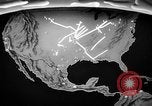
Laying of the Big Inch petroleum pipeline network between Texas and Illinois in the United States during World War 2.
A map shows pipeline network for the transportation of oil and its by-products in the United States, largely for the war effort during World War 2. Shows the laying of the Big Inch petroleum pipelines in Arkansas, Texas, and other locations. Tractors and explosives being used to clear the ground for laying the pipelines. Oil pipeline being laid across a river bed. A welder welds the joints. Pipelines being laid in trenches. Men operate valves to turn on the flow of oil in the new Big Inch pipeline. High octane aviation gas is filled in an aircraft at an airfield. Soldiers fill gas cans all lined up in a lot. An oil tanker in the background. Troops load gasoline jerrycans on trucks. B-17, B-26, and B-24 Bomber aircraft in refueling operations on various airfields. B-17 taking off and formation of aircraft in flight. Long lines of jerry cans being filled with gasoline by personnel near a railroad track. Close up view of gasoline dispensing nozzle in top of Jerry Can and a hand opening the next jerry can in line. Jerry cans loaded into trucks, transported, and unloaded by U.S. Army soldiers. Motor oil being poured into funnels for use in vehicles. Narrator declares, "Oil for freedom. American oil. The blood of the mechanized legion!" A formation of tanks and military vehicles move along a wide field. Narrator encourages sacrifice of American people giving up home comforts of goods and fuels made from oil so that they can be directed to the war effort.
An oil pumping station which serves important fields and a map shows important oil pipe line systems in the United States.
Pumping and transportation of crude oil drilled in the United States. A political map of the U.S. shows oil pipe line systems which are used to transport crude petroleum. The map shows main trunk pipe line systems including a new line under construction from Wyoming, connecting with the Great Lakes and the Gulf of Mexico. A pumping station which serves important fields in Texas, Oklahoma, Kansas and Wyoming with its chief terminals at East Chicago, Houston, Texas and Salt Creek, Wyoming. Internal combustion engines and machinery at the pumping station.

Oil drilling equipment is brought in and set up in a jungle in Mexico.
A documentry 'The Story of a Mexican Gusher' visualizes different stages in oil production in Mexico. A political map of Mexico shows Tampico and the distance between Tampico and New Orleans. Men cut through jungles, cross rivers and make roads to bring equipment into the Mexican oil region. Men cut trees in a jungle using machetes and axes. Men at work in an open area. Smoke rises in the background. A barge goes across a river. A jeep on a road built in a jungle. An oil company's railroad. Men work on the company pipeline near the railroad. A camp hospital in a jungle clearing to the south of the Panuco River. Cable tool method of drilling is practiced. Men do 'spudding in' by drilling a hole. Machinery in operation. After the spudding in a cable is 'hitched on' to a 'walking beam'. Men lower a casing at Ebano to drill out oil. A derrick. Oil is discovered at 800 feet and bubbles up from oil well. Two oil workers completely covered in oil work with the oil well equipment.

World War 2 battle scenes; wrecked buildings and masses of displaced persons in Europe after World War II.
'Problems of Peace in Europe' produced in 1948, depicts reconstruction problems in aftermath of World War II and includes footage from during the war and soon after the war. Scene of desperate and hungry civilian people (possibly in Germany but could be elsewhere in Europe) scrambling over each other and trying to find food on the ground among garbage or wreckage, circa 1945 or 1946. European peoples massing to reestablish political order and seek relief in post-war Europe. Montage of images of people from all walks of life. Reminders of war showing aircrews in bombers and bombs falling. Batteries of rockets being fired. A formation of U.S. B-17s and a B-26 aircraft with D-day stripes, in flight. Allied bombing of cities with devastating effect (likely 1944-1945). Aerial view of the Statue of Liberty in New York Harbor. Aerial view of a major U.S. industrial complex, with many smoke stacks and industrial pollution. Mass of workers leaving at end of shift at a U.S. manufacturing plant or factory. Views of two different streamlined locomotives pulling passenger trains at high speed, approaching camera position. Freight trains speeding on railroads. Farmers harvesting and baling hay by machine and cultivating fields with tractor. Multiple wide views of the K-25 building of the Oak Ridge Gaseous Diffusion Plant, in Oak Ridge Tennessee, the world's largest building in 1944 when it was built, and an instrumental part of the Manhattan Project effort to develop the atomic bomb in World War 2. Huge sprawling industrial sites in America. Map of Europe. Street scene in Germany with destroyed buildings and rubble cleaned from street, but still piled up in places. Desperate, hungry, and poverty stricken German citizens rummaging through garbage piles for anything to eat or anything of value. Two very young German boys standing together on a street, with one boy smoking a cigarette. Children scrambling over trash and rubbish heaps.
CRITICALPAST.COM: About Us | Contact Us | FAQs - How to Order | License Agreement | My Account | My Lightboxes | Shopping Cart | Advanced Search | Featured Collections | Website Terms & Conditions | Privacy Policy ©2026 CriticalPast LLC.
License Agreement |
Terms & Conditions |
Privacy Policy
©2026 CriticalPast LLC.