


 Francais
 Deutsch
 Italiano

Refine Your Search
Elizabeth New Jersey 1952 stock footage and images
- Showing 7057 to 7062 of 8486 results more
 Hide
Color Sound

Planning and training for invasion of North Africa (Operation Torch) in World War II
'Tunisian Victory' shows preparations during World War 2. Film opens showing a sailor in the crow's nest of a ship in a convoy of American warships. Aerial glimpse of the convoy. Sailors working on teletype machines in s communications center aboard an American warship. Ships exchanging light signals at night. Scene shifts to a British naval convoy moving across the sea. View from bridge of forward guns on British King George V-class battleship. A single stack Navy destroyer ship. HMS Rodney with 3 over 3 forward gun turrets leads another warship protecting the convoy. The aircraft carrier, HMS Illustrious in camouflage paint. An American Navy Douglas Dauntless dive bomber seen from a ship. A U.S. Navy Consolidated PBY Catalina aircraft over the convoy. Brief view of a four-engine bomber flying over the convoy. Scene shifts to sailors on ship's deck in the American convoy. The British flag on one of its convoy ships. Scene shifts to the White House on June 18, 1942. President Franklin D. Roosevelt arriving with British Prime Minister Winston Churchill in a car. Lights burning at night in the White House. Closeup of hats of the British and American staff officers on a rack. World Globe showing German army thrusts to the North by Field Marshal Fedor von Bock into Ukraine and the Caucasus, and another by Field Marshal Erwin Rommel South toward Egypt. In Asia, the conquests of Japan are shown. President Roosevelt and Prime Minister Churchill are seated at a desk. Behind them are Roosevelt's assistant, Harry Hopkins and two uniformed officers. View of relief map showing planned joint offensive. British and American staff officers seated at a planning table. Pertinent maps being printed for the offensive. Closeup views of woman's hands typing on typewriter. Tight closeup view of a teletype tape coming across a machine that reads "ANFO GAZE ACROBAT RE NO K" A typist at a teletype machine with tape being made. A busy military communications center. A plan marked "secret" moving across a sliding document mechanism or slide. American and British war production workers arriving at military equipment production factories for work; large groups of war production workers. Workers at military equipment plants and factories in the the U.S. and the U.K., including many women workers involved in war production. A document labeled "SECRET OCSigO" Staff officers in planning session. U.S. Army Chief of Staff, George C. Marshall, seated with British Field Marshal Sir John Dill. More views of the Combined Chiefs of Staff at work viewing wall maps and table maps and plans. Steel mills in operation. American army troops training and preparing in battle drills, firing machine guns, battlefield advance training, swimming under water below flamethrower flames and below oil slicks on fire, leaping into water, practicing paratrooper jumps into water. New ships including Liberty Ships and warships being launched at American shipyards. War production workers inside a plant building B-17 bomber aircraft. An early version of Sherman tank (external bolts showing) and Sherman tanks being built in factory. Shipboard twin anti aircraft guns being test fired. Giant yards filled with newly manufactured weapons, armor, trucks, tanks jeeps, searchlights. U.S. Army generals walk in a group inspecting equipment. War materiel and troops and tanks being transported on railroad trains in America and Britain. Covered Lockheed P-38 Lightning aircraft being towed by trucks past a watching British police (Bobby) at night. Ships being loaded at docks. Troops and war materiel being loaded aboard ships in the U.S. and Britain. Crowd on dock (mostly women) waving goodbye to soldiers on a ship. Soldiers look out portholes and from deck as troop transport ships get underway. Hand sets ship engine control to slow. Soldiers entertain themselves. Soldier playing piano on deck of ship as fellow soldiers listen and tap feet on top of console piano. Closeup view of hands on piano and a soldiers boot nearby on the piano case. Soldiers smile and enjoy the music.
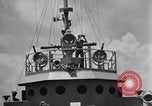
Allied Invasion of North Africa during World War II
Allied warships move towards North Africa during World War 2. A U.S. Navy sailor on a destroyer monitors sonar indicating presence of a submarine. A sailor looks through a pair of binoculars and another U.S. Navy sailor nearby has a pair of headphones. Loudspeaker signals call to general quarters. Sailors rush up the stairs. Numerous depth charges are launched and explode in the water. Next, a wide oil slick on the surface indicates the submarine has been struck by the depth charges. An officer looks through a pair of binoculars. A man speaks into a radio. Soldiers amuse themselves on a troop ship. One plays the piano and others playing play cards, read novel while eating an apple. Flags of Major General Patton and Rear Admiral H. Kent Hewitt aboard the USS Augusta (CA-31) off the coast of North Africa. Semaphore flags and signal lights communicate between ships. Soldier with 'map of West Africa' in his back pocket. Two soldiers read a language guide. An animated map detailing Plan Acrobat to invade North Africa. Map includes Casablanca, Algiers, Tripoli, and Libya. Soldiers exercise, peel potatoes and relax on a troop ship. Clothes hung on a line. British soldiers write letters home. A soldier pastes news on a bulletin board. The bulletin announces that the 'German Afrika Corps' are in full retreat. Night time aerial views of bombing of cities in Italy. Narrator states the bombing included Naples, Genoa, and Turin. Explosions and smoke on the ground below from the bombing. Aerial view of daylight bombing at lower altitude of a Renault tank factory. Submarine on surface at twilight. Eighth Army plane. General Eisenhower, General Mark Clark and French General Giraud. Night scene. Soldiers on the deck. German WWII headquarters at night with guards in Rome and at the The Reich Chancellery in Berlin. Hitler at Berghof . German switchboard, terminal, and radio communications. Messages passed between Allied ships via signal light and ship-to-ship cargo transfer. ( Note The Operation Acrobat discussed in this film is misleading. That plan was scrapped, and the Allied North African campaign was conducted as part of Operation Torch.)
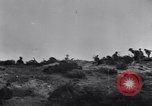
Allied Forces Build up in Algeria to prepare for Spring offensive against German forces in Tunisia during World War II
At start of film, Allied forces are digging in after retreating from counterattacks by German forces in Tunis, during World War 2.. Rains create mud everywhere. A Lockheed P-38 fighter plane parked in foreground. Ground crews use shovels to free nose wheel of a B-24 Liberator bomber with engines running. A truck tows a C-47 transport plane from mud. Army trucks travel over road inundated by running streams. Soldiers standing in a jeep submerged in water. M2 tanks stuck in mud. Airmen huddled around an outdoor fire. P-38 fighter aircraft parked in the background. Soldiers eating around an outdoor fire. Animated map shows Allied battle lines stabilized in Algerian mountains, while German forces occupy the plains in Tunisia. German artillery batteries firing. British troops sheltering in damaged building. Allied wounded being transported atop, as well as inside a field ambulance. Interior of a transport plane configured for evacuation of wounded on litters. U.S. airmen including a woman in leather flying jacket, presumably an Army flight nurse, tend to the wounded aboard the medical evacuation flight. Wounded being transferred from an airplane to an ambulance. British patrols moving through the night. Heavy artillery firing. British soldiers silhouetted at dawn. They return carrying a wounded comrade on a litter. The British soldiers ("Tommies.") trying to clean mud from themselves and their weapons before heading out on patrols again at dusk. Allied soldiers moving on mules in a long line to obtain needed food and supplies. More views of the interminable mud. A British Hawker Hunter fighter plane taking off. A formation of Hawker Hurricanes peeling off to engage German aircraft. Closeup of one rolling over. A German Heinkel 111 bomber being attacked and trailing smoke. Pilot pressing gun firing button in cockpit and a German Dornier Do 17 bomber hit as British fighter plane passes it in cloud of black smoke. The German plane diving to crash in a fireball on the ground. U.S. B-24 Liberator bombers taking off and flying in formation. Formation of American B-17 bombers in flight. The American planes dropping bombs on Italy, Sardinia, and Sicily. Gunners in the bombers firing machine guns at attacking German fighter planes as their bombs keep dropping. Back on land in Algeria, mud still halted any Allied advance. Animated map showing both Allied and German forces building up on their respective sides of the front. Supply lines illustrated all the way back to factories in the United States and Britain. Allied war plants making bombers and munitions. Allied Soldiers assembling Army vehicles at a port. Lockheed lightning fighters being rolled out of a factory. Sign reading "Railroad Equipment Assembly Plant No. 1." Complete trains from locomotives to freight cars being completely assembled, loaded with freight and sent on their way. A formation of P-38 aircraft equipped with long range fuel tanks being ferried in flight from Brazil. It is led by a B-17 flying fortress bomber providing navigation. British Spitfire and Hawker Hunter airplanes heading to the front are seen taking off from an airfield in Gibraltar. A caterpillar tractor moving earth for a new road at the front. Trucks dropping materials for the road bed as soldiers with shovels smooth them on the surface. Soldiers installing Mardsen Matting pierced steel planking for an airfield surface as C-47 transport planes operate on the field. Crates of food supplies being unloaded at a port. War materiel stored in a large yard at a port.
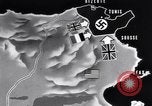
Allied Forces defeat Axis forces in Tunisia during World War II
The final battle of Tunisia, North Africa during World War 2. An animated map shows Allied Forces moving on all sides pressing forward against German forces still remaining in Northern Tunisia. in World War 2. Map outlines battles of Hill 609, Longstop Hill, Goubellat Plain, and Dejebel Mansour, and Takrouna. U.S. forces move 200 miles from the south to confront German forces in the north. Views of U.S. soldiers in trucks and M3 half-tracks, and towing heavy artillery with a tractor. Views of hills where Germans are positioned, west of Tunis and Bizerte. Allied guns firing. French forces sweeping for mines and digging some up with bayonets. French General Alphonse Juin confers with his staff as they review a large map laid out on a jeep. Brief view of French infantry in the field and gunners firing artillery. German Panzer IV tanks moving to counter British attacks. German tanks and artillery firing barrages against the British. Camera pans over destroyed German armor. British 78th Division attacks Longstop Hill. A long line of British infantry moving single file up a hillside. British soldiers firing Vickers machine guns from protected positions and infantry moving uphill, carrying small arms and Bren light machine guns. British troops scaling steep hills, using ropes, as shells burst close to them. One throws a hand grenade that explodes on the hilltop. After reaching the hilltop, the infantry scamper down the other side and continue moving forward, firing their weapons. Several dead German soldiers are seen as the British troops overrun the German positions. British engineers and pioneers working with caterpillar tractors and shovels to build roads. Later, trucks are seen using a new road. In the meantime U.S. troops are seen arriving to commence their assault on Hill 609. It begins with long range artillery firing from camouflaged positions and shells exploding all over on Hill 609. It continues into the night. View of soldiers in artillery headquarters, under a tent illuminated by lanterns. Long sequence of nighttime artillery fire. Medical Corps doctors treating wounded as the nighttime artillery barrages continue. U.S. infantry digging in after taking Hill 609. View of American soldiers walking up Hill 609. View of British Field Marshal Bernard Montgomery consulting with staff officers in the field. British 8th Army commander, Lieutenant General Sir Oliver William Hargreaves Leese, looking through binoculars as he stands with staff members at the front. Scene shifts to U.S. airmen arming machine guns on a parked P-38 fighter plane. Others roughly handling bombs to be placed into U.S. bombers. Bomber with nose art of devil riding a bomb and name "Hell a Poppin." Air crews arrive by jeeps at their B-25 Mitchell bombers and others arrive at their B-17 bombers. View of B-25 number 41-13202 named "Idaho Lassie" of the 321st BG, 445th BS, 12th Air Force. Engines running on bombers and on a British spitfire fighter plane. Formations of Allied aircraft, including B-24 liberator bombers, Martin B-26 Marauder bombers, British spitfire fighters, and B-17 Flying fortress bombers. British and American armor moving forward firing guns. French artillery firing and French infantry advancing. French machine gunners in white hats. U.S. B-24 Liberator aircraft dropping bombs. German fighter planes attacking allied bomber formations. Gunners in the bombers firing at them. Gun camera view of German fighter being shot down. More views of Allied aircraft bombing and strafing. Map shows American forces reaching Bizerte, the British capturing Tunis and German forces split and defeated.

Patients slide down a fire proof canvas chute during the testing of a device to evacuate patients in a hurry during a fire.
Testing of a new method to evacuate patients in a hurry in case of a fire. Exterior of a California hospital. A truck and men outside the hospital. A fire proof canvas chute extends from the ground to the fourth floor window. Patients slide down the chute. (World War II period).

Celebrations in the U.S. on the surrender of Italy and the conditions in Sicily leading to the surrender.
The Allied Forces crush the Axis troops in the Mediterranean during World War II. Italy surrenders. Newspapers in the U.S. show headlines of surrender of Italy. People in the streets read the newspapers. In New York the Americans of Italian descent celebrate Italy's surrender. Roll of honor. A child holds an American flag. American and Italian flags side by side. An Allied convoy moves towards North Africa. Allied troops land in North Africa. U.S. General Eisenhower, the Supreme Allied Commander; British General Montgomery, commander 8th Army and Lieutenant General Clark, commander of U.S. 5th Army are shown. U.S. President Franklin D Roosevelt and the British Prime Minister Churchill meet at Casablanca. Prelude to surrender- Allied planes drop bombs on islands off Italy. Allied warships off the coast of Sicily. Fighting off the coast. Sicily is invaded by the Allied troops. Americans land on shore. The U.S. 7th Army and the British 8th Army land on Italy's mainland behind a naval bombardment. The Allied soldiers in the streets. U.S. Army Corporal Salvatore DeMarco, of Italian origin, reunites with his family after having left home at age 15. German troops surrender to the U.S. troops and are sent out of the country in ships.
CRITICALPAST.COM: About Us | Contact Us | FAQs - How to Order | License Agreement | My Account | My Lightboxes | Shopping Cart | Advanced Search | Featured Collections | Website Terms & Conditions | Privacy Policy ©2026 CriticalPast LLC.
License Agreement |
Terms & Conditions |
Privacy Policy
©2026 CriticalPast LLC.