


 Francais
 Deutsch
 Italiano
Refine Your Search
Elizabeth New Jersey 1952 stock footage and images
- Showing 7315 to 7320 of 8468 results more
more Hide
Hide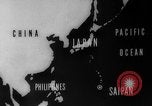
U.S. B-29 operating around newly constructed airfield on Saipan during World War II.
U.S. Army Air Forces B-29 Super Fortress in flight during World War II. Map of Pacific Ocean showing Saipan, Philippines,China and Japan. B-29 circling overhead. A B-29 on final approach over water, with landing gear down. A B-29 flies over the field with gear up. Another B-29 in level flight at altitude, with landing gear down. A B-29 makes approach and lands on the new airfield, as interested military personnel watch from side of runway.
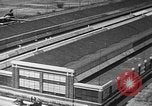
Aircraft workers at American aircraft factories, fabricating DH-4 airplanes with Liberty engines, during World War I.
During World War 1, Americans from various trades, including carpenters, painters, and women seamstresses, at work in an aircraft factory. Men and women work assembling Liberty aircraft engines to power DH-4 aircraft. Workers placing propellers on a row of assembled DH-4s in the factory. New DH-4s being started and tested on factory airfield. After testing, a DH-4 is painstakingly disassembled and packed for transport by train and ship to American units in France. In France, women carry airplane wings to an assembly shed where they are put back together and delivered to the flying units. Truckloads of aerial bombs being delivered to the airplanes. Armorers fusing and loading bombs under an airplane's wings, under watchful eye of the pilot.
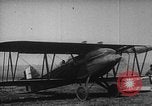
Battleship bombing tests organized by Billy Mitchell carried out by U.S. 1st Provisional Air Brigade in 1921 and 1923
Brigadier General Billy Mitchell taxis in a Boeing Model 15 ( or a Curtis P-1Hawk) airplane, after landing at an airfield. . Battle ships underway at sea. Mitchell organizes 1st provisional Air Brigade for bombing demonstration against battleship target.. Crews and airplanes train and prepare at Langley Field, Virginia. Soldiers load bombs under plane wings. Planes take off to bomb the obsolete U.S. battleship USS Alabama. View from airplane in flight as it drops phosphorus bomb on the Alabama. View from water as bomb strikes with huge explosion. Armorers prepare heavier bombs for the next demonstration. Planes take off and bomb the USS Alabama again. General Mitchell crouched down beside a bomb loaded on an airplane for new tests in 1923. General Pershing, Admiral Shoemaker, Assistant Secretary of War, Davis, and General Patrick on deck of the Ship, USS St. Mihiel (AP-32) to observe the tests. Views of planes dropping bombs on Battleship USS Virginia and the ship rolling over and sinking. Large formations of 1920s era Air Service aircraft in flight.

U.S. Air Service promotional activities during the 1920s.
1924: A crowd gathered at Boston Harbor to welcome the first 'Round the world flyers. Dignitaries seated. Air Service Douglas World Cruiser biwing float planes land in the harbor. United States Army Air Service flyers, led by Lieutenant Lowell Smith, arrive in boat at harbor. The six intrepid Lieutenants: Harding, Nelson, L.P. Arnold, Wade, Ogden and Smith, pose with General Patrick, Chief of the Air Service , along with several young women. View of the Barling Bomber at Wright Field in Ohio. Crew members: Lieutenants Harris and Muir Fairchild together with designer Walter Barling and engineer Culver, pose together and then climb aboard the airplane. The aircraft commander stands in open cockpit and orders flight engineer to start the 6 Liberty engines. The Barling Bomber taxis out and takes off. Commander waves from open front cockpit as aircraft climbs after takeoff. Views of the Barling Bomber in flight. President Calvin Coolidge stands, awaiting the arrival of the Pan American Goodwill flyers, at Bolling Field, Washington, DC. Crew of the Loening OA-1A amphibian, "New York": Major Herbert Dargue, and Lieutenant Ennis Whitehead, are greeted as they climb down from their aircraft. President Coolidge, presents all of the flyers with Distinguished Service Cross Certificates.
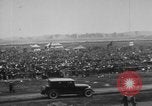
Lieutenant Cyrus Bettis and Lieutenant Jimmy Doolittle win air races in 1925.
In October 1925, crowd gathered to watch the Pulitzer Trophy air races at Mitchel Field, Long Island, New York. VIPs arrive in various automobiles. Army Air Service Curtiss R3C-1 airplane is pushed onto the field. Air Service Chief, General Patrick , speaks with Lieutenant Cyrus Bettis as Lieutenant James Doolittle listens. A Navy crew works on their entry in the race, similar to the Army Air Service airplane. Navy Lieutenant Al Williams seen with a pipe upside down in his mouth. Lieutenant Bettis taxis out for takeoff in his airplane number 43. Then Navy Lt. Williams proceeds to take off in his aircraft, number 40. Lt. Bettis breaks ground and begins to fly the closed course, coming very close to the ground at times. He lands and climbs out of the cockpit, surrounded by spectators and officials who are convinced he has won, registering a speed of 249 miles per hour. Navy Lt. Williams lands shortly thereafter having averaged 242 miles per hour. He is greeted by several spectators, including a young woman. Two weeks later, the U.S. Army was represented by Lieutenant Jimmy Doolittle, who flew the Curtis R3C-1, again, but this time fitted with floats, at the Schneider Cup Seaplane Race in Baltimore, Maryland. He shakes hands with a young woman, just before the race. The Navy also entered with a similar seaplane, shown being pushed into the water. The British entry, a Glouster-Mapier IIIA is seen (replacing the Supermarine-Napier S.4, that was damaged). The Italian Macci M.33 is seen on a dock with engine running. The float planes taxi out over the Chesapeake bay waters to takeoff position. Doolittle is the first to take off and to return, logging an average speed of 232 miles per hour. He is seen smiling after the race.
U.S. Economic Depression and establishment of the Civilian Conservation Corps.
A deserted factory building. Sign 'For Sale' on one of the Unemployed men on bread lines during the Great Depression. Crowds gather as politicians and agitators hold outdoor rallies. Signs of various employment agencies over store fronts where men are gathered seeking work. Job seekers sitting on sidewalks outside possible workplaces. Men sleeping on lawn in public park. Police arrest agitators. President Franklin D Roosevelt speaks about the Civilian Conservation Corps (CCC). Copy of the bill (S.598) establishing the CCC. Newspaper headlines passage of "Labor Army Bill." Another reads: "House Votes Reforestation Plan to Give 250,000 Jobs..." Employment news in various newspapers and magazines. A man talks on phone. Men queued up, in 1935, to join the CCC. A woman stops to converse with some of them. CCC recruits, supervised by U.S. Army personnel, line up to receive clothing and equipment, before starting several weeks of Army boot camp. They board trucks and vans. The Army sets up a mess line on a sidewalk where recruits eat before boarding a large double-decker bus. Recruits wave from several other buses as they depart for their respective training camps. Audio is present in some brief portions only in the second half of the clip.
CRITICALPAST.COM: About Us | Contact Us | FAQs - How to Order | License Agreement | My Account | My Lightboxes | Shopping Cart | Advanced Search | Featured Collections | Website Terms & Conditions | Privacy Policy ©2026 CriticalPast LLC.
License Agreement |
Terms & Conditions |
Privacy Policy
©2026 CriticalPast LLC.