


 Francais
 Deutsch
 Italiano
Refine Your Search
Elizabeth New Jersey 1952 stock footage and images
- Showing 7333 to 7338 of 8468 results more
more Hide
Hide
Officers collected from ground, Naval and Air Force work collectively at the National War College, Washington DC.
The Joint Operations Staff College at Norfolk, Virginia. Seminars conducted at the National War College and the Industrial College of the Armed Forces. Officers collected from ground, Naval and Air Force work collectively. Officers examine globe, read books and attend medical service classes. Officers enter into building. Officers play pool (billiards). Door Sign reads 'Student Committee Room'. Officers seated in a round table conference. Officers attend the War College in Washington DC. Civilian and Army officers meet each other at school. Officers attend classes at the Industrial College of Armed Forces. Officers examine a chart in room. Officers in a aircraft factory examine aircraft being assembled. Officers observe workers assembling a truck. Officers confer in a library with books on nearby shelves. Officers eat together in dining facilities and play handball. Military caps of different services on a hat rack. Massive columns of US Army soldiers and military vehicles, artillery, tanks, and tank destroyers parade on a street (possibly New York City) possibly at end of World War 2 or near that time. Military bomber aircraft in flight in formation overhead. The United States and British flags fluttering side by side in a breeze.
Soldiers of the U.S. 2nd Battalion 47th Infantry (Mechanized) and 4th Battalion 39th Infantry clearing a hamlet during the Tet Offensive in Vietnam
Elements of B Company, 2/47th Infantry (Mechanized) and C Company, 4/39th Infantry, clearing North Vietnamese Army regulars from "Widows' Village" (a hamlet of housing provided by the government of the Republic of Vietnam for widows and children of fallen ARVN soldiers). The action occurs January 31st, 1968 (on "Tet", the Vietnamese Lunar New Year holiday). U.S. troops firing small arms as they proceed across tall grass into the hamlet. Several M 113 armored personnel carriers (APCs) are seen accompanying the troops. A soldier, who has been hit, lying prone between two other soldiers, tries to get up. Flames consuming huts. Riflemen moving cautiously. A slightly wounded soldier, lying on the ground, smiles as he points to his leg as another soldier helps him. APCs advance, firing 50 caliber machine guns. Riflemen staying close behind. Views of a number of huts, in the hamlet, that have not been destroyed. (Note: According to Colonel Sonny Craven, then leader of a combat photo team on the scene, these combat sequences was filmed by soldiers of the 221st Signal Company [Pictorial]). Craven and another photographer, were both wounded in the engagement.) (Vietnam War period).
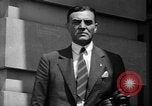
Congressman Fish objects to Roosevelt's pact in which Britain will lease navy bases to the U.S. in return for 50 destroyers
Republican New York Congressman Hamilton Fish III rehearsing a public statement on the steps of the Capitol in Washington DC. In his statement, Congressman Fish, known as Hamilton Fish Jr. in the Congress, objects to President Roosevelt's pact in which Britain will lease navy bases to the United States in return for 50 destroyers. He repeats his statement several times for the camera and microphone, rewording the statement somewhat each time.

Workers engaged in General Electric plant, United States (WW2)
Clock on stand shows time. Map of Europe with flames of war sweeping over it. Two men seated in office. A family sits at dinner table in home. Two men in a news broadcast studio. President Franklin D. Roosevelt addresses Congress during World War II. Clock pendulum swings. Views of American heavy industry: steel making and power lines crossing the country. General Electric factories, all over the United States and thousands of company employees. Close view of GE worker standing. View of machinist's hands, as he stops a lathe and uses micrometer to check dimension of piece being turned. Workers punching a time clock. View of night shift at work.in a defense plant.
Auxiliary generators and Navy ship gears and turbines being built at a General Electric Plant in the, United States; also launching of battleships.
Workers in war production effort busy at a General Electric Plant in the United States during World War 2. Men wheel portable power generators used to power search lights. Search light spots an airplane above in the sky during testing. Various parts being manufactured for large U.S. Navy warships. Auxiliary generators provide heat, light and power to cruisers. Big reduction gears and turbines being finished in the factory and tested by war production workers. Ships outfitted with GE turbines are launched. Narrator mentions the recent launch of several battleships. Two battleship launches are shown, including the June 13, 1940 launch of the USS North Carolina (BB-55), being christened by Ms. Hoey, daughter of Clyde Hoey, the Governor of North Carolina. Beside her in dress white U.S. Navy uniforms are Lt. Sampson and Lt. DeMetropolis. The battleship slides down skids into waters at New York shipyard.
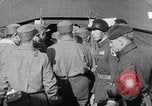
Defecting, former Chinese prisoners reach Incheon harbor during trip to Taiwan.
Liberated Chinese prisoners from Korean War prison camps, getting onto U.S. trucks to reach Incheon harbor in Seoul, en route to Taiwan where they are defecting from Communist China. They were known as "Anti-communist Heroes." The United Nations Transportation Corps and the United Nations officials take care of transportation process. Chinese Ambassador to Korea and other officials bid farewell to the Chinese prisoners. Trucks loaded with Chinese prisoners move along road. Chinese prisoners hold flags on trucks. Trucks stop in between before reaching Incheon. Prisoners have soup. Trucks loaded with prisoners begin the journey. Incheon city streets decorated to welcome Chinese Prisoners. South Korean civilians line up streets. Chinese prisoners greeted by 47th Overseas Chinese Organization members and the United Nations band. Crowd with flags and banners welcomes the Chinese prisoners. Chinese opera with people in colorful dresses. Freed Chinese prisoners march in Incheon harbor. Chinese prisoners holding the Chinese flags march along pier. Crowd cheers at harbor. Stick points out sea route from Incheon to Taipei, Taiwan. Convoy of warships and planes escorts liberated Chinese prisoners heading to new life in Taiwan, Republic of China (ROC).
CRITICALPAST.COM: About Us | Contact Us | FAQs - How to Order | License Agreement | My Account | My Lightboxes | Shopping Cart | Advanced Search | Featured Collections | Website Terms & Conditions | Privacy Policy ©2026 CriticalPast LLC.
License Agreement |
Terms & Conditions |
Privacy Policy
©2026 CriticalPast LLC.