


 Francais
 Deutsch
 Italiano

Refine Your Search
Elizabeth New Jersey 1952 stock footage and images
- Showing 7387 to 7392 of 8486 results more
 Hide
Color Sound

Security police checks identity papers and workers work with radioactive material in an atomic energy plant in Canada.
A film titled 'Inside the Atom' about the structure of atom and the use of radioactive isotopes in the treatment of cancer in Canada. A board on a shore reads 'Picture Taking Prohibited'. Buses drive past a sign reading 'Atomic Energy Project'. Buses are stopped at the entrance of the plant and are checked by security police. Identity cards of men are checked by the security police. Workers enter the plant. A worker walks on the plant grounds carrying a piece of a radioactive metal suspended from a rod. A minute fragment of matter is checked under a microscope. Narrator describes prospect of atomic energy to introduce a new industrial revolution, contrasting with traditional work. Scenes of Chinese or other Asian laborers at an excavation site, moving rocks and boulder by cart and wheel barrow. Men sit atop a wooden frame rig with pedals, using man power to operate a water mill. View of coal miners at work digging in a coal mine and loading coal chunks onto a moving track.

Snow covered roads, trees, vehicles and the U.S. Capitol after a winter storm in the United States.
A winter storm in the United States. In Washington DC: snow covered roads. Cars covered with snow. A public transport bus covered with snow. Snow on trees. Exteriors of the snow covered U.S. Capitol. In New York: wind blows snow. A bulldozer removes snow from roads. Cars covered with snow. Men remove snow from cars. A car is driven.
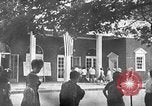
School children and other visitors at Edison Institute, Ford Museum, and Greenfield Village in Dearborn, Michigan
Teachers and students form a line as they enter Greefield Village on a field trip. Students in courtyard,with docent speaking to them. Students assembling in courtyard as they enter Greenfield Village. Group of students walking along sidewalk. Others passing the 17th Century Sussquehanna House. View of the 18th Century Secretary House, home of the first Secretary of State for New Hampshire. The 19th Century Greek Revival, Ann Arbor House, once occupied by Robert Frost. Students enter a Carding House, where spinning wheel and weaving are demonstrated.The Wright Brothers bicycle shop.The home of Noah Webster. A log building and McGuffey readers. Photo montage showing Clock Tower, winter scene with sled, and Mississippi river boat. Visitors,in the Ford Museum,look at cornerstone inscribed by Thomas Edison.Exhibits of home furnishings, silver (including Paul Revere collection) and pottery collections, in the museum.Little girls looking into a shop in the street of shops at the museum. Allegheny steam locomotive and numerous cars in transportation section of the museum. The Roper Steam carriage of 1863 and other historic vehicles.The first Aircraft guidance device. Exhibits illustrating the history of lighting. A hall of exhibits showing development of steam power.A nun in habit, with companion in the hall of wood and metal working machines. School children looking at exhbits of farm threshers and reapers. The clock tower of the Village.Visitors walking through the complex. Newspaper headline announces death of Henry Ford, at age 83, in 1947.Gravestone of Henry Ford showing birth of July 30, 1863 and death April 7, 1947. Negative image of Ford on his Quadricycle with Greenfield Village Clock Tower behind.
American Expeditionary Forces(A.E.F.) 42nd (Rainbow Division) bury their fallen at Baccarat, France, in World War I
A cortege of U.S. Army trucks, covered with American flags and laden with flag-covered coffins of American soldiers,who fell in combat on May 27th, 1918,proceeds through the streets of Baccarat, France, in World War 1. U.S. soldiers of the 42nd Infantry Division march as escorts, beside the trucks. Local citizens observe from the sides of the road. Scene shifts to Memorial Day (May 30, 1918), when U.S. Army Major General Charles T. Menoher and U.S. Army Colonel Douglas MacArthur,of the 42nd Infantry Division, are joined by French Generals Dupont and Penet, in decorating the graves of fallen American soldiers, during a ceremony at a rugged battlefield cemetery containing new graves marked by wooden crosses. A little French girl places a bouquet (reportedly made by Major General Menoher) upon the grave of an American soldier.She is accompanied by other French children who also place bouquets on the graves. An honor guard of American soldiers fires a salute. Scene shifts to a gathering of American soldiers at their base in Baccarat, where they surround a small outdoor stage, to watch a Miss Hart, of the YMCA theatrical Corps dance the Higland Fling. She is dressed in traditional costume of Scotland and accompanied by a violinist. A group of Army musicians, seated close to the stage, watch the performance along with the rest of the troops.

Film depicting threat of disease due to destruction of German infrastructure at end of World War 2. Populace treated with DDT.
Scenes of destruction in Germany at end of World War II, including Destroyed dwellings and rubble and rubbish-filled bomb craters. A U.S. soldier medic steps across a destroyed structure. German citizens line up to obtain water from a small tank trailer. A bucket being filled. A German civilian work crew laying new water pipes. A large trash heap displaying a sign in German reading: Drinking strictly forbidden. Danger from Typhus!(Trinken Strengstens verboten. Typhusgefahr!). Germans wearing gas masks as they lead horses drawing corpse-laden carts, along a road. Allied military spraying German civilians with DDT (Dichloro-Diphenyl-Trichloroethane) at a delousing station. They give each treated person a certificate certifying their treatment. The treated include men, women, and many mothers with their children. A nurse holds a small child as the mother is treated.

Montage of scenes showing American civilian mobilization on the home front, life in the Navy, war scenes and demobilization after war.
View of a U.S. battleship heading toward the camera at high speed. Images of hip's wake becoming gradually more turbulent as camera focuses closer upon it in successive views. U.S. sailors in uniform. The first wears a the Silver Star medal. The next wears a Navy Cross medal. The third sailor wears a Cross medal with red and gold ribbon. A petty officer and two sailors posing together, each one displaying Cross and star medals, respectively. The scene fades to this last three, wearing civilian clothes in a flashback to the beginning of World War 2. The three watch as a draftsman lays out a Roll of Honor for a place called Middletown. Townspeople cheering at an outdoor sporting event. Next they sit and watch a tennis match. Next, many are seen as sailors scrubbing the deck of a battleship. Scene shifts to a Navy Wave guiding a C-45 aircraft into parking position. Another one is parked behind her. Next a "white shirt" on deck of an aircraft carrier is seen directing an aircraft with signals. A Douglas Dauntless aircraft is parked on the deck behind him. Abrupt change of scene shows a wounded sailor being attended by a physician. Members of a Navy ship's crew enjoying a swim, hanging out on a boom extended from their ship, and using rubber rafts and a dinghy as they enjoy recreational time allowed by the Captain. A sailor in a dining hall relishing a large piece of chicken. In contrast, a sailor at an antiaircraft station eats hastily. Twin guns are silhouetted behind him. Sailors getting dressed to go on shore leave. Photos of pinup girls displayed on locker behind them. They leave, but one sailor remains behind, on some kind of restrictions. Sailors on deck in formation as they are inspected by officers. One asks a sailor to adjust his hat and also examines his tie. A sailor sitting alone by a lake in Central Park, New York City. A sailor standing watch in setting sun. A chief Petty officer instructing a sailor on wearing his hat. Successive closeups of the imposing face of the Chief. that transitions into the face of a Lieutenant Junior Grade who is yelling at a sailor. Scene shifts to actual World War 2 battle footage scenes as Navy crew battles fire in an aircraft carrier's Island during naval combat in the Pacific. Hose lines are stretched across the flight deck and smoke envelopes the ship. Injured are carried to place of safety. Another scene aboard a U.S. Navy ship in World War 2, shows a Navy Chaplain praying over sailor who was killed, followed by a ceremonial burial at sea for the dead. U.S. Marines fire rifle salutes as coffins slide out from under American flags to carry the fallen sailor into the sea. As the nation demobilizes after the war, various "rabble-rousers" begin to cause trouble. One is seen speaking before a group of women, who seem influenced by his remarks. Scene shifts to aerial views from a low-flying airplane revealing the total destruction and rubble over miles of a German city, probably Berlin, from Allied bombing and shelling during World War 2. Views of suffering survivors of World War II (especially children) in various parts of the world. Emaciated and starving children in a war-torn area.
CRITICALPAST.COM: About Us | Contact Us | FAQs - How to Order | License Agreement | My Account | My Lightboxes | Shopping Cart | Advanced Search | Featured Collections | Website Terms & Conditions | Privacy Policy ©2026 CriticalPast LLC.
License Agreement |
Terms & Conditions |
Privacy Policy
©2026 CriticalPast LLC.