


 Francais
 Deutsch
 Italiano
Refine Your Search
Elizabeth New Jersey 1952 stock footage and images
- Showing 7405 to 7410 of 8468 results more
more Hide
Hide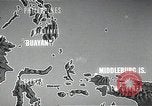
U.S. heavy bomber B-24 Liberator drops bombs over target areas in Buayan in Philippines Island during World War II.
Philippines Campaign in Philippines during World War II. A pictorial map showing distance of 650 MI from Middleburg in New Guinea to Buayan in Philippines Island. U.S. Army men at work. Two U.S. officers on ground below an aircraft during inspection. A U.S. heavy bomber B-24 Liberator taxis and takes off. The B-24 in flight. The nose section of the aircraft. Other aircraft in flight. Bombs being dropped on target areas in Buayan in the Philippines Island. Smoke rises from explosions. Aerial views of inhabited areas in the Philippines Island. A wooded region in view. Paved ways in view on ground. A column of smoke rises from the bombarded areas
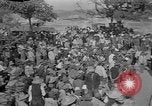
Okinawan workers at work in the area of the village which is the proposed site for an air base, in Okinawa, Japan during WWII.
Okinawan workers during the work of an airstrip in Okinawa, Japan, during World War II. The workers in a village in Okinawa, gather in a group. The workers move in a line to a desk where a pair of U.S. Military Police are seated. Each worker signs on a document. A policeman looks on. Few policemen stand behind the desk. The workers bow to an officer who walks past them. The workers move in a group. A few men in the group eating out of a bowl. The group of workers in a field which is the proposed site for the air base. The workers move in a line along a road. A few workers,with hammers in their hands, at work in the area. Sacks of sand stacked by the workers. Workers along the side of a road. Trucks with material move along the road. Heavy equipment grading the ground for the airstrip. Workers operate heavy equipment. A few workers painting the roof and sides of a building in the area. Aircraft taking off from the new airstrip.

U.S. troops find a child in a village, and takes it to the center for lost and orphaned children in Okinawa, Japan during WWII.
Orphaned children in Okinawa, Japan, during Battle of Okinawa of World War II. The U.S. troops advance through the roads of a rubbled village. Trees and damaged buildings along the sides of the road. A U.S. soldier, holding guns, walks along the side of a rubbled building and finds a small child. Two soldiers seated beside the child. One of the soldiers wipes the face of the child. The soldiers pick up the child and move towards the army jeep. The army jeep with soldiers and the child moves along the road. The jeep stops near a building. The soldier takes the child to the center for lost and orphaned children in Okinawa. The child is placed on a low table. A Red Cross worker and a man puts new clothes on the child and attends to the child. Views of other children in the center. The Red Cross worker feeds the child from a bowl. The workers at the center gives medical attention to a wounded child. A worker attends to a few days old baby. A child in the center looks on.
Firemen in a "fire engine sedan" rush to a building on fire and put out the fire, in Paris, France.
Firemen respond to a fire in a new sedan fire engine, and they put out the fire in a building in Paris, France. Fire fighters rush outside a building. The firemen rush to a "fire-engine sedan, which is a sedan car fitted with pumps and equipment attached to the rear of the vehicle, used for putting out fire. The firemen get into the sedan and drive away. The sedan arrives at a fire-stricken building. The firemen get out of the vehicle and take the pump and other equipment from the rear of the sedan, hook up hoses to local fire hydrants, and start putting out the fire. The firemen are seen spraying water from a hose onto the building on fire.
Cuban President Carlos Manuel de Cespedes y Quesada and cabinet meet at the Capitol to confer on debt crisis, in Havana, Cuba.
The members of the Cuban Cabinet at the Capitol building in Havana, Cuba. The Capitol building in Havana. A motorcade drives through an archway at the entrance to the Capitol building. A crowd gathered on the side of the road. Guards on the road. The members of the Cuban Cabinet climbs up the stairs and enters the Capitol. Guards on either side of the stairs. The officials inside the building, for the new Cabinet, formed by President Carlos Manuel de Cespedes y Quesada, meet on debt crisis. The officials on a large balcony on the Capitol. The crowd gathered outside the building wave to the officials. President Carlos Manuel de Cespedes y Quesada and other officials, seated and standing in two rows, pose for photograph. View at harbor with ship at dock and armed military or militia gathered at stern of ship. View from a moving boat of various ships anchored in Havana harbor including the U.S. Navy Destroyer USS Claxton (DD-140).
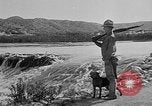
Scenes during Mexican revolution, in 1913, along the U.S. Mexican border
U.S. soldier with shouldered rifle stands guard beside the Rio Grande river, separating the United States from Mexico, in 1913. A dog stands next to him. The river is rushing in the background. View of extensive stakes and barbed wire lining the U.S.Mexico border. U.S. soldiers perform changing of the guard at a checkpoint on the U.S. side of the border between the U.S. and Mexico. Two new American sentries replace those being relieved. Signs on the fence identify the respective country boundaries. Mexican refugees (mostly women and children) flee the revolutionary combat taking place in Mexico. U.S. soldiers monitor as they cross into the United States, and direct some passing inside a trench manned by American soldiers along the border. Scene shifts to an official looking building guarded by U.S. soldiers. Several Mexican men, including Pancho Villa leave the building, accompanied by two or more Americans. (One American, wearing glasses , and carrying a cane. is dressed in a white suit, and wears a bow tie and Edwardian style summer straw hat. Next, Pancho Villa is seen with a number of his soldiers. A group of Mexican men relaxing at a shaded table near rustic structures. Large cacti frame the foreground, where a girl is walking toward them. Closeup of the men gathered around the table.
CRITICALPAST.COM: About Us | Contact Us | FAQs - How to Order | License Agreement | My Account | My Lightboxes | Shopping Cart | Advanced Search | Featured Collections | Website Terms & Conditions | Privacy Policy ©2026 CriticalPast LLC.
License Agreement |
Terms & Conditions |
Privacy Policy
©2026 CriticalPast LLC.