


 Francais
 Deutsch
 Italiano

Refine Your Search
Elizabeth New Jersey 1952 stock footage and images
- Showing 7693 to 7698 of 8486 results more
 Hide
Color Sound
Celebrities help promote American Red Cross blood donor programs and War bond drives during World War II.
Film opens showing a huge crowd gathered in New York’s Madison Square Garden for a rally in support of the American Red Cross, during World War 2. Eleanor Roosevelt, the First Lady welcomes and introduces Princess Martha of Norway. The audience applauds. Scene then shifts for Red Cross activities on the home front. Two Red Cross women remove items from a station wagon in preparation for a local Blood drive. A panel truck parked next to them is marked: “American Red Cross Blood Donor Service.” More Red Cross volunteer women remove items from the panel truck to set up the blood donor activity. View of many persons in beds at a blood donor center. Nurses and Red Cross volunteers working at the center with donors. One of the donors is an active duty sailor in uniform. Complete change of scene to California, where Hollywood stars are seen involved in a war bond drive. Closeup of several, including Irene Dunn, Ronald Coleman, Hedy Lamarr, and Greer Garson. Glimpse of crowd at the bond drive.
The Pacific War Council and British and American General staffs meet at the White House in Second Washington Conference in World War II
Allies of the Pacific War Council met at the White House on June 25, 1942 Pictured with President Franklin D. Roosevelt and British Prime Minister Winston Churchill (both seated) and Canadian Prime Minister, Mackenzie King, standing immediately behind and between them. Others, standing behind are: Dutch Minister of Foreign Affairs, Eelco N. van Kleffens, Australian representative, Stanley Melbourne Bruce. The tall man behind Prime Minster King, is British Vicount Halifax (Edward Wood). To his left is Chinese Foreign Minister T.V. Soong, and Manuel L. Quezon, President of the Commonwealth of the Philippines. The last person standing at the right, is Walter Nash, New Zealand's minister to the United States. Scene shifts to military leaders of the combined British and American General Staffs, meeting in the so-called Second Washington Conference (Code named Argonaut). Closeup of U.S. Army Chief of Staff, General George S. Marshall, conversing with lieutenant General Henry H (Hap) Arnold, Commanding General of the U.S. Army Air Forces. Another closeup shows U.S. Navy Chief of Naval Operations, Admiral Ernest King, conversing with Admiral William D. Leahy, personal Chief of Staff to President Roosevelt. Glimpse of British Military General Staff members.
Public Improvement created by Work Progress Administration in West Virginia during the Great Depression.
View of elderly people and orphan children entering a building. WPA or Works Progress Administration Public Improvements show new log houses at Mercer County Industrial Park, a commune or community helping men, women, and families affected by the depression. Women milk cows. Man plowing a field with two horses pulling a hand plow, to provide food for the common community. Line of men with hoes work in a garden. Scenes from Camp Fairchance at Low Gap in Boone County West Virginia (South of Madison and Danville) shows totem poles at the camp entrance, a boy blowing a bugle, boy orphans waking up in a bunk house and girl orphans eating together in a dining hall. Young girl children sewing. Children playing, swimming in a nearby stream or lake, and marching behind a band on the grounds of the camp. Camp buildings seen in the background. Trumpeter on wood frame lashed tower blows bugle as American flag is lowered.
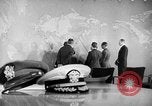
Allied officers examine map in Chateau Frontenac and reports on India; also exterior views of Roosevelt's Springwood Estate
American military officer hats on a conference table in Chateau Frontenac, around time of the Quebec Conference during World War 2. Group of allied officers gathered around wall map. One points at India. Another points at Suez. Reports labeled India, marked "Secret." British officers examining charts. Scene changes to exterior view of President Franklin Roosevelt's Springwood Estate house in Hyde Park, New York. American flag flying on house. Rolls Royce limousine parked at entrance drives away.

Mrs. Beryl Hart and Navy Reserve Lt William S. MacLaren make second attempt to fly to Bermuda.
After failing to find Bermuda on their first flight frim North Beach,Queens, New York, pilot, Mrs. Beryl Hart, and navigator, Lieutenant William S.MacLaren, U.S. Naval Reserve, were forced back to the U.S. where they landed at Norfolk, Virginia. MacLaren replaced his broken sextant, and the pair are seen starting out on their second attempt (this one successful). The pair are seen in flight clothing, with helmets and goggles prepare for the flight. They pose in the cockpit of their Bellanca CH 300, high wing, twin float seaplane, the "Tradewinds." They smile and wave to the camera. The engine starts, and the seaplane taxis over the water and accelerates to flying speed. They break contact with the water and fly off at a moderate rate of climb.

William Eugene "Pussyfoot" Johnson raids an illegal distillery in Sioux City, Iowa during Prohibition.
A staged news film showing Prohibitionist William E. Johnson (aka "pussyfoot") accompanied by uniformed police officers raiding a rum liquor still, in Soux City Iowa. The officers kick open the doors of the distillery, and pull a man out. Then, from inside, two law enforcement men carry out a simple piece of distillation apparatus. Johnson sheds his coat jacket and proceeds to destroy the still equipment with a sledge hammer, bashing holes in the container and breaking pipe and distillation coils from the device. (Note: a slate alludes to Johnson losing an eye while crusading in London. That occurred on November 13,1919, when he was publicly "teased" by medical students who carried him on a stretcher through the streets. Johnson lost sight in one eye, after being struck with an object thrown by a spectator.)
CRITICALPAST.COM: About Us | Contact Us | FAQs - How to Order | License Agreement | My Account | My Lightboxes | Shopping Cart | Advanced Search | Featured Collections | Website Terms & Conditions | Privacy Policy ©2026 CriticalPast LLC.
License Agreement |
Terms & Conditions |
Privacy Policy
©2026 CriticalPast LLC.