


 Francais
 Deutsch
 Italiano

Refine Your Search
Elizabeth New Jersey 1952 stock footage and images
- Showing 8215 to 8220 of 8484 results more
 Hide

U.S. Army Air Force (USAAF) VIII Fighter Command aerial pursuit and strafing of ground targets during World War 2
Shot of aircraft flying ahead, high above fields, taken from mounted camera of 359th Fighter Group, on August 16, 1944, in Europe, during WW2. Scene changes to gun camera footage from a different plane, as it approaches an aircraft, August 16, 1944. The aircraft in pursuit peels off. New scene from August 18, 1944, taken from aircraft of 4th Fighter Group as it makes multiple low passes to attack ground targets. The aircraft strafes enemy German vehicles and other roadway targets.

U.S. Forces conduct amphibious landing and establish a position in the Aleutian Islands, Alaska, in 1942, during World War 2
U.S. Military establishes new positions in the Aleutian Islands to support offensive against Japanese. A convoy of U.S. ships sail through foggy waters in the Aleutian Islands of Alaska, in 1942, during WW2. Dozens of U.S. Army soldiers stand on the deck of a ship. Distant view of a harbor near Kiska Island. Under the cover of the fog, U.S. soldiers climb aboard small assault boats. The boats arrive at the island and soldiers spill ashore carrying supplies. Close ups of vehicles and large weaponry coming off Higgins boats (LCVPs) onto the island. Long human chains "bucket brigades" move supplies onto the beaches from the boats. Soldiers wade through the shallow water, laden with supplies. Wider shot of the beach with stacks of supplies and soldiers moving about. An artillery gun rotates, alert and scouting the area.
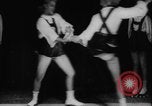
Young German women perform roller skate acrobatics in Germany, 1940, during World War 2
German women, wearing skirts modeled after male German lederhosen, perform acrobatic stunts on roller skates in cabaret style performance. Germany, 1940, during WW2. One woman holds another aloft, swinging them through the air, while spinning in circles. A new pair of women take the stage, performing a more daring stunt where the woman swinging through the air is only connected to the one spinning on the ground by a single leg, wrapped around the neck. A third stunt is performed by two women, followed by a spinning stunt involving all four acrobats. From a Spanish newsreel.
Views of industrial Birmingham, England, taken in 1954, post World War 2
Elevated view of British industrial region of Birmingham, England, in 1954, ten years after WW2. Structural frame of building in the foreground, large cooling towers and smokestacks in the distance. Cars and buses drive on a roadway lined by trees. The view pans left, showing more of the skeletal building in the foreground. New elevated position shows residential housing in the foreground and industrial zones stretching into the distance. Smokestacks and mega-scale construction project in the background. Closer views of the skeletal frame of a many story building.

Dr. Hugo Eckener, commander of German Zeppelin Hindenburg, (LZ-129) talks to journalists about his voyage to the United States.
Dr. Hugo Eckener (1868-1954) who commanded the German Zeppelin Hindenburg (LZ-129), describes the maiden voyage of the airship over the North Atlantic, and states his opinion that even in bad weather the Zeppelin would be able to successfully make regular transatlantic flights.

Author Leslie Charteris, a passenger on zeppelin Hindenburg's maiden voyage, tells of his experience.
Author Leslie Charteris (1907-1993), a passenger on zeppelin Hindenburg's maiden voyage, talks about his trip from Frankfurt, Germany aboard the airship. He says it is the most natural way to travel across the North Atlantic Ocean.
CRITICALPAST.COM: About Us | Contact Us | FAQs - How to Order | License Agreement | My Account | My Lightboxes | Shopping Cart | Advanced Search | Featured Collections | Website Terms & Conditions | Privacy Policy ©2026 CriticalPast LLC.
License Agreement |
Terms & Conditions |
Privacy Policy
©2026 CriticalPast LLC.