


 Francais
 Deutsch
 Italiano
Refine Your Search
Elizabeth New Jersey 1952 stock footage and images
- Showing 937 to 942 of 8468 results more
more Hide
Hide
Army Documentary "The Big Picture", history of the U.S Infantry discussed and views of historic sites shown.
Sergeant James Mansfield hosts the program 'The Big Picture', the series depicting the combat infantrymen in United States. History of the United States Infantry is discussed.Scenes include: large formation of U.S. infantry on parade field; statue of minuteman; Concord Bridge; memorials at Wide shots of revolutionary War sites such as Valley Forge, Bunker Hill, Fort Ticonderoga,Trenton, Monmouth, and Yorktown. View of Manhattan Island and tall skyscrapers of New York City seen. View of Lake Champlain.

A notice by the factory union workers of Isbergues,France.
Shows Robert,a factory worker of Isrbegues,France,in conversation with his parents. Robert leaves from home. A notice by the factory union workers on a wall.The notice tells about false promises by factory owners. It urges all factory workers to unite. Workers seated around a table in a house at night time. A fellow worker informs them about the notice. The news reaches the factory workers of the entire town.
Montage of U.S. Strategic Air Command activities
U.S. Strategic Air Command (SAC) Bombardier leaning over bombsight. Several small explosions in circular pattern on SAC bombing range in flat open desert. Mountains in background. A SAC Convair B-36 bomber aircraft in flight. Two U.S. Air Force airmen remove camera from RB-36 aircraft and holding up large still photo aerial camera with large lens. Animation of flight of B-36 on practice bombing exercise in the United States . Aerial view of formation of four B-50 Superfortress aircraft of the 43rd Bomb Wing, stationed at Davis-Monthan Air Force Base, Tucson, Arizona. They are escorted by two straight-wing F-84 Thunderjet aircraft. Aerial view of a single Convair B-36 in flight. Circle R tail code indicates it belongs to the 6th Bomb Group stationed at Walker Air Force Base, New Mexico.

The freighter, SS Flying Enterprise, damaged by storms and foundering in the Atlantic ocean,
The freighter, Flying Enterprise, is seen listing some 80 degrees to port in the windswept approaches to the British Isles. After suffering damage from a storm on December 28th, she had been taken under tow toward England,by a succession of ocean-going tugs over a period of 15 days. Her present position is only about 30 miles from the coast of England, but her tow line has parted and she is foundering. Closeups of "Flying Enterprise" and "Isbrandtsen" painted on her hull. (Narrator states that the Captain, Henrik Kurt Carlsen,is still aboard.) Aerial view of several other ships around the stricken vessel. Officers and crew of the destroyer, USS Willard Keith (DD-775), are seen firing a line to the Flying Enterprise. Heavy seas are flowing over the foredeck of the destroyer. Another view of the listing ship. (During these scenes, Captain Carlsen is heard on the radio, in the background, describing the circumstances leading to their present trouble.) More views of the Flying Enterprise, helpless and battered by wind and seas, before eventually sinking (not seen). Narrator states that Captain Carlson was rescued. (Note: This ill-fated trip which ended in the sinking of the old Liberty Ship made world-wide news when it turned out that she was carrying paper money.)
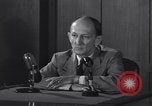
Donald E. Keyhoe, author of the book, "The Flying Saucers Are Real," is interviewed during a broadcast.
Film opens showing Major Donald E. Keyhoe (U.S. Marine Corps, Retired) author of the 1950 book,"The Flying Saucers Are Real." He is seated, quietly, at a desk with microphones. Unseen persons are talking, as they prepare for his interview, and can be heard in the background. An unseen interviewer asks Keyhoe his opinion about new sightings of unidentified flying objects. Kehhoe expresses belief that some will prove to be of interplanetary origin.
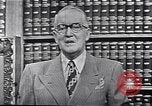
Barry Goldwater speaks on the growth of Federal government encroaching on states' rights
William Bradford Huie and Hardy Burt talk with Senator Elect Barry Morris Goldwater (Republican Party, Arizona). Goldwater speaks about his interest in politics starting during World War 2. Goldwater talks about the growth of the Federal government, stating that it has gotten too big, and that it has a tendency to preempt State functions of states. He says the big federal government has too many federal agencies and too many bureaus. He says the federal government Agriculture Department has multiple agencies in counties that are performing overlapping duties. Goldwater says that what the government is doing can be done more efficiently and cheaper, and in many cases at the state level instead. He speaks about the fear of socialism growing. He cites the example of states being required to involve the federal government when they want to open a new grammar school or high school. He says the issue is one of control and the government taking too much of the tax dollar, and that there could one day be a federal government in Washington DC that believed in socialism, and that if it controlled the schools, it could be telling the schools what to teach. He agrees with presenter that federal tax policies are making it difficult for state and local governments. He says that 78 cents of each tax dollar used to stay local, and now 78 cents of each tax dollar goes to the federal government in Washington DC is not being spent as efficiently as if it was controlled at the local level. Goldwater speaks about the lower standard of living of Native American Indians, and the need to make them "first class citizens". He notes that the Native American Indian can now vote in Arizona, but there is a need to repeal discriminatory laws that prohibit Native American Indians from buying alcohol (liquor), a skillet with handle on it, a gun, or an axe.
CRITICALPAST.COM: About Us | Contact Us | FAQs - How to Order | License Agreement | My Account | My Lightboxes | Shopping Cart | Advanced Search | Featured Collections | Website Terms & Conditions | Privacy Policy ©2026 CriticalPast LLC.
License Agreement |
Terms & Conditions |
Privacy Policy
©2026 CriticalPast LLC.