


 Francais
 Deutsch
 Italiano
Refine Your Search
Elizabeth New Jersey 1952 stock footage and images
- Showing 4249 to 4254 of 8468 results more
more Hide
Hide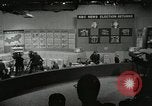
1960 Presidential Election news headquarters operations; results show John F. Kennedy leading over Richard Nixon
The 1960 Presidential Election in the United States. Interiors of a building show NBC News and CBS News Election Tracking headquarters and television studio operations. Board tracking the election result returns. A man behind a camera. Many news employees inside the building. The men preparing to broadcast the results of the elections. Interiors of a television network headquarters shows men and women at tabulating machines and electronic computers. A huge crowd gathered at the Republican Party headquarters. A few men and women beside a tally board updating election results. People in the crowd looking at a board. The board showing Presidential candidates Richard Nixon's and John F. Kennedy's count of votes in states Massachusetts, Michigan, Minnesota and several other states. A woman in the crowd looking through binoculars. The figures show Kennedy leading. The moving ticker bulletin board in Times Square, New York City, is shown reading "Kennedy Overcomes Slow Start, Pulls ahead of Nixon" as the counting continues. The Times Square moving bulletin reads 'Kennedy wins Connecticut's 8 Electoral votes, Sweeps all'. A crowd cheering and shouting 'We Want Kennedy'. The bulletin reading 'Kennedy leads in 17 states with 192 electoral votes'. A CBS news worker beside a map showing the states and the position of Republican and Democratic candidates in each state. A bulletin reading 'Kennedy stage see-saw battle in Virginia'. Men inside the television network headquarters including Walter Cronkite. Close up view of a camera being used to film the television news broadcast. A board showing position of the candidates in the election.
Indonesia is promised independence from Japan, at ceremony in Istana Gambir (Gambir Palace). Indonesian crowds celebrate news.
The promise of independence for Indonesia is broadcast throughout the city of Jakarta, following a ceremony at Istana Gambir, or the Gambir Palace (Merdeka Palace, Jawa Timur Jawa, Jawa Timur 65455, Indonesia). Exterior of Gambir Palace in Jakarta Indonesia. Indonesian leader Sukarno, head of the Japanese-created Poesat Tenaga Rakjat (POETERA - Concentration of People's Power) emerges from a car, climbs steps, and enters the Gambir Palace, presently known as Merdeka Palace. He stands together with other Indonesian officials. Imperial Japanese Army Lieutenant General Kumakichi Harada addresses the gathering and delivers news of Japanese Prime Minister Koiso's September 7, 1944 promise of future independence for Indonesia (the so-called Koiso Declaration). Large Japanese flag seen on the wall behind speakers. Sukarno approaches General Harada, bows and then speaks into a microphone. Scenes of jubilation in the streets of Jakarta as citizens hear the news that Japan has promised future independence for Indonesia (date undeclared). A man standing atop a truck announces the news over a megaphone. People stand near the truck, listen and cheer. A caravan of loaded trucks rolls slowly through a Jakarta neighborhood spreading the news about the promised independence. Citizens cheering and smiling. People standing at a railway station and at stopped trains hear the news and cheer. Citizens including men, women, and many children wave to the passing caravan. Sign on side of truck includes words "Bangsa Indonesia diperkenankan merdeka" meaning "Indonesia allowed Independence". Clip is from a Japanese newsreel during World War 2, with Japanese narration.

Highlights of the Allied New Guinea campaign and other Pacific battles against the Japanese in World War II
The Allied campaign across New Guinea and onward to the Philippines during World War 2. U.S. warships firing their guns at night. Flashes illuminate the blackness. Bombs dropping from an aircraft bomb bay. Bombs exploding on stretch of jungle near water. A U.S. Army Air Forces B-26 bomber in flight View rearward from very low flying USAAF bomber as it bombs it drops explode behind. U.S. troops making amphibious assault on New Guinea. Map showing path of Allied attacks from Australia, across New Guinea from Port Moresby to Buna and on to the Admiralty Islands, cutting off Japanese-held Rabaul, New Britain. Map shows Allied forces moving towards Japanese strongholds at Wewak and along the North shore of New Guinea and bypassing Wewak to strike at Hollandia. General Douglas MacArthur is seen aboard a U.S. warship conferring with American and Philippine officers. Annimated map shows Allied assaults on Japanese positions along the coast from Hollandia, to Warde, Biak, and beyond, stepping along towards the Philippines. Views of numerous fallen Japanese soldiers numbering more than 150 thousand dead. Crosses in battlefield cemetery at graves of some of the more than 13 thousand Allied military who lost their lives during the campaign. A soldier paying respects at one of the gravesites. Admiral Chester Nimitz with members of his staff at his headquarters in Hawaii. U.S. Navy F4F aircraft launching from an American aircraft carrier. American aircraft bombing Japanese positions on an atoll. U.S. warships bombarding Japanese positions with their heavy guns. Admiral Nimitz standing with Admiral William Halsey. More Navy gunfire and amphibious assault scenes. Map showing places where Allied forces had to battle the Japanese, including, Tarawa in the Gilbert Islands, Kwajalein, in the Marshals, Saipan, and Guam in the Marianas, and Palau to complete the "bridging" of the Pacific to the doorstep of the Philippines.

Four British working men and four American counterparts visit officials concerned with war production, in New York City and Washington DC (WW2)
A British film entitled, "People to People." Four British working men, visiting America, are seen in overcoats on the deck of a ship passing the Statue of Liberty in New York Harbor during World War II. They are accompanied by four American workers who were returning on the same ship, from a similar visit to England. Closeup of the eight men, named by the narrator, who calls them trade unionists on an exchange visit. Brief view of Chiang Kai-Shek, Franklin D. Roosevelt, and Winston Churchill at the Cairo Conference in 1943.Camera pans closeup over Roosevelt and Chiang Kai-Shek. Brief views of Roosevelt, Churchill, and Joseph Stalin at the Tehran Conference in 1943. Closeup of Roosevelt and Churchill, with Anthony Eden standing immediately behind them. Closeup of Stalin and Roosevelt, with U.S. Army Air Force Chief, General Henry H.(Hap) Arnold and British General Alan Brooke, Chief of the Imperial General Staff, conversing behind them. Scene shifts back to the men aboard the ship in New York harbor, with the New York City Manhattan skyline of buildings in the background. Next, the eight men are seen climbing steps to New York City Hall. Inside they are welcomed by New York City Mayor Fiorello LaGuardia. The group is then seen entering a building in Washington, DC, where they sit down at a table with Donald Nelson, Head of the U.S. War Production Board. In the Department of Labor building they meet William Hammatt Davis, Head of the War Labor Board, and also the Secretary of Labor, Frances Perkins. After that they are seen heading into the White House, where they are met by Mrs. Eleanor Roosevelt, who comes out of the White House to greet them on the porch. (Narrator says she later invited them inside for tea.) The men are next seen climbing the Capitol steps. Vice President Henry A. Wallace comes out to greet them and comments about industrial production not only during the war, but in the time of peace to follow.
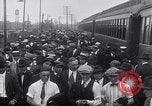
New U.S. Navy recruits arrive at the Great Lakes Naval Training Center in Chicago, Illinois
New recruits for the U.S. Navy line up on a train platform after arriving in Chicago. Sailors in uniform organize the recruits into groups. The next scene shows the recruits, carrying personal belongings, being escorted through the gates of the Great lakes Naval Training Center. Several U.S. Navy officers step from an official staff car and are seen posing in front of a flag pole at the Navy Station. The senior officer is Captain William A. Moffett, USN, Commandant of the center, flanked by a Lieutenant Commander and a Lieutenant, and two other officers in the background. Captain Moffett is later seen observing the new recruits as they are escorted on the base. Next, the recruits are seen carrying white towels as they march to a building where they will be issued personal clothing and uniforms. Later they are seen marching in their new summer uniforms, carrying their original civilian luggage. Under the watchful eyes of the officers, the new sailors use their new mess kits to get food from a chow line. Captain Moffett watches and converses with other officers (not seen). The recruits are next seen, in winter blues, exiting a building carrying their bedding, and presumably headed toward their billets. (World War I; World War 1; WWI; WW1)
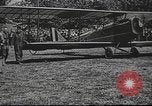
U.S. President Woodrow Wilson at Airmail Service Dedication in Washington DC. and Lieutenant Webb takes off from New York.
U.S. President Woodrow Wilson at Airmail Service Dedication between Washington DC and New York. The new aerial mail service is launched by the Post Office between Washington DC and New York. President talks to the pilot at Washington DC before the take off. The Curtis JN-4 airmail airplane takes off from the Polo field in Washington DC.. At the same time Lieutenant Webb takes off from New York. The airplane halts for six minutes at Philadelphia to collect more mail. The airplane lands New York with the mail after a three hour flight. A man takes out the mail baggage from the airplane.
CRITICALPAST.COM: About Us | Contact Us | FAQs - How to Order | License Agreement | My Account | My Lightboxes | Shopping Cart | Advanced Search | Featured Collections | Website Terms & Conditions | Privacy Policy ©2026 CriticalPast LLC.
License Agreement |
Terms & Conditions |
Privacy Policy
©2026 CriticalPast LLC.