


 Francais
 Deutsch
 Italiano
Refine Your Search
Elizabeth New Jersey 1952 stock footage and images
- Showing 475 to 480 of 8484 results more
more Hide
Hide
Former New York Governor, Al Smith, endorses Franklin Roosevelt for the 1932 Presidential elections in the United States.
View of crowd of 200,000 supporters during Franklin Roosevelt’s presidential campaign in Newark, New Jersey, during the Great Depression. Crowds clapping as former New York Governor, Al Smith, endorses Franklin Roosevelt. “The best way to bring back prosperity, the election of Roosevelt, Garner and the entire Democratic ticket!” Smith concludes his endorsement to the roaring cheer of the crowd.
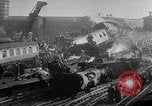
Disastrous Harrow and Wealdstone train collision claim lives of 200 people in England; Freighter Flying Enterprise founders at sea
Clip opens with 8 October, 1952 scenes from the aftermath of the Harrow and Wealdstone railroad train crash in England, where the collision of a Scottish Express train and a commuter train, followed by another express train, killed 200 people outside of London, England. Destroyed British railway trains on the track. Rescue operations carried out. Injured carried away for medical help on litters. Scene changes to coast of England in early January 1952, as the United States freighter ship Flying Enterprise (formerly the SS Cape Kumukaki) founders to one side while underway in rough seas. The ship had battled to stay afloat for 8 days following structural damage and then shifting cargo. Captain of the ship Kurt Carlsen is honored at a ceremony for putting up a brave fight for eight days trying to get the ship to port across the rough sea.
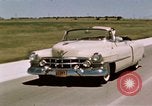
Use of petroleum and byproducts in transportation, agriculture, defense and industries in United States.
Various uses of petroleum and its byproducts in United States. Man drives a cream colored 1952 Cadillac Convertible car along the road. Close ups of various car parts in the 1952 Cadillac Convertible that are manufactured from petroleum byproducts, including seating, parts of dash, and window seals. Other vehicular traffic on road, including an antique automobile. An American Airlines DC-6 aircraft taking off. A streamlined locomotive: Burlington Route E-5A Diesel-Electric Silver Pilot locomotive approaching on a railroad train track. Tractor driven plow. A field being plowed. Petroleum byproduct being sprayed on fruit trees as a pesticide. Use of oil for American ground, air and naval forces. Petroleum byproducts and uses in oil industry. View of an oil refinery. Tourists visit an early oil derrick in Pennsylvania. An oil rig at work.
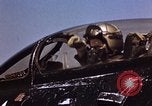
U.S. Navy locates a missing pilot using photographs and rescues him from behind enemy lines during Korean War.
Glimpse of a U.S. Navy pilot in the cockpit of an airplane, during the Korean War. He is pointing down at something. Next, a parachute is seen drifting rapidly in the wind as it descends. Pilot in aircraft hears about a pilot bailing out behind enemy lines. He is instructed to photograph the area. Next, a Navy 9F9 Panther aircraft is seen in the air. It has tail code "PP" indicating it is from the aircraft Carrier USS Essex (CV 9) with Carrier Air Wing Five (CVW-5) and Composite Squadron 61 (VC-61) from June 1951 to March 1952. . Glimpse of Navy ships in formation. View of Landing Signal Officer bringing in several 9F9 Panther aircraft to land on deck of the USS Essex. These aircraft carry tail code "M" of Squadron VF-23 with Air Task Group 2, aboard the Essex from June 1952 to February 1953. Next, several Navy A-4 Skyraider aircraft come in to land. They display "S" tail codes of Squadron VF-54. They are followed by another 9F9. Scene shifts to photo interpreters and pilots studying the photographs for clues to where their parachuting pilot might be located. They discover a parachute in the photos, and circle it. Ship loudspeaker is seen as helicopter crews are alerted for rescue mission. A Sikorsky HO3S-1 helicopter takes off from the flight deck. Other pilots wait anxiously as the Helicopter returns to land on the Essex flight deck. The missing pilot is aboard and they help him from the helicopter, place him on a litter and cover him with blankets. His friend takes his picture.
Warships of the U.S. Navy fleet in the Hudson River on Navy Day in 1945
View of the Hudson River from an aircraft flying North, over the New Jersey shoreline. United States Navy warships are seen in the Hudson River, on the occasion of President Truman's first official visit to New York City, on Navy Day, October 27, 1945. Approximately 50 ships were anchored in the Hudson. The first clearly identified is the Battleship, USS Missouri(BB-63) with the Destroyer USS Renshaw (DD-499) tied alongside (bringing President Truman aboard during his review of the fleet). Others seen include the USS Midway (CVB-41); the USS Enterprise (CV-6); The USS Augusta (CA-31); and the USS Boise (CL-47). Several more surface ships are seen followed by six submarines on the surface, as the aircraft approaches the George Washington Bridge. More warships seen North of the bridge. Scene shifts to the USS Missouri and USS Renshaw, again. Next, the aircraft flies past a Navy blimp hovering below, over the river. The Aircraft Carriers, Enterprise and Midway are seen again. Glimpses of the New York City shore and buildings are seen at times in the film, as well as the palisades on the New Jersey shore, near the George Washington Bridge.
Documentary about geography, fine harbors and long waterfront of New York, being the reason for its commercial supremacy.
Documentary about the geography of New York City. Slate indicates New York is the largest city in America. Its commercial supremacy is due to its fine harbor. A geographic map of New York, showing areas as Brooklyn, Manhattan, Lower Bay, Bronx and New Jersey. The bays and rivers in New York are shown. View of the Statue of Liberty. The waterfront of New York City as seen from a ship on the water. High rise buildings and early skyscrapers along the waterfront of Manhattan Island. Miles of docks at the New York City waterfront for ocean shipping.
CRITICALPAST.COM: About Us | Contact Us | FAQs - How to Order | License Agreement | My Account | My Lightboxes | Shopping Cart | Advanced Search | Featured Collections | Website Terms & Conditions | Privacy Policy ©2026 CriticalPast LLC.
License Agreement |
Terms & Conditions |
Privacy Policy
©2026 CriticalPast LLC.