


 Francais
 Deutsch
 Italiano

Refine Your Search
Elizabeth New Jersey 1952 stock footage and images
- Showing 5149 to 5154 of 8486 results more
 Hide
Color Sound

U.S. recruits being classified for assignments and being informed about the progress of World War II and why they fight.
New U.S. army recruits seated at benches in the classification center, taking notes, as an instructor at a blackboard tells them how to fill out their classification questionnaires, during World War 2. View of machines processing the questionnaires. Hollerith 88 column punch cards being sorted by machine. Newspaper article about the Air Force efforts to improve classification and assignments of new airmen. A recruit being counseled. An Airmen in barracks, filling out a post card form to complain about his assignment. Servicemen working with sewing machines and at long cobbler's benches repairing shoes. U.S. soldiers in pith helmets, laying communications cable from a truck. A soldier recording information about a shipment of supplies. Soldiers filling 5-gallon "jerry cans" with fuel from a hose. Others serving at a communications center in woods. A soldier fastening a cable to a tank. Soldier standing on a truck. Large group of soldiers gathered to listen to a lecture about explosives. Army draftsmen at their work tables. Soldiers using information and training materials.(Narrator states these materials are often ignored.) An army newsmap for Monday, August 31, 1942 posted on an Army office wall. A sergeant points to July, 1943, on a current calendar next to it, illustrating that the newsmap is long out-of-date. View of another news map and narrator notes they are produced weekly. An officer speaking to an auditorium of soldiers. A soldier arranging his personal gear. Infantry on field maneuvers, firing rifles as they advance across a field. Soldiers firing a Browning water-cooled machine gun; a mortar; and a 105mm M101A1 howitzer. The sergeant using a newsmap to brief his staff about the progress of the war. Opening frames of a War Department Film Bulletin, and soldiers in a theater, watching the film. Opening frames of the film,"Why We Fight," that goes on to show animated map of the German advance across Europe in World War 2. Scenes of German forces on the move, towing artillery, riding on tanks, and entering towns as they invade countries of Europe. Women and children running in streets under bombardment, and civilians fleeing from their homes during aerial bombing. A Bombed out city and civilian corpses lying on the ground. Women in Poland, identifying their dead and grieving over them. German Heinkel He 111 aircraft dropping bombs. Norwegians evacuating the city in trucks, and other vehicles and on foot, during the German invasion. A squadron of German Messerschmitt Bf-109 aircraft in flight. German Ju-87, Stuka dive bombers diving on targets. Civilians rushing to a bomb shelter, and other refugees boarding a truck to evacuate. More He-111 bombers dropping bombs. A Ju-52 trimotor transport (type used to transport German paratroopers). Buildings ablaze in a town. Large formations of German aircraft of various types flying overhead. Building destroyed and burning from bombing. Ju-87s flying close past the camera.
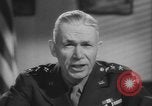
ASF Commanding General Brehon Somervell speaking about the problem of substitution and conversion of needed World War 2 supplies
Production of supplies for American soldiers during World War II. Commanding General of Army Service Forces( ASF ) Brehon B. Somervell seated at a desk in his office in the United States. He explains the serious problem of substitution and conversion and what is being done by American science to meet these needs. Somervell states that he is issuing an order: A command to think along new lines regarding every product essential to the war. He asks: 1) Can it be made as well of some less critical material; 2) Can it be made better, faster, or in greater quantity by some other method of production? He calls on viewers to draw on the brains and ingenuity. View of ordnance insignia. Interior of an office. An officer and a draftsman examine a machine gun. Exhibit of mannequins wearing uniforms with supplies for soldiers and nurses. Miniature tents and kitchen equipment. An officer and executives from two rubber production companies check synthetic rubber and collaborate on improvements. Radio engineers at work in front of equipment checking new type equipment. Workers weighing equipment and finding ways to make needed supplies lighter in weight. Chemical warfare officers at work. A soldier with a new plastic gas mask comes out of a room. Medical and other industry leaders around a conference table. Men gathered around tables planning improvements. Workers entering a large aircraft production factory. A man places a paper in a suggestion box labeled "ideas for increasing production."
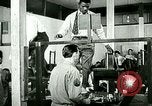
African American recruits in U.S. Army are issued uniforms and begin basic training in World War II
African American recruit sits in a chair with feet on a measuring device. A sergeant gives him a pair of shoes. But before he wears them the Sergeant tells him to stand, in the measuring device, holding two 20 pound weights. He then tells him to put on the shoes and go into the next room, where other African American recruits are lined up. They are instructed to remove all civilian clothes and begin dressing in army clothing. Next, completely dressed in their army uniforms, the recruits carrying duffel bags as they leave the snow-covered camp to board a train. Views of steam locomotives pulling trains in various places in the country. A convoy of army trucks carrying the new soldiers into a military base. The trucks park side-by-side in a line and the soldiers jump out with their gear to begin their basic training. A sergeant instructing the new soldiers on how to make a bed and other responsibilities. The new African American soldiers assembled in formation outside their barracks, on the snow, practicing close order drill, and making mistakes in the process. Next they are seen in a cross country march, carrying rifles. they take a 10-minute break. Soldiers in an infirmary, being visited by army doctors and African American nurses. Newly recruited soldiers being tended in an army dental clinic by African American dentists and hygienists. Soldiers shooting rifles on a firing range. Targets moving up and down on the range. Soldiers participating in sports, including football, baseball, boxing, and ping pong. A woman in the base library reading poetry aloud from a book entitled: "An Anthology of American African American Literature." African American members of the Women's Army Corps (WAC) are seen at another base, engaged in close order drill. Next these WACs are seen driving and riding in jeeps over rough terrain. A soldier shines his shoes, on Saturday night. African American soldiers and women dancing to music from an orchestra. The soldiers performing calisthenics in the open air. Rifles are held in some of the exercises. (World War II; WW II; World War 2; World War Two)

U.S. Pacific fleet at sea before Pearl Harbor attack, and Italian sailors establish barrage balloons around Italian Naval base
The U.S. Naval fleet underway in the Pacific before Pearl Harbor. Italian narrator describing names and sizes of various ships including the USS Arizona,USS Oklahoma, USS West Virginia, USS California and USS New Mexico. Footage of the U.S. Pacific fleet ships in heavy seas with water crashing over their bows. Army Air Force biplanes take off from the deck of the USS Langley Aircraft Carrier. Sailors stand by as a biplane aircraft lands on the deck of the USS Langley (CV-1). Biplane aircraft on the deck of the USS Langley. Topic then changes to Air-Raid Defenses in and around Italian naval bases. Italian Sailors roll helium barrage balloon inflation tanks into ships. Sailors direct air into a balloon. Numerous barrage balloons in the sky. Soldiers prepare to release a balloon from a boat and fasten the metal cables. Deck guns in position. Soldiers observe through binoculars, telescopes, other instruments and monitor gauges and radar on a machine. A soldier talks on the radio from amidst sand bag barricades. Soldiers watch as two play a bacci ball game. They run to take their positions as a soldier signals incoming enemy aircraft. Enemy planes attack the Italian base. Explosions near ships in the water. A barrage balloon is hit and bursts into flames. Sailors fire anti aircraft artillery from behind a barricade. Mobile units dash to substitute the destroyed barrage balloon with a new one. Soldiers in a truck hold onto the new balloon and then release it. (World War II period).

Exchange of cultures and collaboration in science and arts between the Soviet Union and the United States
The Moscow summit between the U.S. and USSR in Moscow, Russia. Wyeth family artwork being packed in boxes for a visit to the Soviet Union. Various paintings being packed up. In exchange, some Russian paintings and artwork seen that will be displayed in America. General Secretary of the Communist Party of Soviet Union Mikhail Gorbachev visits the United States during Glasnost efforts amid Perestroika reforms. People on the streets in what appears to be New York or possibly Washington DC are surprised when he exits his motorcade to shake hands directly with American citizens gathered on the sidewalks.The U.S. Secretary of State George Shultz and his wife visiting Soviet Georgia and being greeted by Soviet citizens. Gorbachev and U.S. President Ronald Reagan side by side at a summit in Washington DC. They stand together on the White House lawn as a band plays. Animation depicts the sharing of cultures between the two nations and the exchange of magazines. View of American rock star Billy Joel and his band performing at a concert in the Soviet Union on New Year's eve. A Moiseyev Dance Company folk troupe from Russia performing a dance in the United States. Cultural exchange between the two countries includes views of a piano performance by Vladimir Horowitz in Moscow and a ballet performance in the United States by the Bolshoi Ballet. Several Russian school children pose for pictures on the steps of the Lincoln Memorial in Washington DC. Soviet teenage children enjoy a elevated ropes course in an outdoor program. People sit in an amphitheater with officials at a Chautaqua Talk in 1987. A group of Soviet citizens view a touring "Information USA" exhibit in the Soviet Union that presents American culture. They view the program on an array of television monitors. A young Russian boy speaks in Russian about his interest in learning about American culture. People watch a science exhibition. Astronauts of the USA (NASA) and Soviet Union in a spacecraft. The astronauts open a connecting hatch and shake hands (possibly on a space station). Narrator describes collaboration of the two nations to monitor and study the depleting ozone layer of the earth and how to protect it. A man is shown sunbathing. Officials of the America and the Soviet Union sign an agreement relating to sharing information about safety of nuclear power plants. Soviet representatives and George Shultz, the U.S. secretary of State, inaugurate a new communication system that communicates nuclear dangers between the two countries. A woman in the communication room. Food grain pouring from a harvester, part of what is supplied to the Soviets. Soviet Union tanks and soldiers in Afghanistan. Soviet soldiers walking on a street in Afghanistan in front of a shop. Arrested American journalist Nicholas Daniloff disembarks an aircraft after his release. View of the exterior of the American Embassy in Russia. U.S. marine Sgt. Clayton J. Lonetree being escorted under guard after having been accused of collaborating in a Soviet spy mission at the U.S. embassy in Moscow. Scene inside a Voice of America radio broadcast studio. Sign indicates it is broadcasting in Russian. Close up of meter moving on a radio instrument during the broadcast. Dancers from the Dance Theatre of Harlem performing before their visit to the Soviet Union. A group of Soviet citizens including men, women and children walking outdoors. Mikhail Gorbachev with U.S. President Ronald Reagan at a ceremony on the White House grounds on December 8, 1987.
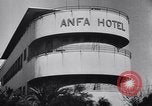
Allied leaders at the Casablanca Conference in Morocco during World War II. Allied forces battle Germans in Algeria and Tunisia
Film begins showing the Anfa Hotel in Casablanca, North Africa. Inside, Allied generals meet to plan further steps in World War 2, against the Axis powers. Charles de Gaulle and French General Henri Giraud are seen walking together at an airport. Closeup of the two. View of Allied General staff members around a table. U.S. principals include Army Chief of Staff, General George Marshall and Air Force Chief, Lieutenant General Henry H. Arnold. Views of General Dwight D. Eisenhower, Supreme Commander of Allied forces, His deputy for land forces, British Field Marshal Harold Alexander, his deputy for sea forces, British Admiral Andrew Browne Cunningham, and his deputy for air operations, British air marshal, Arthur William Tedder (1st Baron Tedder) Outdoors. President Franklin D. Roosevelt and Prime Minister Winston Churchill are seen seated, conversing. Churchill's airplane, named Commando, a very long range Consolidated Liberator II aircraft adapted for passenger transport is seen ready to take him to Tripoli to greet the victorious British 8th Army. Churchill greeting British Field Marshal Bernard Montgomery at Tripoli. Animated map shows battle lines and disposition of Allied forces along the Algiers-Tunisian front. View of German Field Marshal Erwin Rommel inspecting defenses at the Mareth line in Tunisia. Fifteen divisions of German, and 7 divisions of Italian troops entering the front lines. German Panzer IV aus d tanks moving on a dirt road. German infantry marching along a road. Seasoned German troops in camouflaged vehicles. Formation of German Focke Wulf 189 aircraft and view of one dropping bombs. General Rommel pointing to something at the front. Animated map showing the battlefront. (Narrator says German orders were to hold Tunisia at all costs.) View of Rommel, eating a sandwich as he studies document in a defensive position behind the Mareth line. German soldier using periscopic binoculars to view the front. German forces initiating an attack westward driving Allied forces back. Map show German forces advancing beyond the Kasserine pass. Rommel in a staff car, as he learns that the Allied forces have counter-attacked and are driving his forces back to the original battle lines. American infantry marching Eastward to reoccupy Kasserine Pass and beyond, past destroyed German tanks. Rommel's forces make an attack Southward toward the British 8th Army positions. View of new Tiger tank employed by the Germans. A British soldier removes the cover from their new 17 pounder anti-tank gun. View of burning Tiger tanks destroyed by the new British guns. (Narrator says 52 were left burning hulks.)
CRITICALPAST.COM: About Us | Contact Us | FAQs - How to Order | License Agreement | My Account | My Lightboxes | Shopping Cart | Advanced Search | Featured Collections | Website Terms & Conditions | Privacy Policy ©2026 CriticalPast LLC.
License Agreement |
Terms & Conditions |
Privacy Policy
©2026 CriticalPast LLC.