


 Francais
 Deutsch
 Italiano

Refine Your Search
Elizabeth New Jersey 1952 stock footage and images
- Showing 5317 to 5322 of 8486 results more
 Hide
Color Sound
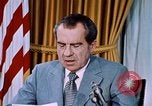
President Richard Nixon gives an energy crisis statement from the Oval Office of the White House in Washington DC.
U.S. President Richard Nixon addresses the nation from the Oval Office of the White House in Washington DC, United States. President Nixon says that lack of energy supplies would bring temporary shortages in fuel supplies and some increase in fuel prices. He says that if energy resources were properly developed they could fulfill American energy requirements for centuries. He says that his administration was going to end quantitative controls on oil imports and establish a national energy office in the United States. He talks about increasing the ability of the United States to prevent oil spills. The President proposes that the Congress should remove government regulations which discouraged the growth of domestic natural gas industry. Secondly, the Congress should help to establish research and ground work for developing new forms of energy for a long range future (alternate sources of energy). Thirdly, the Congress should permit the licensing of new deep water ports to open the way for long delayed Alaska oil pipeline.

Scenes of Charles A. Lindbergh in flights of the Spirit of St Louis.
Charles A. Lindbergh posing in front of his airplane, "The Spirit of St. Louis." The Spirit of St. Louis landing at an airfield in the United States. People gathered around the Spirit of St. Louis, with its engine running.Lindbergh climbing aboard his airplane at Roosevelt Field on May 20, 1927, and taking off on his historic solo transatlantic flight to Paris. View of Lindbergh climbing steeply in the Spirit of St. Louis during his flight from Paris to Brussels, in 1927, Nightime scenes of crowds running to see Lindbergh upon his arrival at Le Bourget airfield in Paris on May 21, 1927. French President Gaston Doumergue stands with Lindbergh on a balcony, where they wave the French tricolor. They converse, framed by American flags (one of which, almost falls from the balcony). Lindbergh holds and waves both the American flag and the French tricolor. The French President presents the Honor Legion Medal to Charles Lindbergh. Tug boats and fire boats fill New York Harbor to welcome Charles A. Lindbergh upon his arrival in that city. New York fetes Lindbergh with tickertape parade.

CCC (Civilian Conservation Corps) workers construct roads and bridges in forests to fight fire.
CCC (Civilian Conservation Corps) in the United States during the Great Depression. Fire control measures taken by CCC shows CCC workers using shovels to dig and build road. Construction equipment in operation. A dump truck loaded with concrete moves along road. Workers construct a bridge. Shows an old house replaced by a new one, as workers work to build a new house. Telephone lines are put up. Men construct a lookout post.

Demonstration of old styles helmet and 16th century gauntlet body armor at an armorer's workshop in United States.
Armorer's workshop in the United States during World War II. Man displays 16th century gauntlet body armor, and 15th century helmets. Various old style and present day helmets. Helmet with steel ear-flaps designed for pilots. A man puts on an armored suit. 16th Century Elizabethan 'Jack' or armored jackets with new type of armor for aviators. Man hammers a helmet. Headless mannequin dressed up with armored suit. Demonstration of how quickly aviator's armor can be released in case of bailouts over water. View of lock on new type of armor.
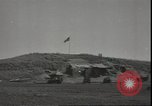
USMC (United States Marine Corps) officers confer at Henderson Field on Guadalcanal during World War II.
American flag flying from a tall flagpole over a hill near Henderson Field on Guadalcanal during World War 2. U.S. Marine officers are seated at a table in a local headquarters tent dug in and sandbagged at the base of the hill, which sits on the edge of the captured Japanese airfield (Henderson Field). One of the officers is looking through binoculars. Nearby, behind them a C-45 transport plane (Beechcraft Model 18) is approached by a fuel truck. Many other aircraft parked aircraft are seen in the distance. Two Marines standing in front of a mound of sandbags discuss something on a clipboard. Several Marines relax in front of a wooden building. Another Marine officer wearing a sidearm joins them with a large map, which they discuss. One of the Marine officers is a Colonel (O-6). Scene shifts to a B-17, tail number 41-2403, taxiing. Next, several B-17s are seen through palm trees, flying overhead. One has its landing gear extended and descends, beyond some trees, to land. Camera moves to a site where pipelines are being repaired by Seabees. A Seabee welder is at work on one. Seabees move new pipe into position on cross ties. (Note: The B-17 Number 41-2403 ditched January 27, 1943, on the way from Guadalcanal to Espiritu Santo, with Brigadier General Nathan Farragut Twining, Commander, 13th Air Force, on board. On 1 February 1943, the U.S. Navy rescued him and 14 others from their life rafts, near New Hebrides Islands.)

North-American Indian students exercise and play sports at Pipestone Government School in Minnesota, United States.
A film surveys federal provisions for the education of the Native American Indians in the United States. A new gymnasium and a new hospital at Pipestone Government School, a boarding school in Minnesota. Boys use lawn mowers in the campus of a school. Athletes lined up. Boys playing football and baseball. Girls playing "kitten ball" which looks like baseball. A boy runs and leaps over another who is stationary for the other boy's vault.
CRITICALPAST.COM: About Us | Contact Us | FAQs - How to Order | License Agreement | My Account | My Lightboxes | Shopping Cart | Advanced Search | Featured Collections | Website Terms & Conditions | Privacy Policy ©2026 CriticalPast LLC.
License Agreement |
Terms & Conditions |
Privacy Policy
©2026 CriticalPast LLC.