


 Francais
 Deutsch
 Italiano
Refine Your Search
Elizabeth New Jersey 1952 stock footage and images
- Showing 5491 to 5496 of 8468 results more
more Hide
Hide
Aviation in U.S. after World War I. Inauguration of air mail. Barnstorming and wing walking
World War One - war is over, Armistice signed. Crowd celebrates and waves flags in New York celebrating end of World War 1. America cuts down its Air services to much extent. American troops march on streets. American airman is decorated by the French. Captain Eddie Rickenbacker,in uniform, in front of line of airplanes, and later in civilian clothes, after leaving military service. Former World War I flyer,and Army Captain Fiorella LaGuardia, parading with American Legion, in streets of New York. Scenes of U.S. Air Mail service inauguration attended by President and Mrs. Wilson, shows U.S. Air Mail wagon and President Wilson holding first air mail letter. Men load mail sacks onto aircraft. Pilot talks to President Wilson. Pilot boards the plane and takes off. .View from an airplane, of a forest fire as airplanes were employed by the Forest Service to watch for fires. Two JN-1 "Jenny" airplanes flown by "barnstormers" after World War I. "Wing walkers" switch from one airplane to the other during flight, to entertain spectators. A Curtis Pusher airplane in flight. Crowds looking up at barnstormers performing with JN-1 airplanes. Wing walker leaves one airplane and grabs hold of another as it passes. One wing walker wears shirt identifying him as one of the so-called "Thirteen Black Cats." Man performs daredevil feats on the wings of the airplane and stands on top of fuselage as the aircraft lands. Many passengers board a large airplane for introductory rides. Interior of airplane shows a lavatory. This is a large twin engine biplane with double main gear wheels and double tail resembling a Caprioni or Handley page design. A man waves his straw hat as the aircraft takes off.
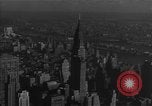
Views of Manhattan Island from a skyscraper building. Chrysler Building. Central Park. Queensboro Bridge. East River.
A view of the Chrysler Building in Manhattan, New York City, United States. The East River and Queens in the background. Central Park is seen from a high building. The George Washington Bridge and Hudson River are far distant to the Northwest. Looking South, from a high building, towards the Battery and tip of Manhattan Island. Brooklyn Bridge in distance to left (Southeast) and Greater New York Harbor in far distance. View from above, of Chrysler Building, with East River and Welfare Island visible, and Queens, beyond. View of Chrysler Building, with Queensboro Bridge over East River and Welfare Island.
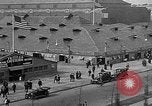
Famous personalities appear before crowds in the United States, in 1916
Famed Evangelist, Billy Sunday before a crowd in New York City. Scottish entertainer, Harry Lauder, raising funds for the Red Cross. French actress, Sarah Bernhardt appealing on behalf of France, during World War 1. Billy Sunday's Tabernacle at Broadway and 106th Street, in Manhattan, New York City, is seen in opening shots of film. Next to it is a YMCA cafeteria, Some cars are parked on the street and some pedestrians stroll along the sidewalk. Scene shifts to inside the Tabernacle, that seems filled to capacity. (It could seat 18 thousand persons.) Camera pans over the crowd. On a stage, Billy Sunday stands next to a desk and removes his tie. Displayed on the wall behind him is a huge patriotic circular bunting. Some men and women also occupy the stage with him. Next, Sunday is seen standing on the desk emotionally haranguing the audience with a fundamentalist Christian sermon. Change of scene to closeup of John Philip Sousa conducting an open air band concert, attended by a vast audience. Closeup of Harry Lauder, famous Scottish singer and comedian. Next, Scottish bandsmen in uniforms, including fur busby hats, crowd onto a raised platform in a park. A sign on the platform refers to B.F. Keith's and the Red Cross. Next, bandsmen are gone and the platform contains seated guests, including a British Army officer and several civilian officials. Harry Lauder is speaking to a crowd of mostly men, from the platform. Scene shifts to closeup of famous French actress, Sarah Bernhardt, seated next to a man in an open car. A huge patriotic bunting is hung in the background. A large crowd fills a park. Some wave American flags. Camera moves back revealing the setting with Bernhardt standing in the car speaking. The bunting is seen to decorate a raised speaker's platform. Her car, which displays the French tricolor flag, is surrounded by spectators. Photographers in foreground stand to take her picture.
Colin Kelly III, son of America's First Combat Hero of WW2, enters the United States Military Academy at West Point.
The Registration Day at the United States Military Academy at West Point. Colin Kelly III, son of America's First Combat Hero during World War 2 enters the United States Military Academy (Colin Kelly Jr who was shot down in his B-17 three days following Pearl Harbor, after bombing the Japanese Cruiser Natori. He remained at the helm long enough to permit his crew to bail out. His own parachute did not open after his bail out). On the Registration Day officers inspect the new cadets. Colin gets the regulation hair cut. A tailor takes measurements. Officers inspect as the new cadets march past.
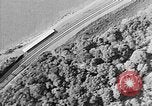
U.S. Army Air Corps B-6A bombers and O-1D observation planes fly over Hudson River and West Point
U.S. Army Air Corps B-6A bombers and O-1D observation planes in formations over Hudson river in New York. View of the Bear Mountain Bridge over Hudson River. Rear view of massed formations as they approach, and fly over the United States Military Academy, at West Point, New York. Groups of cadets, on the ground at the West Point Academy, watch the formations fly overhead.
U.S. Vice President Nixon talks about the foreign policy of America prior to presidential elections in the United States.
The fourth presidential election debate between Democratic nominee Senator John F. Kennedy and Republican nominee U.S. Vice President Richard Nixon on 21st October 1960 in in New York, United States. News correspondent Quincy Howe speaks prior to the fourth Kennedy-Nixon presidential debate. Mr. Howe reads out the rules and conditions under which the candidates will proceed. He says that Senator Kennedy will make the second opening statement and the first closing statement. Vice President Nixon speaks about the present issue in the United States which is keeping peace without surrender. The peace which is threatened by international communist movements. Nixon says that the United States has to learn from mistakes made in past. He relates to this by mentioning the period of the Iron Curtain in Europe and during the Korean War. Nixon says that situation in President Dwight Eisenhower's administration is reversed. He says that the United States made errors in the past in misjudging the Communists, applying same rules of conduct that are applied to the leaders of the free world. Nixon mentions East-West Paris summit conference of 1960 and Eisenhower's policy regarding Formosa Strait (Taiwan). Nixon speaks that that United States should increase its military strength to high level regardless of what potential opponents have and if any surprise attack is launched, the United States can destroy their war-making capacity. Nixon further says that American policies of military strength, economic strength, and diplomatic firmness will keep the peace without surrender.
CRITICALPAST.COM: About Us | Contact Us | FAQs - How to Order | License Agreement | My Account | My Lightboxes | Shopping Cart | Advanced Search | Featured Collections | Website Terms & Conditions | Privacy Policy ©2026 CriticalPast LLC.
License Agreement |
Terms & Conditions |
Privacy Policy
©2026 CriticalPast LLC.