


 Francais
 Deutsch
 Italiano
Refine Your Search
Elizabeth New Jersey 1952 stock footage and images
- Showing 5683 to 5688 of 8468 results more
more Hide
Hide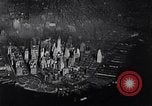
Transcontinental Air Transport (TAT) providing combined rail and air service taking passengers across the U.S.A. from coast-to-coast
Operations of the Transcontinental Air Transport (TAT) Company. Aerial view of New York City's Manhattan Island, below. Camera focuses on Pennsylvania Station (Penn Station) seen from above, and then at street level. Travelers purchasing tickets for combined transcontinental rail and air travel at a window in the station. Families seeing travelers off at one of the railroad gates. Temporary sign at gate reads "The Airway Limited, second section." View of passengers on rear car of train as it pulls out. The car displays Pennsylvania Railroad logo sign reading "The Airway Limited, Pennsylvania Railroad." Views of Pennsylvania RR passenger train and closeup of locomotive wheels in motion. Animated relief map shows train proceeding from New York, past Columbus, Ohio, to Port Columbus station in Ohio. Transcontinental Air Transport, Inc. billboard sign at the station shows picture of passengers connecting between a train and an airplane. Billboard reads: "Port Columbus, Eastern Transfer Point, Air-rail Service, Coast-to-Coast." Passengers leaving the train and entering the station waiting rooms. Their baggage being weighed (Narrator says 30 pounds is the allowance.) View from terminal roof, of a Ford 5-AT-B, trimotor passenger airplane ready to accept passengers for the next phase of their travel. A logo on fuselage has "TAT" with small ribbon through it reading, "Transcontinental Air Transport." View of passengers seated inside the aircraft. The plane taxis and takes off from the Port Columbus airport. Ground is snow-covered, but the runway is plowed. Closeup aerial view of the airplane flying over the city of Columbus, Ohio. Distant view of it flying close to the LeVeque Tower skyscraper (a 47-story Art Deco-style building at 50 West Broad Street). Aerial view of the airplane passing the train, continuing westward, from Port Columbus. Views inside passenger cabin of the plane. Animated map show plane heading to Indianapolis. Officer hands out TAT illustrated map and points out features to passengers. Closeup of map. Aerial view of the airplane on final approach to land at Indianapolis airport. Clerk at airport typing arrival message on teletype, and company executives reading it at their headquarters. Animated map show plane moving to St. Louis, Missouri. View from air of Missouri and Mississippi rivers. Passengers in cabin. aerial view of the plane on final approach, over snow, to St. Louis. The aircraft taxiing on ramp and parking at terminal building, where passengers enter, under cover of awning-covered walk. Closeup of the aircraft engines. Inserted view of TAT engine overhaul facility, with Charles Lindbergh, the airline's technical adviser, and TAT officials inspecting the operation.
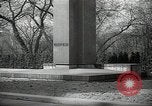
President Woodrow Wilson's statue in a park in Czechoslovakia.
The Woodrow Wilson Monument (New Town, 110 00 Prague 1, Czechia) in New Town, Prague, Czechoslovakia before World War II. President Woodrow Wilson's statue in a park. Written on a wall nearby: 'The World must be made safe for Democracy'. People pass through the park.
French soldiers firing various machine guns in World War I
French soldiers firing a Saint-Etienne model machine gun in a field in France. One soldier waits with a new strip holding 24 rounds of 8mm Lebel ammunition. As the previous clip is done firing, he inserts the new one, and the gunner continues firing. Behind them another gun crew is firing a Maxim machine gun. Next, French gunners are seen firing Hotchkiss Mle 1914 machine guns. Data appears on the screen comparing the machine gun output from the mobilization to 1917. (World War I. World War 1. WWI. WW1)
Devastation from atomic bomb dropped on Hiroshima Japan in World War II
U.S. War Department film showing devastation from atomic bomb dropped on Hiroshima, Japan, during World War 2. Opening scene is darkness of predawn in Alamogordo, New Mexico, on 16, July, 1945, at 5:29:45 AM. Suddenly, a huge explosion lights up the sky. A fireball and mushroom shaped cloud form. Closer view of the explosion from another camera. Following the initial explosion, the ensuing sound is a continuous roar. Another view is shown, from a third camera location. It highlights the boiling fire and smoke of the explosion. These scenes document the first successful test of a nuclear weapon, code named "Trinity". Change of scene shows glimpse of the Manhattan Project B Reactor site at Hanford, Washington, as viewed from a car driving past. Closeup of the facility, from right up against a boundary fence. Glimpses of other Manhattan Project facilities in New Mexico, Oak Ridge, Tennessee, and another view of the Hanford, Washington facility. Next, a rough topographical map of Japan is shown. Closeup of elevated railroad train traveling in Hiroshima, Japan. Imperial Japanese Army motorized vehicles are shown on parade, including fully tracked open personnel carriers with soldiers aboard and Type 94 Tankettes being driven by individual soldiers. Japanese infantry marching in full field gear including shouldered rifles with fixed bayonets. Closeup of a Japanese Army officer. Glimpse of Japanese support troops, such as quartermaster elements, in black uniforms. Japanese technicians in white lab coats at a wartime facility. Japanese Navy Warships being launched from Hiroshima ship yards. A lone B-29 bomber seen in flight over clouds. Its tail number, 42-63735 is clearly seen. It displays a large "05" on it upper tail. (This is not the "Enola Gay" whose tail number was 44-86292.) Closeup of one of the aircraft's engines with propeller turning. Glimpse upward from interior of the aircraft. Scene shifts to aerial photograph of Hiroshima with overlay depicting the bomb strike zone. Animated map showing explosion and precise point ot detonation above the junction of the Motoyasu and Ota Rivers. A view at the ground of destruction from the atomic explosion. An American soldier stands in the midst of the destruction. Slabs of heavy concrete are destroyed. View looking East from ground zero, past a burned tree trunk in the foreground, where the shells of several stronger buildings still stand amidst a sea of rubble. To the South, hardly anything is left standing. Looking West, everything is essentially leveled.
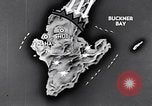
U.S. naval heavy gunfire supporting invasion of Okinawa, Japan, during world War II.
Animation showing disposition and range of Naval Gunfire supporting the U.S. invasion of Okinawa, in World War II. At times 00:25 battleship USS New York, BB-34, and at time 00:33 foreground, heavy cruiser USS Salt Lake City, CA-25; directly behind CA-25 is the battleship USS New York, BB-34; to the right is the battleship USS Nevada, BB-36; to the left is the battleship . all fire heavy guns at Okinawa, Japan. A floating Japanese mine is seen. A Japanese suicide boat. U.S. troops stand by a Japanese suicide "Baka" rocket propelled bomb sitting on a wooden frame. Views of Japanese Kamikaze planes being shot down by U.S. naval antiaircraft fire, at time 00:38 is a Cleveland Class light cruiser firing its forward 6-inch triple mount guns; and time 00:59 to 01:04 a kamikaze flies past the battleship USS Colorado, BB-45 ( in Measure 33/3D camouflage) and past an Astoria Class heavy cruiser. It then explodes on the starboard aft quarter of the USS Idaho, BB-42.
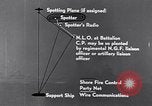
Coordinating naval gunfire during U.S. invasion of Okinawa in World War II. Destroying enemy caves and hideouts
Animation graphic describing how land sea and air information was coordinated to enable precise targeting of enemy positions by naval gunfire during the U.S. invasion of Okinawa, Japan in World War 2. U.S. minesweepers enable capital ships with heavy guns to safely operate close to enemy targets. Views of heavy naval gunfire. Advance of the Marine 3rd Amphibious Corps. U.S. troops, advancing slowly, routing out Japanese defenders dug in to caves and holes throughout Okinawa. Naval heavy guns were called upon to destroy these caves. Detailed live images include: Mine sweepers off Okinawa, sweeping for mines; heavy cruiser USS San Francisco, CA-38, under a head of steam and using signal lights; battleships fire at Okinawa; A bow view of a Tennessee Class battleship; battleship USS Nevada, BB-36, fires its main battery; closeup of a Cleveland Class light cruiser's main aft battery firing at Okinawa; stern view of the heavy cruiser USS Pensacola, CA-24, fires her aft main 8-inch/55 main battery; U.S. Marines on the march and blowing up caves; battleship USS New York, BB-34, fires her main battery; time 03:36 shows a Cleveland Class light cruiser firing its forward main 6-inch battery; time 03:30 shows the USS New York, BB-34, again; various naval guns fire and explosions on Okinawa are shown; time 04:08 shows the forward main deck, looking aft, of the USS Nevada, BB-36, with a Tennessee Class battleship in the background.
CRITICALPAST.COM: About Us | Contact Us | FAQs - How to Order | License Agreement | My Account | My Lightboxes | Shopping Cart | Advanced Search | Featured Collections | Website Terms & Conditions | Privacy Policy ©2026 CriticalPast LLC.
License Agreement |
Terms & Conditions |
Privacy Policy
©2026 CriticalPast LLC.