


 Francais
 Deutsch
 Italiano
Refine Your Search
Elizabeth New Jersey 1952 stock footage and images
- Showing 583 to 588 of 8484 results more
more Hide
Hide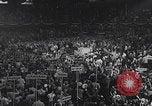
Dwight Eisenhower accepts nomination of the Republican Party for President of the United States
Dwight D. Eisenhower accepts the nomination of the Republican Party during the 1952 Republican National Convention. Attendees hold signs bearing the names of American states at the Republican Party's Convention held at the International Amphitheater (4220 South Halsted Street; Chicago, Illinois 60609; United States) in Chicago, Illinois. Eisenhower raises his arms in front of the audience and accepts the nomination, saying, “I pick up this task therefore in the spirit of deep obligation, mindful of its burdens and of its decisive importance, I accept your summons- I will lead this crusade.” Richard Nixon, Patricia Nixon, Mamie Eisenhower and crowds clapping as Nixon enthusiastically holds Eisenhower's arm in the air in victory.

Specialists at the Kessler Institute for Rehabilitation help the disabled and handicapped to recover.
Handicapped and disabled people at Kessler Institute for Rehabilitation, West Orange, New Jersey. A musician who met with a swimming pool accident plays an instrument with sticks. A physically handicapped boy reads a book. A man at the center is tested on Kohs block intelligence test. A woman puts on makeup after recovering from an accident. The founder, Dr. Henry Kessler talks about special training to be given to the patients to recover from disabilities. Specialists including physical therapists at Kessler Institute help the disabled recover. Disabled clients receiving therapy. A new leg is given to a woman who met with an accident and she takes her first step. Kessler specialist helps the woman to walk again properly.
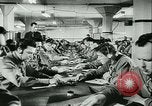
U.S. Army Signal Corps officers train at Fort Monmouth and production of signal communication items in the United States.
The role and contribution of the U.S. Army Signal Corps in combat and war. U.S. Army Signal Corps officers train at the Signal Corps Officer Candidate School (OCS) Fort Monmouth, New Jersey. Officers train at telegraph machines under the supervision of an instructor. Officers seated at desks in a classroom. Instructors take classes with the help of charts, diagrams and black boards. Officers seated atop electric poles for training. Two officers train in hand-to-hand combat at the OCS. Officers learn to use Radio Relay. Students listen to an instructor as he demonstrates the process. A U.S. soldier lays field wire across a hilly terrain to establish wire communications in the European Theater during World War II. Soldiers on the hill. Soldiers set up a sending station at the point where the wire can't go forward. A receiver is set up at the point from where the wire can go forward again. A soldier receives a photograph of a map through facsimile. Items of signal communication including radio relays, receivers, walkie-talkies, radio boxes and fuses to be produced and distributed by the USA Signal Corps to all other ground forces, navy and the Allies. New, modern, improved efficient signal communication equipment. A soldier displays two old type fuses and their counterparts.
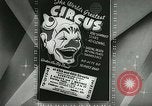
Various Federal Theatre presentations by the Works Progress Administration (WPA) in the United States.
Posters of various Federal Theatre presentations by the Works Progress Administration (WPA) in the United States during the Great Depression. Posters of dramatic theater productions like Macbeth, Battle Hymn, Jefferson Davis, Taking the Air and The Mikado, at various theatres in New York and New Jersey. A painted truck of the Portable Theatre. A puppet show at the "Theatre of the Magic Strings". Children lined up at the theater entrance with the marquee seen announcing "Marionettes" and the box office area. Children laugh during the show with the marionette puppets. A performance of the Gilbert and Sullivan popular operetta Pinafore with actors singing on stage the song "For He Is An Englishman". Actors seen on stage for Sinclair Lewis play 'It Can't Happen Here'. A presentation of the William Shakespeare play "Macbeth" presented by an all African American cast (also termed "Voodoo" Macbeth).
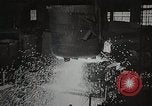
American men and women at work and on holidays in 1950s
Images of life and typical lifestyle in America in the 1950s, including work, leisure and recreation activities. American workers work in a steel plant. Worker with protective goggles near blast furnace at work. Men and women workers in factory assembly lines including a canning factory and a light bulb factory. Woman packaging completed light bulbs at manufacturing plant. Various machines performing heavy industrial labor in the United States. Station wagon assembled on a car assembly line in an American automobile factory. John Deere farm tractors rolling off assembly line. American men and women, white and African American, assembling electrical components. Workers exit their factory after work shift. Labor representatives and corporate managers of a American company in a collective bargaining meeting. Aerial view of a post-war residential suburban neighborhood. Street view in suburb as station wagon drives into driveway of home. Children and wife greet American man coming home after work. Vintage suburban scene with period-typical housewife and family image. Man reads to children in living room while woman sews. 1950s cars on an expressway highway as people go to see a baseball game on holidays. American people watch baseball and football games in stadium during holidays. Baseball scene is in Yankee Stadium in the Bronx, New York City. New York Yankee player with jersey number 8, Yogi Berra, is at bat. Yogi Berra gets a hit down deep down the 3rd base line. Next scene shows a football stadium with an American football game in progress. Scene changes to an American man fishing on a holiday. People working in their home gardens and seated on porches of their homes. American family on a picnic in public park, seated at a picnic table. A young child sleeps, napping during the picnic. Arts and culture: Men and women reading and studying at the Library of Congress. Views of various magazines and books read by Americans. Patrons view contemporary American paintings displayed in a art gallery or art museum. Young American sculpture artists working in an art studio, including an African American male sculptor. Symphony Orchestra performs on stage as audience listens in a concert hall.
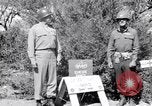
Lieutenant General George S. Patton presents Silver Stars to members of the U.S. Army 39th Infantry, 9th Division, during World War II
Lieutenant General George S. Patton addresses troops from an outdoor stage and then awards Silver Stars for gallantry to members of the U.S. Army 39th Infantry, 9th Division, in Capo Playa, near Cefalu, Italy. Patton awards the medals and then the soldiers form into groups from their respective home states, which include New Jersey, South Carolina, North Carolina, Tennessee, West Virginia, Pennsylvania, and New York. The army band is seen standing near the soldiers. The soldiers parade in front of the officers. Awarded soldiers take off their helmets and pose for photographers. Close-ups of soldiers with medals while flags from the honor guard wave in background. (World War 2. WWII. WW2.)
CRITICALPAST.COM: About Us | Contact Us | FAQs - How to Order | License Agreement | My Account | My Lightboxes | Shopping Cart | Advanced Search | Featured Collections | Website Terms & Conditions | Privacy Policy ©2026 CriticalPast LLC.
License Agreement |
Terms & Conditions |
Privacy Policy
©2026 CriticalPast LLC.