


 Francais
 Deutsch
 Italiano
Refine Your Search
Elizabeth New Jersey 1952 stock footage and images
- Showing 5905 to 5910 of 8468 results more
more Hide
Hide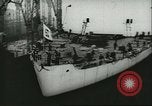
Activities of U.S Merchant Marines and American ships underway in the United States in the 1920's and 1930's.
The legislative and maritime history of the U.S. Merchant Marines in the period between World War 1 and World War 2. Newly launched German, Italian and Japanese ships underway at sea. Ships including the German liner Bremen and the Italian Ocean liner Rex are seen underway. People gather at a dock. American ship underway in heavy seas with waves crashing over. Point of view shot at heavy seas from deck of a ship. A man works in a ship radio room. A man watches through binoculars and uses a sextant. Sailors row a small boat with oars in heavy seas. A sailor decorated by officials of the Merchant Marines. Dock workers and ship construction workers at a shipbuilding yard in the United States working on building new ships. American liners are seen undereway including: SS Washington off shore of New York City skyline and skyscrapers, SS Manhattan also off shore of Manhattan, the SS Lurline, the SS Mariposa, and the SS President Hoover (named for Herbert Hoover) underway at sea. The U.S. flag fluttering from a flag pole. The text of the declaration of policy under the Merchant Marine Act of 1936 is shown.
U.S. Army movies are loaded on and transported by ships, airplanes, dog sleds and camels to remote areas during World War II
Distribution of motion pictures to U.S. Military units during World War II. Men work in an office of overseas motion picture service in New York. Men tying a document related to shipment of films. Men discuss amongst themselves. The films are placed in wooden cases for shipment. Animated map shows various locations. An airplane in flight. Men unload the wooden cases from the airplane. A ship docked in a harbor. Men gather near the ship. A man enters a building in New Delhi, India. A sign outside the building reads: 'India Film Exchange Film Library'. A sign outside other building reads: 'Special Service Section'. Men stand outside the building. A car arrives near the building. The films are transported to remote areas with the help of dog sleds and camels.
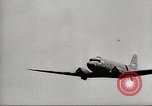
U.S. troops and their improvised movie theaters in combat zones during World War II
A U.S. Army Air Forces C-47 airplane carrying movies among its cargo bound from New Caledonia to troops stationed at Bougainville, Solomon Islands, during World War 2. Views inside the airplane cabin, where troops sit alongside the cargo. Glimpse from cockpit of aircraft on final approach to land on the airfield. Troops unloading canisters of movie films from the C-47. (Handing the movie reels out of the C-47 is Russ Laming of the 13th Troop Carrier Squadron, a.k.a the Thirsty 13th.) Army truck carrying mail bags and movie films driving away from the airfield. U.S. soldiers walk to their makeshift movie tent from foxholes and fortified positions. Sign on the tent reads: "Bougainville Roxy, Tonights feature." Movie projector seen inside the tent, as soldiers enter. Views of movie theaters made out of logs and other available materials at various locations in the Pacific theater of operations. They range from simple and rugged to more elaborate, at rear locations, away from the front lines. U.S. servicemen racing to get the best seats in a theater, as the doors open for a movie. Servicemen walking into an open air theater. They are called to attention as the unit commander arrives and takes his seat. View of wounded soldiers recuperating in a hospital,where a movie camera is being set up in the ward. They are tended by a French nurse wearing a "flying nun" hat (possibly North Africa). Servicemen and women being seated in an outdoor theater, and other places, waiting to watch movies. Allied troops join Americans to watch U.S. movies. A theater sign announcing the week's movie program at a Royal New Zealand Air Force post in the jungles. Courier carrying film canister from a jeep into a jungle theater. Soldier mounting the film on projector. U.S. troops watching a movie outdoors, during rain storm.
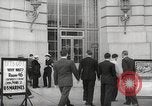
Men gather in a large number to enlist in the the United States Navy, in San Francisco, California, during World War 2
Recruitment of new Navy personnel in a Navy Department building in San Francisco, California. Men gather outside the building. They enter and leave the building. Sign boards outside the building read: "Let's Go Why Wait" and "Arise Americans" encouraging men to enlist in the U.S. Navy and U.S. Marine Corps. A board outside the entrance of the building reads: 'US Navy recruiting'. Military representative seated at a desk inside the building. New recruits gather inside the building and wait in a queue to give their applications to be recruited for posts.
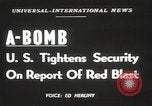
An announcement by President Harry Truman in the United States about the possession of an atomic bomb by Russia.
An announcement by President Harry Truman in the United States. Men read newspapers at news stands announcing nuclear tests conducted by the Soviet Union, proving that Russia has nuclear weapons. President Truman announces that Russia possesses an atomic bomb. A meeting of the United Nations delegates in New York after the announcement. Soviet official Andrei Y. Vishinsky exits a car at the UN and refuses comment to reporters regarding the nuclear testing. Other men greet him. United Nations officials seated inside UN building. President of the UN General Assembly Carlos Peña Romulo addresses the officials and states that the United Nations and the world now must strive harder for atomic controls.
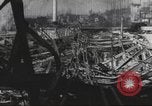
1937 Ohio Valley flood scenes, with major loss of property and life in the United States.
Damage caused by 1937 flood in the Ohio Valley area of the United States. A heavy loss of property due to a flood. Supplies being unloaded from trucks for the people. People being rescued from the areas affected by flood. Men aboard boats moving through buildings on the edge of the Ohio River that are submerged in water. Men moving a wooden casket. Destroyed houses and buildings in the areas. Flooded streets. A weather vane blowing briskly in wind. Narrator details how the weather bureau forecasts the weather and offers the information to help prevent losses from such disasters. Automatic typing machine records weather instrument readings. View of newspapers being printed at a printing press. A radio tower. People gather near injured flood victims. People lined up on the street to get supplies. Scenes of floodwaters below Memphis where flooding was effectively contained. Water rushing under the then new Bonnet Carre spillway of Lake Pontchartrain near New Orleans. Man opens a book published in Lisbon in 1605, now in the Library of Congress, written by Gabriel Lobo Lasso de la Vega, reporting on the exploration team of De Soto on leaf 300 of the book. De Soto's group, in 1543, reported on the flood they saw below current day Memphis, extending over 20 leagues of land, covering the tops of trees, but not overrunning the homes of the Native Americans who build shelter atop high poles. A view of submerged homes in the 1937 flood are shown as the narrator laments that more modern people did worse than the Native American Indians.
CRITICALPAST.COM: About Us | Contact Us | FAQs - How to Order | License Agreement | My Account | My Lightboxes | Shopping Cart | Advanced Search | Featured Collections | Website Terms & Conditions | Privacy Policy ©2026 CriticalPast LLC.
License Agreement |
Terms & Conditions |
Privacy Policy
©2026 CriticalPast LLC.