


 Francais
 Deutsch
 Italiano
Refine Your Search
Etain France 1944 stock footage and images
- Showing 631 to 636 of 9933 results more
more Hide
Hide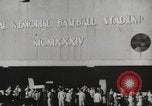
Filipinos attending different sports contests in the Philippines before World War 2.
Sports activities of Filipino people in the Philippines before World War II. Filipinos gather outside the Rizal Memorial Coliseum (Ocampo St, Malate, Manila, 1004 Metro Manila) in Manila, Philippines. Different sports activities of Filipino people. Filipino professional players compete during a baseball competition in Manila. Young indigenous Igorot teenagers play baseball in the Cordilleras Region. Participants swim in a pool during a swimming contest. People gather for a horse-racing contest. They watch the horses and cheer. Filipino men playing Sepak Takraw, also known as kick volleyball. Igorot men engage in amateur boxing outdoors. An American G.I. acts as a commentator during the match. Boys compete in amateur boxing. Filipino boxer Ceferino Garcia participates in a boxing contest. Billboards of American brands such as Chesterfield, Texaco, Camel and Socony to Baguio City. A gas station sign showing the distance to various cities in Northern Philippines. (Film is from 1944, showing scenes from pre-war)
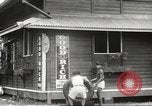
Filipino people working in different jobs, industry, and factories in the Philippines before World War 2
Activities of Filipino people in the Philippines before World War II. A horse-drawn calesa moves through Escolta, the business district of Manila. Billboards advertise Coca-Cola in the Philippines. Activities and quiet scenes at the siesta time. Buildings along the sides of a street. Sign boards outside the buildings read: 'Good Rich' and 'Coca Cola'. A Bahay Kubo (Nipa hut) in the countryside. A horse drinks from trough. A monkey hangs on bamboo pole. A water buffalo (carabao) laze in the mud. Timber trees are felled by men for lumber. Smoke from chimneys of factories. Wooden logs are carried on railroad wagons moving on rails. People work in a sugarcane farm and harvest the sugarcane. Men with Carabaos plow in a sugarcane field. Filipino workers transport sacks of sugar into a ship. Men climb up coconut trees and pick coconuts. The coconuts are loaded into carts. A Filipino man pours out a cup filled with sap from a rubber tree. Men cut tobacco. Filipino women roll tobacco into cigars inside a cigar factory. Men harvesting and slicing abaca (also known as Manila hemp). The processing of hemp. Men shredding Manila hemp into long strands. Shredded abaca are hung outdoors to dry. A machine twines hemp. (Pre war scenes, but from a 1944 film.)
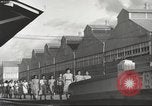
Filipino people going about their routine activities in the Philippines; Filipinos trained by American soldiers.
Part of a 1944 film showing scenes of Filipino people circa 1940, before World War 2. At opening, Filipino women are seen walking alongside a row of factory buildings. A factory room filled with Filipino women dressed in white caps and white uniforms engaged in production at individual individual work stations in a factory. A machine shop filled with Filipino men engaged in metal work. Several people at the window of an office, conducting business with a woman inside. A stock or commodities market office with quotes on tote boards. Women working alongside a moving production line. A woman operating a fabric processing machine. Filipino miners pushing hopper cars of mined ore across a bridge. Miners riding on an engine pulling a train of hopper cars filled with ore from a mine. Filipino longshoremen handling cargoes on a wharf. Scene shifts to an open field where a number of Filipino men are being trained to use firearms during World War 2. One is being coached by an American soldier as he works with a Browning M 1917 water cooled machine gun. Lines of Filipino men firing rifles under supervision of U.S Army trainers. A contingent of uniformed Filipino soldiers, led by an American soldier, marches past a sign, in an camp of tents, reading "A-T Company, 1st Filipino Infantry." Filipino soldiers at a tent camp, being instructed by an American soldier, using a large set of maps. Camera pans over a camp of many tents laid out in order. A formation of Filipino soldiers marches between tents. An American soldier opening his foot locker at his quarters. An illustrated portrait of General Douglas MacArthur. A formation in a field with a Filipino band playing and a Color Guard carrying the American and Filipino flags. A large group of Filipino children walking along a path. A Filipino boy lying on the floor in his home, reading a large book. Filipino school girls seated at benches next to tables. Women doing laundry at an outdoor pond. Next, an actor in khaki clothing sits in a tent and speaks as if addressing American soldiers regarding the Philippines. Among other things, he says,"These people aren't natives. They aren't beggars. They have cities and farms and industries.They have schools and courts and a Constitution. They also have pride and patriotism and self-respect. They love freedom They'll die for it." He cautions American soldiers about their behavior vis-a-vis Filipinos. He states that "Filipinos are American." He alludes to messages received from American and Filipino defenders in Fort Mills, at the fall of Corregidor on May 5, 1942. View of radio towers and worker in radio studio. Morse code messages heard as an American army radio operator with a headset transcribes the messages. Scene shifts to an amphibious invasion fleet attacking a Japanese held island in the Pacific.
First flight of Bell YP-59A aircraft. GE develops J-33 jet engine. First flight of Lockheed P-80 jet fighter.
Official films of the flight of Bell YP-59A Airacomet jet-powered airplane, October 1, 1942. Workers at the General Electric plant in Lynn, Massachusetts, producing versions of increasingly more powerful jet engines: the I-16 with 1600 pounds of thrust and the J-33, with 4000 pounds of thrust. First flight, January 8, 1944, of a Lockheed P-80 shooting star fighter jet powered by the J-33 engine. Formation of P-80 fighter planes in flight. (World War 2 period.)
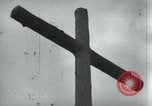
The initial World War II Memorial at Baugnez, Malmedy, Belgium 1945, honoring U.S. POWs executed there by German forces.
The first memorial erected to commemorate U.S.prisoners of war executed by the Nazis during the battle of the bulge (mostly elements of the American 285th Field Artillery Observation Battalion (FAOB), executed by the Kampfgruppe Peiper (part of the 1st SS Panzer Division). This was also known as the Massacre at Baugnez, or the Malmedy Massacre. A wooden cross and a sign reading 'USA - Belgium. To the prisoners of war of overseas who liberated the East districts and were the victims of Nazis cruelty." The wooden cross at the monument to commemorate the massacre of 115 American prisoners at Baugnez on December 17th 1944 during the Battle of Bulge, in World War 2.
United States capture various islands in the Pacific Theater after defeating the Japanese during World War II.
Allied campaign against the Axis in 1944 during World War II. Exteriors of a building in Tehran, Iran where the Tehran Conference took place in 1943. Soviet Premier Joseph Stalin, U.S. President Franklin Roosevelt and British Prime Minister Winston Churchill seated outside the building after the conference. A map depicts United States campaign against the Japanese in the Pacific Theater. U.S. troops land at the Marshal Islands. Troops fire and advance in Palau islands. Soldiers wade through water. Flakes burst and explosions occur at sea near Saipan. U.S. troops advance inland in Guam. A blind soldier walks.
CRITICALPAST.COM: About Us | Contact Us | FAQs - How to Order | License Agreement | My Account | My Lightboxes | Shopping Cart | Advanced Search | Featured Collections | Website Terms & Conditions | Privacy Policy ©2026 CriticalPast LLC.
License Agreement |
Terms & Conditions |
Privacy Policy
©2026 CriticalPast LLC.