


 Francais
 Deutsch
 Italiano

Refine Your Search
Etain France 1944 stock footage and images
- Showing 103 to 108 of 9965 results more
 Hide
Color Sound
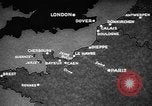
German Army fights Allied infantry and tanks while retreating from the Western Front in Europe, during World War II.
German Army fights with the Allied infantry and tanks on the Western Front in France and England, during the summer of 1944 in World War 2. Animated maps show English and French invasion coastlines. During Battle of Caen, German soldiers load ammunition on a camouflaged truck. The truck driven on roads. A German soldier on truck observes American bombers in sky overhead. Truck parks to the side and German antiaircraft guns fired. Night view from ground of bombs being dropped and buildings burning in the distance in Caen, France. German military trucks move at night on roads passing by burning fires. View from inside cabs of moving German vehicles. Daytime view of heavily bombed and destroyed city of Caen with ruins of houses and shops; German infantry walk through the streets of the destroyed and empty city. German soldiers fully loaded with their weapons ready for a battle. Close views of their faces with determined expressions. German tanks, armored vehicles, and infantry move on roads. Among them are two Borgward IV remote-controlled demolition vehicles (Schwerer Ladungsträger Borgward B IV, or heavy explosive carrier Borgward B IV) each driven by one man. Soldiers of German Army observe approach of U.S. Army forces. A German soldier arranges shells for artillery to fire as they fire on Allied positions. Wehrmacht infantry soldiers advance cautiously along roads. German soldiers take cover and prepare to attack as American tanks pass through a village. German soldiers fire on U.S. Army tanks. German soldiers direct an unmanned, remote-controlled small armored vehicle laden with explosives across a field and detonate it near U.S. Army vehicles (it is known as a Goliath Tracked Mine, or Leichter Ladungsträger Goliath (Sd.Kfz. 302/303a/303b); also known as a "beetle tank" to Allied forces, or a German robot tank). Large explosion as the remote-controlled demolition vehicle is detonated. Dead U.S. Army soldier along a road side, and injured German soldiers are aided by other German soldier
U.S. shuttle-bombing of German positions and military installations under Operation Frantic during World War II.
Film title slate indicates "Operation Titanic" but it, in fact, depicts "Operation Frantic" with U.S. shuttle bombing operations over Germany from bases in Great Britain, Italy and Russia during World War II. United States Army Air Force B-17 Flying Fortresses in flight. Aerial view of bombers in flight with several aircraft flying in formation leaving behind contrails. View inside bomber aircraft with bombardier preparing to drop bombs. View of bomb bay door opening and closeup of hand near bomb drop switch. Bombs awawy view as bombs are dropped from American aircraft. German defenses are bombed along the invasion coast of France (just prior to D-Day) on June 2, 1944. Aerial views of B-24 and B-17 bombers also in flight bombing German military installations in German-occupied northwestern Europe. Aerial view of a target area. Smoke rising up from bombardment. Two different U.S. Army Air Force B-17 Liberator aircraft are seen falling from the sky toward crashes after being hit by German enemy fire. One of them has smoke trailing from it, and the other is in a free fall. Railroad and marshaling yards are also bombed over Debrecen, Hungary on June 2, 1944, with aircraft continuing on (shuttle bombing) rather than returning to base. United States Army Air Forces B-24 Liberator flying in formation on June 21, 1944. Aerial view as they bomb the Focke-Wulf Fw 190 engine aircraft factory near Basdorf, Germany. German factories are bombed. B-17 aircraft on the same date are seeing in formation and bomb railway stations, freight yards, and factory targets, along with the Nazi German Ministry of War, Ministry of Propaganda, and Gestapo headquarters in Berlin, Germany. Heavy flak bursts seen in the air near the aircraft. Dogfight scenes as several German airplanes are shot down. Machine gunners aboard U.S. bomber aircraft firing at German fighter aircraft and shooting down 43 of them, according to narrator. Aerial view of ball turret rotating below bomber and firing guns at German fighter aircraft. The B-17s and B-24s bombing the targets. Synthetic oil plants and refineries are bombed at Ruhland Germany, east of Leipzig. Planning for the operation was done on December 7, 1943. A document about the operation is typed. Animated map shows Nazi positions and method of shuttle-bombing, allowing American aircraft to bomb from Soviet bases, and allies broadly to bomb German targets from bases in the United Kingdom, Italy, and Soviet Ukraine.

A U.S. 8th Fighter Command plane piloted by 1st Lieutenant V.J. France attacks two German Focke-Wulf Fw-190 fighters.
German aircraft attacked by a U.S. aircraft on 21st March 1944 in the European Theater during World War II. A U.S. aircraft of 8th Fighter Command is piloted by 1st Lieutenant V.J. France of 334th Squadron. The aircraft strafes a stationary Focke-Wulf Fw-190 fighter aircraft on a ramp. The aircraft makes a return pass over a field and strafes another Fw-190 which is taxiing.
American troops in England, rehearse for the amphibious invasion of Normandy, France during World War II.
American troops rehearse amphibious landings at Slapton Sands, England in January, 1944, before the invasion of Normandy, France, in World War 2. American soldiers descend from a troop transport ship and board a Landing Craft Tank (LCT 504) that takes them toward the beach. A group of Higgins Boats is seen maneuvering in the water. Their troop transport ship is seen further offshore. Next, a Higgins Boat full of soldiers is silhouetted against the sky and the sun shining on the water. Closeup of Coast Guardsman at the tiller of the boat. Scene changes to a view from the beach as a Higgins Boat, from Transport ship, USS Samuel Chase (APA-26) hits the beach, drops its front door ramp, and soldiers rush ashore. Complete change of scene shows American troops, carrying full battle gear, coming up a gang plank to a large established port terminal, where they go up another gangplank to board a large transport ship.
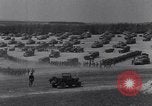
Allied forces gather in British seaside ports and depart in convoys to invade France during World War II
Opening scene shows U.S. troops, tanks, jeeps, and trucks assembled in a sandy marshaling area in southern England preparing to proceed, on 30 May 1944, to embarkation points for the invasion of France during World War 2. Troops are seen heading toward Sherman tanks, landing vehicles, tracked, and other military vehicles. An army Captain is seen overseeing some of the activity. The troops riding armored vehicles and trucks begin moving in formations from the marshaling area. Wading tanks and Sherman tanks, some pulling artillery pieces, are seen moving through an English town.(An unusual deep wading tank with no turret and two forward guns in the front is seen. (It seems to be a modified Stuart tank.) Next, the vehicles are seen arriving at a seaport pier, where a large transport ship is docked. A heavy truck is seen loading in reverse aboard British Landing Craft T 453, at Trebah gardens (Polgwidden cove) at Falmouth docks, Grove place slipway falmouth, England. View from the landing craft as another truck backs into it. Another truck driving forward onto a landing craft. Allied troops marching toward the embarkation points and marching from a pier to board a transport ship. Troops boarding USS LST 376. Troops boarding Higgins boats to be ferried to their transport ship, the USS Samuel Chase (APA-26) anchored in the harbor. Troops stepping from the Higgins boats to board the Samuel Chase. Some of the troops boarding the transport ship by means of a landing net, and being helped aboard as they reach the top. Camera pans across the harbor where transport ships are moving to their places in the invasion convoy. View from a ship underway, with other transport ships behind it and barrage balloons in the air above. Troops on a ship's deck shooting craps with dice. Sailors playing with a small puppy. Soldiers napping on deck. View of sailors on a warship being briefed in groups about their forthcoming combat roles. Troops being briefed about the invasion operations. Troops checking and making sure their personal arms and equipment are ready. One soldier shining his boots. The U.S. battleship USS Arkansas (BB-33) seen at anchor. Closeup from rear of General Dwight D. Eisenhower, British Admiral Sir Bertram Home Ramsay and another officer on the deck of British light cruiser, HMS Belfast. Major General Clarence Ralph Huebner, Commanding General of the 1st Infantry Division ("The Big Red One") standing on deck of the cruiser, USS Augusta (CA-31) together with Rear Admiral Alan G. Kirk, who is later seen with his Chief of staff, Rear Admiral Arthur D. Struble, on the deck conversing with officers. An unidentified American admiral walking along a ship's deck followed by a Captain and other members of his staff. Other officers conversing on a ship's deck. Inserted near this point is a view of a U.S. Navy Vice Admiral walking along a deck followed by a Captain and other naval officers.
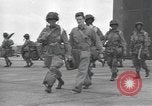
U.S. paratroopers board C-47 airplanes in England for the D Day invasion of Normandy, France in World War 2.
Paratroopers of the U.S. 502nd Parachute Infantry Regiment, 101st Airborne Division, at RAF Station, Greenham Common, proceed, in full battle gear, to board C-47 aircraft for their flight to Normandy, France, on June 5, 1944, during World War 2. Camouflage is seen on their helmets and their faces are blackened. One group is seen boarding C-47, tail number 43-15296. An officer reads briefing notes to them.They don life vests. A Captain and two Sergeants discuss briefing notes.Paratroopers help others who have difficulty climbing aboard the aircraft because of their heavy and ungainly equipment. Ninth Air Force Commander, Lieutenant General Louis H. Brereton speaks to Chaplain, Lieutenant Colonel Louis R. Goodrich, and shakes hands with some of the troopers, wishing them well, as they board C-47 number 42-92847, named, "That's All...Brother."(This was the lead aircraft for the airdrop, just behind the C-47s dropping pathfinders. It was piloted by the commander of the 438th Troop Carrier Group, Colonel John Donalson, and 87th Troop Carrier Squadron Commander, Lieutenant Colonel David Daniel.) The C-47s taxi out for takeoff, as senior officers watch them depart. (Note: There has been confusion about the name of the lead aircraft, C-47, 42-92847, because Colonel Donalson normally flew one named "Belle of Birmingham. " Research, including information from his daughter, indicate that he chose 42-92847, as lead aircraft, because it would have to be cut open to accommodate SCR 717C radar equipment, and he didn't want that done to his favorite airplane.)
CRITICALPAST.COM: About Us | Contact Us | FAQs - How to Order | License Agreement | My Account | My Lightboxes | Shopping Cart | Advanced Search | Featured Collections | Website Terms & Conditions | Privacy Policy ©2026 CriticalPast LLC.
License Agreement |
Terms & Conditions |
Privacy Policy
©2026 CriticalPast LLC.