


 Francais
 Deutsch
 Italiano
Refine Your Search
Etain France 1944 stock footage and images
- Showing 157 to 162 of 9933 results more
more Hide
Hide
President Roosevelt returns to Washington DC after winning a 4th term in the 1944 presidential election.
President Roosevelt returns to Washington after winning a 4th term in the 1944 presidential election. President Roosevelt, Harry Truman, and Henry Wallace ride down Pennsylvania Avenue. Secrete Service Agents ride on running board of the automobile. Scenes of Armistice Day Ceremony at the Tomb of an Unknown Soldier. (World War II period).
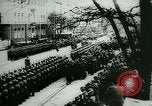
German Colonel General Heinz Wilhelm Guderian is celebrated following his appointment as Army Chief of Staff, in July, 1944, during World War II
Film opens showing German Colonel General Heinz Wilhelm Guderian, who was appointed Chief of Staff of the Army, by Adolf Hitler, on 21 July 1944, in World War 2. He is being feted as the New Army Chief. He reviews a large Honor Guard of German troops who line both sides of a street, in Germany. Local people cheer him from the sidewalks, and he is greeted by several German Youth girls. He steps into a building where other officers greet him and present him with a scale model of what appears to be a Panther Ausf. G tank. He looks closely as another officer points out the model's features. He then writes his name in the city's book of distinguished visitors. Complete change of scene shows General Guderian visiting members of his family, who greet him with kisses at the entrance to their house in Goslar, Germany. Inside their home Guderian shares coffee and cake with them at their dining room table. He and family members then look together through albums of photographs and memorabilia, of his career in the military, including one photograph of General Guderian with Adolf Hitler.

Destruction in coastal northeast USA from the 1944 "Great Atlantic Hurricane" (First example of a named hurricane in the US)
Views of The Great Atlantic Hurricane lashing at northeast United States areas (after having already hit the North Carolina Outer Banks), and views of the aftermath and early cleanup following the storm. Regions shown include Atlantic City, Long Island (where it came ashore as a category 3 hurricane on September 15, 1944), New York City suburbs, and parts of New England. High surf flooding boardwalks and coastal cities. Trees bent over and snapped in high winds. People walking with difficulty in the high winds. Streets of towns submerged in water. Coastal docks destroyed and large boats scattered high onto shore areas. Trees, poles, and wires downed over roads and homes. Entire homes moved off of their foundations and placed down the street. The "Great Atlantic Hurricane" was the first example of a named hurricane by the Miami Hurricane Warning Office, which later became the National Hurricane Center. The name was meant to reflect the hurricane's size and intensity.
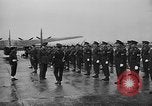
Various Allied Generals assume new commands in Italy during December, 1944, World War II.
On 12 December, 1944, at an airport in Naples, Italy, British General Sir Henry Nathan Wilson inspects an honor guard of American Military Policemen in formation. (Narrator states he is en route to replace the late Field Marshal Sir John Dill, in Washington, DC, USA) A contingent of British troops is also present as part of the honor guard, on the wet airport tarmac. (Narrator states that Wilson will head the British Joint Staff Mission and be personal military representative for Prime Minister Winston Churchill.) He approaches a line of U.S. military officers who salute him. Closeup of General Wilson With U.S. Army Air Forces Lieutenant General Ira C. Eaker, next to U.S. Vice Admiral Kent Hewitt. Also with them (back to camera) is British Admiral Sir John Henry Dacres Cunningham, Commander-in-Chief for the Mediterranean Fleet. Next, General Wilson and his party are seen boarding a British Avro York four-engine Heavy Transport aircraft. View from the ground, of the aircraft cockpit and the engines running as it taxis out for takeoff. Change of scene shows troops gathered in open air battlefield environment. General Mark Clark, now Commander-in-Chief of the Allied 15th Army Group, decorates some members of the 5th Army, as General Lucian King Truscott Jr. (new 5th Army Commander) stands by his side. General Clark says farewell to members of the 5th Army and shakes hands with many of them. (World War II; WW II; World War 2; World War Two)
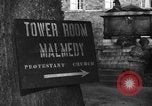
Allied forces counter attack following German offensive on December 18, 1944 (Battle of the Bulge).
Film begins showing a sign in English pointing to the Tower Room of the Malmedy Protestant Church. Views of burning buildings from German counteroffensive (The Battle of the Bulge) begun December 18, 1944 during World War 2. Fire fighter pouring water from a hose. A substantial church building in background. Fire fighters directing stream of water upward onto side of a burning building. Closeup of fire fighter directing stream of water. Ice from fire fighting efforts. Change of scene to British Field Marshal Bernard Montgomery exiting a building with U.S. Major General Matthew Ridgway, Commanding General XVIII Airborne Corps. They greet some British officers. Closeup of Montgomery and Ridgway walking together. A tank and driver silhouetted against light sky. Allied troops riding on a Stuart Light Tank. Armor moving along a rural road. Snow on the ground. British infantry walking in the snow and then marching along a cleared road. Trucks and armored vehicles in the background.Allied troops and vehicles passing substantial buildings, as they advance. Damaged buildings near a rail line. Allied forces advancing through rural area with many trees in background. Animated map showing the Allied push-back against the German offensive, showing British forces under Montgomery pressing from Malmedy and U.S. General Patton's advancing from Bastogne. Glimpse, from above, of allied bomber over enemy target. Bombs away view of bombs dropping from bomber aircraft and detonating on the snowy ground below. Allied troops moving in snow, beside a rail line and into a town. Four Allied soldiers make a fire and warm themselves, beside a parked snow-covered M4 Sherman tank. Then they begin removing snow from the tank. Army truck moving on snow-covered road. A jeep that slid off the slippery road. Other vehicles having difficulty on the snowy road. Trucks continuing to make their way along road through the forest.
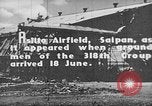
Aslito Airfield as it appeared when ground men of the 318th Fighter Squadron arrived on 18th June, 1944, Saipan Island.
The Pacific Campaign of World War II on the Island of Saipan, Mariana Islands. Aslito Airfield as it appeared when ground crews of the 318th Group arrived on 18th June, 1944. A U.S. Marine as he walks around inspecting the dead bodies of Japanese soldiers. Japanese mess kit showing spilled rice. Several dead Japanese soldiers lying around in the area. Destroyed Japanese aircraft with "NTP-1" written on tail. Demolished hangars and buildings. Fuel drop tanks lying around in the area. Surrounding installations showing the buildings that have been bombed or completely demolished. 804th Aviation Engineers at work clearing the area for camp site using heavy duty equipment such as bulldozers, graders, cranes, and half tracks. Damaged Japanese hangar.
CRITICALPAST.COM: About Us | Contact Us | FAQs - How to Order | License Agreement | My Account | My Lightboxes | Shopping Cart | Advanced Search | Featured Collections | Website Terms & Conditions | Privacy Policy ©2026 CriticalPast LLC.
License Agreement |
Terms & Conditions |
Privacy Policy
©2026 CriticalPast LLC.