


 Francais
 Deutsch
 Italiano
Refine Your Search
Etain France 1944 stock footage and images
- Showing 4615 to 4620 of 9964 results more
more Hide
Hide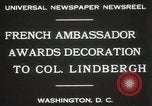
Colonel Lindbergh awarded Legion of Honor.
Colonel Charles Augustus Lindbergh awarded Legion of Honor highest decoration of France by French ambassador Claudel. He is being made Commander in recognition of his memorable flight across Atlantic. 1931.
Rocket motor designs by International scientists and inventors, reflecting early work by German rocket researchers
Designs by various international scientists and inventors who have contributed to solving the problems of rocket motor development, based on the German preparatory work. Their combustion chamber designs owe much to the German pioneers in the field. Shown are design sketches by Russian scientist, Konstantin Tsiolkovsky (Ziolkowsky) in 1914; French inventor Henri Melot, in 1920; German Friedrich Zander, in 1931; Bull, 1932; The American Rocket Society, with several designs from 1932; and The Cleveland Rocket Society. Views of rocket combustion research activity by Ernst Loebell of the Cleveland Rocket Society in 1933. He is seen outdoors in the snow with his apparatus. View of Loebell's test firing stand, and a picture of an actual test firing, outdoors. Ernst Loebell with model and rocket motor from his spaceship projects of 1934 and at the International Exposition dedicated to Art and Technology in Modern Life held in Paris, 1937. Cutaway views of the spaceship. The rocket motor wrapped in cooling coils. Rocket motor design by John Shesta of the American Rocket Society, from 1934. Design by Rene Armengaud of France, in 1934 and Deich in 1935.
Canned crab tins displayed in Japan.
Steamers underway at sea in Japan. The flag of Japan at steamer. Logo of Three Diamond Brand on steamer. Various countries signs on map. The map explains the data of cases of USA, Hawaii, Canada, England, Australia, France, Germany, Denmark, Sweden and others countries for year of 1924-1927. Tins of 'Three Diamond, Fancy CrabMeat'. Tins of 'Icebond Brand, Selected CrabMeat' displayed. Three Diamond Brand of canned crab and logo of Three Diamond.
Japanese actions leading to 2nd Sino-Japanese war and attack on United States at Pearl Harbor in World War II
Japanese army officers examining foreign military equipment. A Japanese worker employing electric drill developed in a Western country. The Japanese freighter, Tatsuno Maru, loading scrap iron at a port in the United States. Other Japanese freighters loading coal and oil for shipment back to Japan. View of the Washington Naval Conference in Memorial Continental Hall, Washington, DC, held in 1921-22 and again in 1927 and 1930, to deal with several lingering issues. Glimpse of Japanese people holding flags while gathered near the Imperial Palace in Tokyo. Glimpse of Japanese army troops on parade. Japanese Navy warships at sea. A fleet of Japanese Mitsubishi G3M bombers and Nakajima Ki-27 pursuit planes, parked on an airfield. A loose formation of Ki-27s airborne. Animated map illustrates Japanese fortification of Mariana, Caroline, and Marshall islands in the Pacific. Animated map illustrating China's greater size and population vis-a-vis Japan. Animated map illustrating Japanese occupation of Manchuria in 1931. New York Times newspaper with headline "Japs Seize Manchuria" hovers over fires burning in Manchuria. Other newspaper headlines reporting on Mussolini's invasion of Ethiopia; the Spanish civil war; surrender of Czechoslovakia; invasion of Poland; assaults on France, Belgium, and the Netherlands by Nazi Germany; the London Blitz; and Nazi advances against Russia on the Eastern Front. Fnally, a Boston Hearald extra edition headline reports: "Pearl Harbor Bombed." A still photograph of Japanese Baron Tanaka Giichi (on left) with two other dignitaries, circa 1929. Japanese infantry streaming into Manchuria and then celebrating as they walk into local town. A busy street in a Chinese city. Japanese soldiers in Manchuria escorting local prisoners along a street. Animated map illustrating Japananese warships surrounding harbor of Shanghai, China. View from a Japanese ship bombarding Shanghai. Smoke rising from shell striking on Shanghai waterfront. View from land of severely damaged buildings on a street, and a shell exploding in background, as Chinese defenders move to successfully repel the Japanese forces. New map illustrates subsequent Japanese move, annexing Jehol, from occupied Manchukuo, and Korea. Japanese troops entering a town in Jehol. Sun newspaper headline: "League Censures Japan." Chinese diplomat protesting at League of Nations. Japanese troops exiting railroad trains in Jehol. Aisin Gioro Puyi aka Henry Pu Yi, Kangde Emperor (Kang-te Emperor) of the Japanese puppet state of Manchukuo, is seen saluting Japanese troops on parade. Closeup of Puyi wearing shaded glasses, looking directly into the camera. chiang Kai-shek, with other Chinese officers. Reenactment of barbarian forces riding against China and thwarted by the Great Wall. Many Chinese walking in a long line along the Great Wall. Map tracing the Great Wall across China. Aerial view of the Great Wall from overflying airplane. Japanese troops marching through a city gate; infantry climbing a sheer cliff; and helmeted Japanese soldiers marching past civilians in a city. Map illustrated progress of Chinese unification by year 1937. Japanese officers conferring during occupation. Japanese troops leave a barracks, riding in open trucks. A line of the troop trucks moving along the dirt street of a town. The troops climb from their trucks in the town.
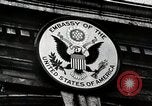
Beginnings of the Second Sino-Japanese war
Sign over American Embassy in China. Colonel William Mayer, former military attache in that embassy relates events precipitating Second Sino-Japanese war. Scenes of the Marco Polo bridge near Peking, on night of July 7, 1937, as Japanese artillery bombards the area. Animated map shows movement of Japanese forces out of Manchuria to occupy Peiping and Tientsin. Victorious Japanese troops stand atop a building, raising their flags and shouting cries of victory. Japanese army officers sit around a table smiling and contended and others walk in a group. Chinese artillery crews are seen retaliating as they fire field pieces at Japanese positions in Shanghai. Shells explode in background, and Chinese infantry advance through damaged buildings and rubble. Animated map shows Shanghai and other cities, and film transitions to view of the bustling city of Shanghai on the Yangtze River. In the seaport, large ocean liners and freighters, as well as tug boats and Junks, are seen. What looks like a Japanese Tachikawa Ki.54 Type 1 transport plane takes off over a Chinese pagoda. Double-decker buses travel through the streets. Rickshaws are also seen. Map outlines the foreign residential areas of the French Concession and the International Settlement. American, British and Japanese flags are shown in the International Settlement. Detachments of troops from Japan, Britain, France, and United States Marines are seen. A U.S. Marine is posted as a sentry at the Shanghai Power Company. Coolies carry heavy bucket on a long pole. British, French and Japanese troops also performed sentry duties. Japanese troops and armored cars are seen. A scuffle breaks out in August, 1937, and Japanese soldiers start moving in trucks, take up firing positions, and begin firing guns from their armored cars. Map shows Chinese counterattack pushing the Japanese contingent toward the Khangpoo River. Next it shows Japanese warships and reinforcements in the Yangtze River and their advance toward Woosung and Shanghai. Views of Japanese warships bombarding the shore and large explosions from their striking shells. Beachhead is shown South of Shanghai, where two divisions of Japanese infantry are seen arriving in landing craft. They advance across the fields toward Shanghai. Map shows Chinese withdrawals to West and South, toward Nanking and Hangchow. Chinese medics along with infantry march in retreat. Japanese pilots are seen being briefed. Next, Japanese Mitsubishi G3M bombers are seen in flight, and bombardiers and other crew in them. Bombs falling on the city. Civilians running for cover as bombs explode. Aichi D3A1 aircraft dropping bombs. The Shanghai waterfront being bombed and civilians running.
Third United States World Trade Fair at the Coliseum, in Manhattan, New York City, 1964
Scenes of fire works. New York city in America. Views of Manhattan skyline and 5th Avenue in New York City. The Third United States World trade fair at the Coliseum on Columbus Circle in New York city. Flags hang on walls in the building. Stalls from various countries around the world like France,Germany,Norway,Italy,India,Venezuela, Japan,Luxembourg and China. Two men ride up on escalator. Men greeted by a Japanese woman at Japanese stall. Japanese woman adjusts flowers kept in a porcelain vase. Japanese Noritake China crockery and furniture on display along with other Japanese merchandise like vase,bowls,scissors. American women check Japanese leather bags made by Matsutaki Company. Bamboo merchandise on display. Silk clothes made by Kanegafuchi spinning company are also on display. 1964-65.
CRITICALPAST.COM: About Us | Contact Us | FAQs - How to Order | License Agreement | My Account | My Lightboxes | Shopping Cart | Advanced Search | Featured Collections | Website Terms & Conditions | Privacy Policy ©2026 CriticalPast LLC.
License Agreement |
Terms & Conditions |
Privacy Policy
©2026 CriticalPast LLC.