


 Francais
 Deutsch
 Italiano
Refine Your Search
Etain France 1944 stock footage and images
- Showing 4915 to 4920 of 9964 results more
more Hide
Hide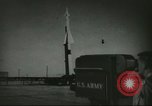
Atomic bomb scenes WWII; atomic testing at U.S. Army atomic experiment station 'Camp Desert Rock' in Nevada, United States
Episode of "The Big Picture", a U.S. Army series of news release programs. U.S. Army cameraman recording Nike missile launch. Atomic cannon fires shell creating atomic explosion and classic mushroom cloud.. Army troops spill out of Sikorsky YH-19 helicopters. U.S. Army infantry soldiers ascend hill firing their rifles. Atomic experiments at Camp Desert Rock in Nevada, United States. U.S. Army Master Sergeant Stuart Queen seated at a desk in his office. He speaks about a series of atomic experiments ("Desert Rock 6") held in barren lands of Nevada at Camp Desert Rock. Celebrating victory in Europe, during World War 2, American troops parade down the Champs Elysees in Paris, France, with the Arc de Triomphe behind them. Happy Parisians watch the parade. War scenes in Japan: footage of explosion and mushroom cloud rising after atomic bomb blast over Nagasaki on August 9, 1945. Barren land on the ground in Hiroshima after the August 6, 1945 atomic blast there . B-29 bombers in flight. Atomic bomb test detonation. Atomic artillery gun M65, also called the Atomic Cannon or Atomic Annie, fires and creates nuclear explosion on distant target.Viking missile launch. U.S. soldiers on parade. Headquarters sign at U.S. Army atomic experiment station at Camp Desert Rock, Nevada, displaying 6-pointed star with "A" in center.. Several atomic test explosions. Soldiers on hillside witness a non-nuclear explosion. Buses carry troops along a road past a sign warning of radiation hazard. Army captain, instructor, briefing troops before the start of atomic maneuvers.. Maps of planned maneuvers. Engineer surveyors lay out ground zero target. View of the ground zero area which is the target area for testing. Signal men lay communication lines to receive and transmit teletype messages. Men operate machinery and dig trenches in which troops will take cover. Other men cover them with sand. [Note: According to the U.S. Department of State, Office of the Historian, from February 18 to May 15, 1955, the United States conducted Operation Teapot, a nuclear test series at Yucca Flat and Frenchman Flat on the Nevada Test Site in the continental United States. During the test period 14 nuclear shots and 1 non-nuclear shot were detonated. Several thousand scientific, military (army, air force, navy, marines), and civilian contract personnel participated in the organization, planning, and execution of the test series. Military exercises undertaken during and following the shots took place under the name Desert Rock 6.]
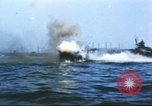
Color scenes of WWII including Pearl Harbor, D-Day, and Pacific campaign.
Montage of scenes dealing with Japanese attack on Pearl Harbor in World War 2. Bombs exploding and ships on fire; Japanese airplane diving from formation; a jeep driving past a burning airplane; hangars burning; Sailors firing anti-aircraft guns from an American ship; A New Orleans class American Cruiser firing her 8-inch guns; A South Dakota Class battleship firing her 16-inch guns; Group of American M3 Stuart light tanks in a field; U.S. Aviation Cadets marching between rows of Boeing Stearman Model 75 training biplanes; American soldiers marching in huge formations; Paratroopers in training jumps from towers; U.S. soldiers climbing down netting on side of troop transport ships to board small landing ships in the Pacific.; Marines in a landing craft carrying a large American flag; Landing craft in an amphious assault; Troops coming ashore from a Higgins boat, during training; An amphibious invasion task force at dusk; Troops wading ashore during the invasion of France in World War II, with barrage balloons aloft and support ships offshore. Staged scene of soldier on transport ship using flash light to read letter from home. Capital warships firing heavy guns and soldiers descending rope nets to enter landing craft. Soldiers landing on shore from Higgins Boats during training, and then on the shores of Normandy during the D-day invasion. American tank crew on an M26 Pershing tank. Major General George Patton with 1st Armored Division patch on his uniform sleeve. General George Marshall. General Dwight D. Eisenhower decorating an officer. Lieutenant General Henry (Hap) Arnold. Paratroopers jumping en masse from C-47 transport planes. German forces retreating in trucks along a road. Japanese General Yoshijirō Umezu, Chief of the Army General Staff, signing Surrender document aboard the USS Missouri, ending World War II, in the pacific. Glimpse of troop ship arriving in a U.S. harbor. View of U.S. military cemetery. Scene shifts to John Charles Daly, speaking in front of wall with names of Medal of Honor recipients, in the Hall of Heroes at the Pentagon, Arlington, Virginia, in 1968.
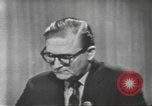
Vice President Nixon and Senator Kennedy debate in the U.S. over a summit conference between the U.S. and the Soviet Union.
The fourth presidential election debate held between Democratic nominee Senator John F. Kennedy and Republican nominee U.S. Vice President Richard Nixon in New York, United States on 21st October 1960. News correspondent John Edwards ask Vice President Nixon about the conditions to be met before meeting Soviet Premier Nikita Khrushchev at Vienna Summit of 1961. Nixon replies that an agenda should be prepared which should delineate those issues on which there is a possibility of some agreement or negotiation. He says that U.S. President should not go to the conference unless they have such an agenda, unless they have some reasonable assurance from Khrushchev that he intends seriously to negotiate on those points. News correspondent Quincy Howe asks Senator Kennedy to comment on the topic. Senator Kennedy says that the U.S. should not go to the summit until there is some reason to believe that a meeting of minds can be obtained on either Berlin, outer space or general disarmament including nuclear testing. He mentions the failure of the conference on May 15th 1960 in Paris, France. He further says it is important that they maintain their determination, that they indicate that they're building their strength, that they are determined to protect their position and that they are determined to protect their commitment.
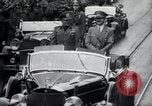
Adolf Hitler, Benito Mussolini, Neville Chamberlain, and Edouard Daladier, sign the Munich Agreement
Signing of the so-called Munich Agreement between Germany, Italy, Britain, and France, in 1938. German Chancellor Adolf Hitler and Italian Dictator Benito Mussolini ride together in an open car enroute to the Führerbau of the Nazi Party, near the Konigsplatz, in Munich, Germany. Each of the Conference principals enters the Führerbau (Arcisstraße 12, 80333 München, Germany). Adolf Hitler, Benito Mussolini, Hermann Goering, Neville Chamberlain, and Edouard Daladier are seen moving about and conversing. They begin signing the accords. Hitler and Mussolini converse together. After the signings, Hitler shakes hands with the French Foreign Minister, Daladier, and the four principals, Hitler, Chamberlain, Mussolini, and Daladier, stand together.
Members of the U.S. House of Representatives view piles of dead bodies at the Buchenwald Concentration Camp in Germany.
Members of the U.S. House of Representatives at the Buchenwald Concentration Camp near Weimar, Germany towards the end of World War II. The group includes Frances E. Walters from Pennsylvania, Eugene Worley from Texas, Carter Manasco and Albert Rains from Alabama, Henry W. Jackson from Washington, Earl Wilson from Indiana, Marion Bennet from Missouri, Gordon Canfield from New Jersey, Major General Vanier of the Canadian Army and Major Walter Mosmiller of SHAEF (Supreme Headquarters Allied Expeditionary Forces) who is in charge of the tour. The group views piles of dead bodies and crematoriums. The group poses in front of a memorial.
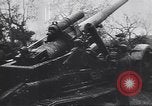
German artillery fires propaganda leaflets in the European Theater during World War II.
Dramatization about German artillery firing propaganda leaflets in the European Theater during World War II. German artillery fires propaganda leaflets towards U.S. soldiers. Two soldiers look at leaflets being fired at them, one of them is an African American soldier. Writing on the leaflet reads, 'What will you get out of this war? Surrender ! Come over to us. Colored soldiers will be well treated in a German camp.' U.S. soldiers continue their attack. German officers surrender at Allied headquarters in France towards the end of World War II.
CRITICALPAST.COM: About Us | Contact Us | FAQs - How to Order | License Agreement | My Account | My Lightboxes | Shopping Cart | Advanced Search | Featured Collections | Website Terms & Conditions | Privacy Policy ©2026 CriticalPast LLC.
License Agreement |
Terms & Conditions |
Privacy Policy
©2026 CriticalPast LLC.