


 Francais
 Deutsch
 Italiano
Refine Your Search
Etain France 1944 stock footage and images
- Showing 547 to 552 of 9933 results more
more Hide
Hide
German troops pass under Brandenburg Gate during Chancellor Adolf Hitler's 55th Birthday celebrations in Berlin.
Celebrations during 55th Birthday of German Chancellor Adolf Hitler on 20th April, 1944 during World War II. A German Eagle statue on a base with inscription to the effect that our walls may be broken but not our hearts. A youth raising a Nazi flag on top of a building. People and troops march through the Brandenburg Gate in Berlin. People set up Nazi flags amidst rubble, and a woman sets up a sign reading that our walls may be broken but not our hearts. Demolished building in the background. People buy newspapers at a newsstand.
U.S. Major General William O. Butler gives address on third anniversary of Tuskegee Army Airfield, during World War II.
Final segment of "Army Air Forces special film project 151" known as "Wings for This Man". Third anniversary of United States Army Tuskegee Army Air Field being celebrated in August, 1944 during World War 2. Tuskegee Airmen U.S. African American cadets march. Commanding General U.S. Army Air Forces Eastern Flying Training Command addresses the cadet soldiers, families and spectators assembled. Cadets march at the ceremony. P-40 airplanes seen parked at the airfield. Several P-40s taxiing. (note: narrated by Ronald Reagan)
Japanese bomber makes a suicide attack on USS Franklin (CV-13) underway in the Pacific during World War II.
Japanese suicide bomber plane crashes on deck of USS Franklin (CV-13) underway in the Pacific Ocean on 30th October 1944 during World War II. Japanese kamikaze plane approaches in flames. Planes burns on flight deck of Franklin due to suicide crash. Men fight fire that breaks out on deck and among the on deck aircraft. Smoke billows up through flight deck from fire on hangar deck. Men fight fire on hangar deck. Injured man. Crew with fire hoses directed at hole on flight deck. Body of burned crew man. Navy crew fight the fire. Crew push a destroyed aircraft off the carrier into the ocean.
United States Army Air Forces bombers bombard Siena, Italy and provide air support to U.S. 5th Army during World War II.
USAAF (United States Army Air Forces) squadron provides air support to U.S. 5th Army in Siena, Italy during World War II. Animated map of Italy highlights Siena. USAAF bombers taxi and take off from an air strip. A formation of bombers in the sky over Siena. Bombs are dropped over Siena on 11th April, 1944. Smoke billows up from explosions.
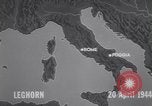
United States Army Air Forces bombers bombard Leghorn, Italy and provide air support to U.S. 5th Army during World War II.
USAAF (United States Army Air Forces) squadron provides air support to U.S. 5th Army in Leghorn, Italy during World War II. Animated map of Italy highlights Leghorn. USAAF bombers drop bombs over the port of Leghorn on 20th April, 1944. Smoke billows up from explosions.
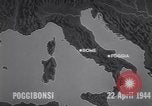
United States Army Air Forces bombers bombard Poggibonsi, Italy and provide air support to U.S. 5th Army during World War II.
USAAF (United States Army Air Forces) squadron provides air support to U.S. 5th Army in Poggibonsi, Italy during World War II. Animated map of Italy highlights Poggibonsi. Aerial view of bombs being dropped by USAAF bombers over Poggibonsi on 22nd April, 1944. Smoke billows up from explosions on the ground. Aerial view of clouds of smoke rising from the city.
CRITICALPAST.COM: About Us | Contact Us | FAQs - How to Order | License Agreement | My Account | My Lightboxes | Shopping Cart | Advanced Search | Featured Collections | Website Terms & Conditions | Privacy Policy ©2026 CriticalPast LLC.
License Agreement |
Terms & Conditions |
Privacy Policy
©2026 CriticalPast LLC.