


 Francais
 Deutsch
 Italiano
Refine Your Search
Etain France 1944 stock footage and images
- Showing 553 to 558 of 9933 results more
more Hide
Hide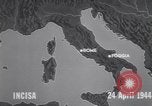
United States Army Air Forces bombers bombard Incisa, Italy and provide air support to U.S. 5th Army during World War II.
USAAF (United States Army Air Forces) squadron provides air support to U.S. 5th Army in Incisa, Italy during World War II. Animated map of Italy highlights Incisa. Aerial view of bombs being dropped by USAAF bombers over Incisa on 24th April, 1944. Smoke billows up from explosions on the city.
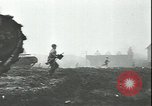
The U.S. Army Signal Corps in War and Peace. Descriptions and demonstrations of VT (proximity-fused) munitions
Opening scene shows troops of the U.S. Army 101st Airborne Division engaged at Bastogne, Belgium, during the Battle of the Bulge, in 1944, during World War II. They advance through fires and set up defenses in buildings, firing rifles from apartment windows. Outside, riflemen fire from behind a concrete barrier. Closeup of one firing his M1 Garand rifle. Glimpses of infantry firing mortars and walls falling to mortar fire. Gun crews firing heavy field artillery pieces, some under camouflage nets and others in the open. Intervening slate reads: "VT." and introduces postwar discussion of Signal Corps-developed proximity fuse, using animated cartoon. Shows how it proximity shells increase their explosive envelope compared to regular time fused munitions. U.S. Army gunner fire a number of proximity shells that burst above ground targets in the distance. A cartoon shows the proximity fused munition being used by a fighter aircraft. A Republic P-47 fighter plane is seen firing VT munitions from guns in its wings. Aerial bombs falling. A line of VT bombs exploding above ground.
Funeral of German General Günther Korten in World War II. Hitler visits other victims of bomb plot, in hospital
Camera pans across the Tannenberg Memorial courtyard where Nazi military hierarchy is gathered for the funeral of General Günther Korten, Chief of the General Staff of the Luftwaffe, who died from injuries suffered in the assassination attempt on Adolf Hitler in July 1944. German military Honor Guard and band are seen in background as Marshal Hermann Goering expresses his condolences to the General's widow and relatives. Closeup of a German soldier and of the bereaved. Scene shifts to view from above and behind the flag-draped casket of General Korten, as Goering, standing in front of it, salutes with his Marshal's baton. Field Marshal Wilhelm Keitel, Grand Admiral Karl Dönitz, and other senior military officers all salute. Soldiers bring a large wreath forward and Goering places it before the casket and salutes. View of the flag-draped casket with helmet and dagger atop it. Pall bearers lift the casket shoulder height and proceed to carry it into a tomb in the memorial building. In a complete change of scene, Adolf Hitler is seen walking with a medical officer into a military hospital in Rastenburg, where he visits German Army officers, who were injured, in the July 20th bomb plot against him during World War 2. He visits Major General Walter Scherff; Navy Captain Heinz Assmann; Rear Admiral Karl-Jesco von Puttkamer; and General Walther Buhle. He takes time and speaks with each of the wounded officers. Women nurses, assembled outside, render Nazi salutes, and cheer Hitler as he departs.

U.S. troops set up a field kitchen and mess in Eygelshoven, the Netherlands, during World War 2
View from hill, above, of U.S. Army troops, from the 3rd Battalion, 115th Regiment, 29th Division, who have set up a field kitchen and mess along the side of a road (Nieuwenhagerweg) in Eygelshoven, the Netherlands, during World War II. Closeup of the troops in a chow line, receiving food in their personal mess kits. Closeup of one soldier's mess kit with his ration. Closeups of smiling soldiers and views of some eating their meals. [Note: In the first 10 seconds, two churches can be seen in opposite corners of the background.The oldest, on the right, sheltered US soldiers. The other, on the left, was hit by German shelling around December 20, 1944. U.S. soldiers of the 562nd Anti-Aircraft Artillery Battalion, Automatic Weapons (Mobile), Battery D, patched the hole in the church roof.]
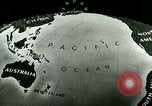
African American soldiers engaged on all fronts in World War 2
Film opens with map of the world showing the various theaters of operation in World War II. Narrator refers to Allies liberating town after town, as they advance. View of American troops being welcomed in a European town during an advance (probably Italy in 1944). Next, African American troops are seen boarding troop transport ships. A huge convoy of ships is seen from the air. Huge piles of war materiel on a dock. Ammunition being delivered by landing craft from the transport ship USS Hunter Liggett (APA-14) to American troops at a beachhead in the Pacific. An African American sailors directs the lowering of a piece of artillery from a ship into a landing craft. Construction equipment being used to clear the way for a new landing field. Docks, roads, and bridges being built as the Allies advance. American troops in the swamps of the South Pacific. American Army engineers clearing trees to build the Alaska Highway (ALCAN Highway) in 1942. Corps of Engineers building the Ledo Road (from India to China) during the war. African American soldiers building a bridge across a river in Europe. A U.S. Army truck under fire, driving along a dirt road in Europe as shells burst all around it. U.S. troops firing various kinds of field artillery and tank guns. U.S. infantryman using a flame thrower. Closeup of African American soldier using a bayonet and others firing small arms. A tank being blown up by artillery fire. A Japanese Mitsubishi A6M3 Zero aircraft maneuvers overhead in the Pacific theater. An African American soldier runs to man his Browning .50-caliber, water-cooled antiaircraft machine gun, and begins firing as the Zero fighter plane strafes his position. Closeup of Japanese pilot in his cockpit and his machine guns firing from leading edges of his plane. His rounds strike all around the U.S. gunner, who turns and follows him with more fire. His tracers show behind the plane. Closeup of the African American gunner as he continues firing. View of the Japanese airplane rolling over and diving. Next the Japanese plane, aflame, crashes on a tropical island and explodes. (Note: It is apparent that some of these combat scenes have been made up of clips from other sources, edited into this film.) (World War II; WW II; World War 2; World War Two)

U.S. A-36 Invader aircraft bombards marshaling yards and communication lines in Furbara, Italy during World War II.
Air attacks against Italy during World War II. A map of Italy shows the location of Rome. U.S. Army Air Forces A-36 Invader aircraft in flight over Furbara to strafe marshaling yards, communication lines and railroad bridges. An aircraft dives and drops bombs. Billows of smoke rise as the bombs hit the target on April 14, 1944. Another A-36 aircraft drops two 500 pound bombs. Smoke rises after an explosion.
CRITICALPAST.COM: About Us | Contact Us | FAQs - How to Order | License Agreement | My Account | My Lightboxes | Shopping Cart | Advanced Search | Featured Collections | Website Terms & Conditions | Privacy Policy ©2026 CriticalPast LLC.
License Agreement |
Terms & Conditions |
Privacy Policy
©2026 CriticalPast LLC.