


 Francais
 Deutsch
 Italiano
Refine Your Search
F-86 stock footage and images
- Showing 115 to 120 of 2472 results more
more Hide
Hide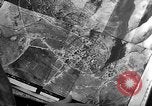
U.S. Douglas A-20 Havoc (aka Boston) aircraft take off from airfield in North Africa during World War II
North African Campaign in World War 2. U.S. Army Air Forces fliers of the 47th Bomb Group, , assemble for mission briefing outside a large tent at Allied airfield in North Africa, in World War 2. They look at aerial photos of targets. Red Cross women hand out refreshments to fliers. Crew members climbing, via top canopy, into an A-20 solid nose model Havoc bomber (called Boston, in British service). The aircraft is named "Boomerang." Numerous bombs are painted on its side for missions completed. An A-20 (with glass bombardier nose) is starting engines, as fireguard stands nearby. It has 38 bombs painted on its fuselage. A-20s taxiing for takeoff. One, of the 97th Bomb Squadron, with number 80 painted on its tail, takes off. A parked A-20, number 72, of the 86th Bomb Squadron. An instantaneous glimpse of several British Spitfire aircraft parked on the field. The bombers are seen flying in formation overhead. Closeup of one inflight. Aerial view of target area below. Waist gunner firing downward from a B-26 aircraft.
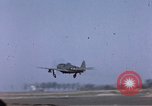
P-47D Thunderbolt fighter planes take off with bombs in Germany during World War II
P-47D Thunderbolt fighters of the 386th Fighter Squadron (coded "D5"), 365th Fighter Group, in Germany, in final days of World War 2, in Europe. The P-47s take off from a runway carrying bombs. A P-47 without bombs taxis after landing. Note: Location is possibly at Fritzlar Airfield (Y-86)
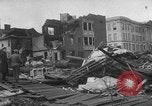
Devastation in Elizabeth, New Jersey residential neighborhood after American Airlines plane crash; also mid-air explosion of plane at British air show.
Major catastophe events of the year 1952. Views of destruction on the ground in Elizabeth, New Jersey, after American Airlines flight 6780, a Convair 240, crashed into a house at Williamson and South Streets on January 22, 1952. Burned wreckage and devastation seen at the crash site in Elizabeth following the crash and subsequent explosions damaging or destroying multipole houses in the 600 block of Williamson Street. In the first few seconds of the clip, the Battin High School for Girls is seen in the background. The school was adjacent to the crash but not hit. Narrator also describes the crash of an Army transport plane in California which killed 86 soldiers, but no images of that crash are shown. Next scenes shift to England, on September 6, 1952, as a de Havilland DH.110 jet aircraft, piloted by John Derry, explodes in midair after achieving Mach 1 and then beginning a left bank and climb at 450 knots during the 1952 Farnborough Airshow. Spectators at the British air show are seen on the ground in the area below the explosion and where debris rained down on the crowd causing deaths and injuries. Engines from the blown-up DH.110 plane (prototype, ID WG236) are seen hurtling through the sky toward Observation Hill immediately after the mid-air explosion. Scenes show crowd working to tend to the wounded and shocked families and children crying.
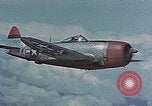
P-47 aircraft in flight over clouds.
A Republic P-47D Thunderbolt aircraft, with bubble canopy, in flight over clouds as seen from another plane flying extremely close. At one point, the two airplanes move a little too close as slipstream of lead plane (unseen) forces the P-47 to adjust. The P-47 has tail number: "226716" and "K" and "E4" are painted on its fuselage which indicates it was one of the P-47D-27s of the 362nd Fighter group, 377th Fighter Squadron (or later, of 86th Fighter Group, 525th Squadron). Slate at start notes the P-47 footage was shot by Air Force Lieutenant Colonel William Clothier, a famous cinematographer.
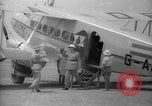
General De Gaulle greeted by Colonel Leclerc on his arrival at Fort Lamy in French Equatorial Africa, in World War II.
French General Charles De Gaulle descends from a De Havilland D.H.86 airplane at Fort Lamy in French Equatorial Africa. He is greeted by Colonel Leclerc and town dignitaries. Accompanying the General are General Spears, Lieutenant Colonel Gosset and Captain Decourcel, Aide-de-camp to Charles De Gaulle. General Gaulle meets town personalities on arrival. He inspects troops. General Gaulle and General Spears walk. Troops march. Generals salute marching troops. Natives line up street and troops march away. Colonel Leclerc takes salute. Native troops march away. General Charles De Gaulle and Spears arrives at the House of Colonel Leclerc. Guards of honor lined up.
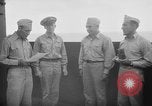
Captain Switcher awards medal and congratulates Lieutenant Commander Dodson on USS Wasp in the Pacific Ocean during World War II.
Activities abroad United States Ship Wasp in the Pacific Ocean, during World War 2. Commander Joseph C. Clifton, Executive Officer of the USS Wasp, reads citation accompanying medal to be awarded to Lieutenant Commander, Cleo J. Dobson, Commanding Officer of Squadron VF-86. Captain of the Wasp, Captain W.G. Switcher, pins the medal on Dobson. (Note: Downing of the last Japanese plane of the war, has been attributed, by some sources, to Dobson.)