


 Francais
 Deutsch
 Italiano
Refine Your Search
F-86 stock footage and images
- Showing 1231 to 1236 of 2472 results more
more Hide
Hide
Battle for Leyte Gulf between the Allied naval-air forces and the Japanese naval-air forces in region of Philippine island of Leyte during World War II
Documentary titled 'Battle for Leyte Gulf' depicts the battle fought between the Allied naval-air forces and the Japanese naval-air forces in Pacific waters off the Philippines, in World War 2. Montage of views chronicling the battle, opens with aerial views of pacific islands seen through clouds followed by glimpse of numerous ships maneuvering far below. Port bow views of U.S. New Mexico class battle ship, followed by the USS Pennsylvania (BB-38) of the 7th Fleet. Glimpse of troops on landing craft and charging across an island. Transport ships underway. Cruisers and battleships firing their guns. An Essex class aircraft carrier silhouetted against the horizon. An F6F aircraft comes up on elevator to flight deck next to the island on the USS Enterprise (CV-6). It has white triangle on tail containing its number. An F6F taking off from the Enterprise. Formation of U.S. aircraft in flight overhead. Gun crew firing twin bofors 40mm anti-aircraft cannon. Flak bursts and tracer bullets seen in the sky as a Japanese warplane falls. Gun camera footage of American aircraft strafing Japanese aircraft on ground at an airfield. View, from an aircraft carrier, of a Mahan class destroyer traveling to her port side. Glimpse of two ships close together during refueling operation at sea. Animated map dominates remainder of the film. It illustrates movement of Task Force 38 to Okinawa on 10 October 1944 and launching of aerial attacks. the map shows further maneuvers and activities of the task force. During these activities, Narrator notes that the cruisers USS Canberra and USS Houston are torpedoed and taken in tow. Animated propaganda cartoon depicts Japanese naval commander (speaking accented English) talking about Japanese naval prowess. Glimpse of Japanese sailors cheering. Animated map continues showing maneuvers of U.S. task forces. Narrator notes the Houston is again torpedoed. Animated map continues to illustrate movements and attacks against Luzon and amphibious landings on outpost islands in Leyte Gulf.
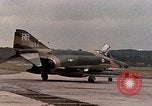
U.S. aircraft participating in a NATO military exercise
McDonnell Douglas F-4 Phantom II fighter aircraft of the United States Air Forces in Europe (USAFE). Views of the F-4D Phantoms on the airfield, taking off, and then in the air. A USAF General Dynamics F-111 Ardvark aircraft taxis on the airfield. F-4s are seen in formation in a NATO military exercise. They fire rockets and drop bombs on ground targets including a watch tower. Explosions, fire, and smoke are seen. The watch tower in flames. A uniformed military observer watches from the ground.
USAF aircraft attacking targets during NATO live fire exercise in Europe
A NATO military exercise in Europe. U.S. Air Force F-4s and F-105 aircraft are seen dropping a variety of ordnance, including demolition bombs, antipersonnel bombs, and mixtures of both. F-4s seen dropping napalm. Air to Air and Ground to Air views of the aircraft attacking targets. Also seen are air-to-ground guided missiles being launched from airplanes. Two U.S. Air Force Captains in flight gear, approach and pose by a ladder in front of an F-111 aircraft parked on the ramp (possibly at RAF Upper Heyford).
18th Fighter Bomb Wing of the U.S. Air Force in Korea.
P-51 aircraft of the USAF 18th Fighter Bomber Wing, at Chinhae Base (K-10) in Korea. Some, from the 12th fighter bomber Squadron, are seen with shark's teeth painted on their noses. Several P-51s in a line ready to take off. F-51s as they take off. A jeep in the background. Three stationary R-5s behind the jeep. Formation of F-51s in flight. Aircraft parked on the ramp. Formation landing of F-51s. Men signal and direct F-51s on the ramp. Several ground crew members on the ramp. (Korean War)
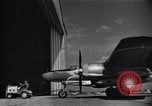
Use of artificial lightning equipment in Project Thunderstorm, and radar operations supporting project and its aircraft
Tug tows Northrop F-15 Reporter into hangar in Minneapolis, Minnesota to be instrumented for Project Thunderstorm. Various scenes of electrical equipment used in making man-made lightning, including a generator made up of hundreds of transformers, and a connected massive generator for producing high voltage. A large oscillograph is shown along with a smaller oscillograph designed for airborne use. A scientist is seen inside the giant generator. Artificial lightning tests are made on canopy of the F-15 occupied by a scientist, and the canopy remains intact following lightning strike. Lightning rods are attached to lightning-vulnerable nose, tail fin, and wing tip locations of the Project Thunderstorm aircraft. Pilot climbs into canopy of F-15. Airborne F-15 project aircraft seen in flight headed toward area of dark clouds. In Ohio at Clinton County Army Air Field, a project officer (AAF Captain) describes how search procedures of the pilot, weather observer, and radar observer are coordinated and key locations of radar and cooperating facilities at Jamestown and the Clinton County Army Airfield. Large radar antenna revolving on top of large tower, scanning for signs of thunderstorms. Radar antenna scanning vertically, near Quonset huts. Command center inside a quonset hut with project personnel at radar scopes and thunderstorm and aircraft positions plotted on large plexiglass screens. Technician adjust motion picture camera that photographs radar scopes every four seconds. Operator at vertical measuring instrument, showing reflected returns from targets, on July 18, 1947. View of operator at plan position indicator radar scope showing weather returns on June 6, 1947. Ground Control Approach (GCA) truck located near end of airfield to guide landings of Thunderstorm aircraft. Radio operators sitting at radar scopes inside the GCA unit. P-61 makes GCA approach and landing in good weather, to maintain skills needed when weather is bad. Briefing officer at blackboard cites radio channels to be used for various purposes. View of AAF aircrews in audience.
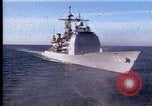
221st anniversary of Navy celebrated at Aircraft Carrier Theodore Roosevelt in Norfolk Virginia.
U.S. Navy Marine Corps newsreel from 1996. Opening scenes show glimpse of the USS The Sullivans (DDG 68) followed by a Green shirt giving signal for catapulting of an F-14 Tomcat aircraft from an aircraft carrier. Next the USS Theodore Roosevelt (CVN-71)is seen underway. Behind a waving U.S. flag, the destroyer, USS Barry (DDG-52) is seen in the distance. Closeup of the fast attack submarine, USS Atlanta (SSN-712) surfacing with a huge splash. Petty officer Terry Mathis and Petty officer Ron Flanders hosting the program, are seen outdoors at U.S. Naval Station, Norfolk, Virginia, on the Navy's 221st Birthday. Scene shifts them speaking as they walk along the empty flight deck of the USS Theodore Roosevelt. Suddenly a slate, reading,"March 1996, Crisis Looming?" overlays view of the USS Theodore Roosevelt. An F-14 aircraft takes off from a carrier deck. An amphibious assault ship is shown. Red shirts moving ordnance aboard a carrier. An F-14 being catapulted. Four segment split screen shows a Landing Craft Air Cushion (LCAC); a marine aiming a weapon; an amphibious assault ship; and President Bill Clinton, wearing a flight jacket and a cap identifying the USS Theodore Roosevelt (CVN-71) as he speaks during a visit to that ship. Full screen of the President, is followed by another F-14 being catapulted. Scene shifts back to empty deck of the Theodore Roosevelt. Petty Officer Demetrios Adams is introduced. Noting that their catapult is in some maintenance activity, Adams describes its operation. Below decks in the bomb assembly shop, Aviation ordnanceman 2nd class Joel Bell, who describes assembling 500, 1000, and 2000 pound bombs seen behind him. Next, Petty Officer Charles Warren is introduced in the jet shop. Standing near jet engines he describes duties of his shop. Next, in damage control central, Electrician's mate, 1st Class, Jack Rickart, explains his duties (mentioning two nuclear reactors). At the flight deck control board, Petty Officer, Michael Knowles tells about the flight deck "Ouija board." Program hosts are back on flight deck next to ship's "Island." Sailors approach in dungarees. Others are shown at work on the ship. The USS Albany (SSN-753) moving on surface. Sailor Layton McGaw,Landing Craft chief Engineer speaks briefly. Sailor Jackie Tatum, Air Traffic Control Supervisor, speaks, and is seen in the control tower. Corpsman Donald Abele, talks of his responsibilities and is seen treating a sailor's foot. A Landing Craft Air Cushion (LCAC) headed to shore, and interviews with LCAC navigator, Christopher McCoy, and Chief engineer Andrew Sebastian. Interior of LCAC. Hosts in Primary flight tower. A sailor receiving a warfare pin. A submarine on the surface. Sailor Richard Cooper discusses the warfare pin. Sailor Ron Schneider, on the USS Barry, discusses it. Views inside a submarine. Sailor Jeffrey Strickland on the USS Atlanta, and Curtis Sears,on the Roosevelt.