


 Francais
 Deutsch
 Italiano
Refine Your Search
F-86 stock footage and images
- Showing 1225 to 1230 of 2472 results more
more Hide
Hide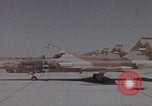
Iranian Air Force jets and pilot training.
Aircraft from the Imperial Iranian Air Force fleet includes United States McDonnell Douglas F-4 Phantom II and Northrop F-5 fighter jets. A row of Northrop F-5 fighter jets at an airfield in Iran. Sign in English and Persian reads “31st T.F. (Tactical Fighter) Squadron”. Imperial Iranian Air Force pilots attend class. A map of the Middle East showing flight paths, radii, flags of the various Air Forces in the region. Flags and roundels of the Soviet Union, Iran, Iraq, Lebanon. A bomb is installed into a jet fighter-bomber. A fuze is fitted into the bomb nose. A man wearing a jacket with an “F-5 Iran” patch. Iranian military pilots run out of a building and board trucks.
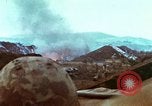
U.S. Air Force Military Airlift Operations in 1968 during the Vietnam War, and during 1976 border tensions in Korea
View from a U.S. Marine bunker as enemy shell explodes nearby, during the siege of Khe Sanh in 1968 during the Vietnam War. The United States Marines in the Battle of Khe Sanh firing mortars and a 105mm howitzer from their bunker. Enemy shells exploding on the tarmac, where American Air Force C-130 aircraft are parked. Marines rushing wounded comrades on stretchers, to C-130s for evacuation. Scene shifts to U.S. Marine Corps Lieutenant Colonel James P. Sheehan, standing at Camp Pendleton, California. (He was a company commander in the siege at Khe Sanh.) As he describes the C-130 aircraft support operations, a contingent of marines marches past, behind him. Scene shifts to a civilian narrator standing in the Military Airlift Command (MAC) Headquarters Command Center at Scott Air Force Base, Illinois. Among other things, he describes MAC support to the Tactical Air Command in Korea. Camera focuses on MAC air routes in the vicinity of the Philippines, Japan, and Korea. Next, is seen view of airfield at Mountain Home Air Force Base, Idaho, briefly at sunset, and then at night, as pilots of the 366th Tactical Fighter Wing and their F-111 aircraft prepare to depart for Korea, in response to border tensions, in August, 1976, after North Korean forces killed two American officers ("Korean Axe Murder Incident" and resulting "Operation Paul Bunyan"). Ground crewman directs a taxiing F-111 using lighted wands. The F-111s takes off. One of them is seen landing after the 7 thousand mile flight to Korea, as Major Paul Malandrino,Jr. (unseen) of the 366th Wing, speaks about MAC's airlift support. A C-141 MAC aircraft is seen landing. View of a C-141 with tail doors open and its cargo of military equipment on the ramp behind it. Glimpse of a marine with rifle and earphones, guarding equipment on the airfield ramp. Closeups of F-111 aircraft taking off.
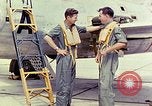
Boeing B-47 Stratojet bomber's target practice during a test conducted at Eglin Air Force Base, Florida.
Two crew members wearing flight clothing along with Mae West jackets (life jackets), by hand action demonstrate flight of an aircraft. The pilot donning parachute enters the Republic F-84 Thunderjet. Crew members get into cockpit of Northrop F-89 Scorpion aircraft. Airmen prepare MB-3 Red Bird for flight. Airmen attach tow line to pylon of Northrop F-89 aircraft for towing MB-3 Red Bird. Map shows the course of flight from MacDill Air Force base to Eglin Air Force Base, Florida. Aerial view of bay bridge. Sergeant marks course on radarscope and speaks into a microphone. Boeing B-47 Stratojet bomber and F-84 Thunderjet in flight. Airman atop a trailer, manually operates antenna. Gatling gun fires from Boeing B-47 Stratojet bomber targeting MB-3 Red Bird. Damaged rear fuselage and wing of section of MB-3 Red Bird. The aircraft lands with a drag parachute. Boeing B-47 Stratojet bomber, taxis, and parks on ground.
United States 1st Marine Division troops bomb Peleliu Island, Palau.
U.S. 1st Marine Division operations on Peleliu, during World War 2. U.S. F4U Corsair aircraft, flying low and slow, with gear down, drop napalm incendiary bombs on Japanese troops dug in on a ridge. Huge explosions seen. A C-47 transport airplane taxis on airfield. F4U Corsairs are seen parked and tents are pitched nearby.Several C-47s are parked on a ramp. Three F4Us taxi past them headed to the runway. F4Us take off and one is seen bombing Japanese positions on the ridge. Slate notes 1st Marine Division and D+24. Major General William Henry Rupertus,kneels on one knee, in sand, as another officer (shirtless) briefs him. They briefly discuss tactics and then walk away. Marine rifleman firing into burning wreckage of a Japanese position. Marine firing grenade from his rifle. Two Marines stand on beach with LVT (landing vehicle tracked) on the sand, nearby. They point at large ship offshore. Views of the Peleliu beachhead, with numerous ships and landing craft beached, including the second USS Seaward (LST 278) that collided with LST-129 and suffered considerable damage, On October 2, 1944. (LST-129 may be the LST seen next to LST-278.)
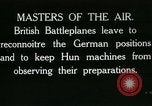
British airplanes take off and see German positions from plane during Battle of Arras in World War I in France.
British F.E.2 pusher biplanes take off on reconnaissance mission during Battle of Arras in World War I. A gunner checks his weapon in the front cockpit of an F.E.2. Ground crewman pulls prop through while another assists pilot. The engine starts. Another F.E.2 also starts and they both take off from the airfield. View from F.E.2 , at ten thousand feet, of French city on a river. Steam locomotive train seen crossing a railroad bridge over the river. View of German trenches and fortifications from altitude of thirteen thousand feet.
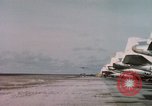
U.S. Air Force aircraft at an air base on Eniwetok Atoll in Marshall Islands.
B-52 lands on an airstrip at the Eniwetok Atoll In Marshall Island. Man checks over B-57 with a geiger counter with two men seated in cockpit . Nose art of aircraft reads 'The Prowler' and shows a picture of a woman kneeling. A F-101 on ramp. Cameraman takes a photo of aircraft damage . Several U.S. Air Force aircraft such as F-101, B-66, B-47, F-84F's and others at the air base.