


 Francais
 Deutsch
 Italiano
Refine Your Search
F-86 stock footage and images
- Showing 1525 to 1530 of 2472 results more
more Hide
Hide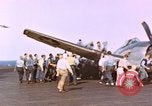
A Japanese plane crashes in the water amid heavy flak in the Pacific Ocean during World War II.
Japanese plane crashes in the Pacific Ocean during World War II. Forced landing crash of U.S. Navy F6F Hellcat on the deck. Maintenance crew work on the plane. Japanese plane "Kate" crashing in the water off the carrier amid heavy flak. An aircraft lands on the carrier. Scenic shots of planes against a red sunset.
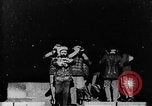
Musicians from Broadway Musical Farce, "A milk white flag," perform a Band Drill
Bandmaster, Frank Baldwin, and musicians from cast of the show, "A Milk White Flag,"perform. The musicians are: A.D.. Dorsch, E.P. Brown, J.F. Boardman, George Goddard, E.F. Balch, Paul Pfarr. Fred W. Boardman, and William Cushing, Filmed at Edison studio in New Jersey.

President John Kennedy attends first baseball game played at DC Stadium, between Washington Senators and Detroit Tigers, in 1962.
U.S. President John Kennedy attends the first ballgame played at the new $20 million District of Columbia Stadium, or DC Stadium, in April 1962. 45,000 spectators in stands for the opening of the stadium and the Major League Baseball season. Glimpse of the new DC Stadium in Washington, DC, filled with baseball fans. President John F. Kennedy enters the ballpark, accompanied by David Francis Powers, and proceeds toward seats bearing the Presidential seal. Spectators in nearby seats stand to greet the President, and several shake his hand. Scene shifts to players and newsmen on the field all focused on President Kennedy. News photographers are busy photographing him. Camera shifts to President Kennedy making a long throw followed by the ballplayers scrambling for it on the ballfield. View of the President smiling after his throw, with Illinois Republican Senator Everett Dirksen standing to his left, and slightly behind him, and David Powers to his right. Senator George Smathers of Florida is laughing behind them. The President bends down momentarily revealing Senator Mike Mansfield of Montana, directly behind him and Special Assistant to the President Lawrence “Larry” O’Brien, at Mansfield's right. Associate Press Secretary Andrew Hatcher, wearing sun glasses is behind and to left of Dirksen. Closeup of Home plate umpire Charlie Berry shouting "Play Ball!" after brief rain delay. Lights are on during daytime as game is played. Washington Senators player hits single to left field. Senators go on to beat the visiting Detroit Tigers 4-1. (Note: The stadium was later renamed Robert F. Kennedy Stadium, or RFK Stadium, in 1969).
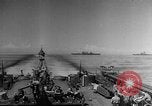
U.S. ships carry troops and war materiel during World War II; U.S. Navy task force attacked by Japanese aircraft in Pacific.
Opening scene shows view from stern of a warship in an Pacific U.S. Navy task force during World War 2. Other convoy warships are seen in far background. Closeup of American flag on a ship. Glimpse of U.S. Destroyer moving behind the camera ship. Four warships in side-by-side formation. Naval guns firing in the dark at night. A U.S. light tank being loaded aboard a ship at a dock. Several towable pieces of field artillery covered and ready for loading at the port. Numerous army trucks parked in a group at the port. Silhouettes of U.S. Army soldiers, in full battle gear, ascending a gangway to a troop transport ship. Heavy field guns being loaded aboard a ship. Cargo manifests for U.S. Army Transport Service ships preparing to sail from the New York Port of embarkation in Brooklyn, New York. Several Army transport ships underway in the ocean. A Fletcher class destroyer nearby. A Yorktown class aircraft carrier. Closeup of a sailor manning a Bofors 40mm antiaircraft gun on board an aircraft carrier. Fletcher class destroyer in background. View from the bridge of troops on open deck of a transport ship. Sailors standing near variety of guns aboard a warship. Sailors scanning skies for enemy aircraft. A Grumman F4F aircraft being launched from deck of an aircraft carrier. Quad Bofors antiaircraft guns being fired and skies filled with black flak clouds. View down from Bridge on the Island of an aircraft carrier, showing antiaircraft gun positions. More views of black flak clouds. Sailors in battle gear on the aircraft carrier deck. Bofors guns firing. View from carrier flight deck of Japanese Nakajima B5N2 "Kate" attacking close to the carrier. It is struck by gunfire and bursts into flames. Another Japanese Nakajima B5N2 "Kate" torpedo bomber passing close to the flight deck. It bursts into flames and crashes into the water, close to the carrier, exploding violently in heavy black smoke. View from carrier of transport ships following.
Mixture of scenes from various U.S. amphibious assaults on Japanese occupied islands in the Pacific during World War 2
First scenes show United States Marines riding in a landing vehicle tracked (LVT) heading toward a Japanese occupied island in the Pacific. View from one of the landing craft of heavy smoke obscuring the island coast. Next, a dozen landing craft from the USS George Clymer (APA-27) are seen with mountains of the target island looming in the background. View from a different perspective shows several landing craft heading toward an inlet to the island. View from a landing craft of a Japanese Mitsubishi A6M "Zero" airplane flying overhead. Closeup of American soldiers in a landing craft headed toward a different Japanese occupied island. U.S. soldiers leaving a landing craft in the surf. View from inside a landing craft as U.S. Marines head ashore. Soldiers splashing in the surf. Troops wading ashore. Soldier dug in on beach near underbrush, firing many round from his Browning M1919 machine gun. Marine firing his rifle behind a palm tree. Troops seeking cover at very edge of shore. Some lying in the water, before moving on. A soldier firing an automatic weapon through foliage. A bomb explodes near an invasion ship. Troops descending on rope nets from the troopship, USS Crescent City (APA-21) and entering her Higgins boats. Heavy equipment and ammunition being offloaded from the troop transport ship. Marines coming ashore. An LVT in the background. Marines behind a barricade built by the Japanese. Marines throwing hand grenades and firing Browning M1919 machine guns. Flame throwers being used to force Japanese from strongholds. Marines gathered all along a shore line. A bulldozer driving along the waters edge. Soldiers rolling steel mesh across the sand. An antiaircraft machine gun with a side magazine mounted on a jeep, moves on the sand. Several ensuing scenes show flame throwers being used. Marines near a wrecked Japanese structure and then escorting a Japanese prisoner. A group of Japanese prisoners being spoken to by a Marine with a microphone. Marines hunkered down on a beach. One is cranking a hand powered radio transmitter. Front ramp of a landing craft is dropped down with a splash at waters edge. An M3A1 light tank drives off the landing craft. A truck being offloaded onto the shore. A heavy field artillery piece being moved into position. Troops work to move another field artillery piece into position. Trucks and other vehicles wading through shallow water as they leave an LST. Troops wading ashore from the LST. Trucks arriving on the shore. A tractor pulls a canvas covered vehicle. Soldiers ride aboard a light tank. Unusual view of troops assembled on shore of a mountain with ice seen in places on it (likely in the Aleutians). Crowded beachhead with LST 477 seen beached. Marines looking at destroyed Shore defense installation containing heavy gun. Remains of a 4-engine Japanese Kawanishi H8K2 (Emily) flying boat in the water. Seabees building an airfield with heavy construction equipment. Troops gathered around a Navy F4F aircraft that landed on the new (unfinished) airfield. Closeup of the smiling pilot climbing down from his plane. Troops saluting as the American flag is raised on remains of a Palm tree trunk, on Eniwetok, February 1944. Remains of a Japanese shrine and views of dead Japanese soldiers.
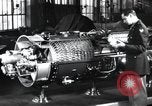
Rocket and jet engine on test stand and officer checks remains of the jet engine at WADC, United States.
Technicians and officers in the laboratories and offices at WADC, United States. Interior of Service Engineering Department. Superimposed over jet engine in laboratory building are the words: 'II-Service Engineering'. Officer placing section of screen over the air intakes of the jet engine. USAF F-84 Thunderjet taxis. Rocket and jet engine on test stand at Wright Field, numerous engines are on the test block. View of test instrument panel. Jet engine on test stand. One worker drops a small screw into pipe which leads into a jet engine. Workers clearing the area. Operator of the instrument panel controls the jet engine. Exhaust section of the jet engine. Jet engine explodes due to foreign object entering through the air duct. Interior of laboratory building, officer checks remains of the jet engine. USAF F-89 Scorpion stationary at Wright Field. Technician install screen in the main air intake. View of the screen.