


 Francais
 Deutsch
 Italiano
Refine Your Search
F-86 stock footage and images
- Showing 1531 to 1536 of 2472 results more
more Hide
Hide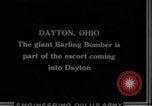
Douglas World Cruisers aviators are greeted by army officers, government dignitaries and friends in Dayton, Ohio.
U.S. Army Air Service Douglas World Cruisers (DWC) in the United States during their first flight around the world. In Dayton, Ohio: A formation of three world cruisers. A formation of six aircraft. American aviator Lieutenant Jack Harding seated on the shoulders of a man being welcomed by personnel. Lt. Erik H. Nelson's dog wags a friendly welcome. Greetings are given to Lt. Nelson as he is handed a bouquet of flowers and is greeted by his dog. Mayor F.B. Hale presents a traveling bag to each flier. A flier as he accepts a bag. Two other pilots holding bags. U.S. Army Major John F. Curry as he welcomes all the pilots and crew members. Homecoming for Lt. Nelson, Lt. Leigh Wade and Lt. Harding. A crowd along a ramp. A sign above a building: 'This Field is Small'. A world cruiser taxiing at McCook Field.
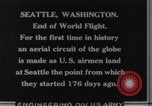
Douglas World Cruisers aviators are greeted in Seattle, Washington after their first flight around the world.
U.S. Army Air Service Douglas World Cruisers (DWC) in Seattle, Washington after their first flight around the world. In Seattle, the point from which they started 176 days ago. The world cruisers in flight. A world cruiser coming in for a landing. Major Frederick F. Martin greets Lieutenant Lowell H. Smith, Lt. Leigh Wade and Lt. Erik H. Nelson. The pilots in uniforms pose. Animations of the North American continent pinpointing Alaska where Major Frederick F. Martin crashed into a mountain. The path over which the world cruisers flew pinpointing the place where the cruiser flown by Lt. Wade was forced down and wrecked. Then the course to Seattle is shown.
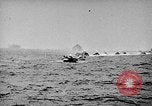
Japan Kamikazes attack U.S. Navy Task Force 58, in battle of Okinawa in World War II
Role of U.S. Navy Task Force 58 in Okinawa, Japan during the Battle of Okinawa in World War 2. Film begins showing amphibious assault by U.S. forces of Navy Task Force 58, against Okinawa, on Easter Sunday, April 1, 1945. Higgins Boats from U.S. transport ships race through the water and discharge troops on the land, with no signs of Japanese resistance. Some of the boats' markings show they came from the U.S transport ship USS Barnett (APA-5). Sailor aboard a transport ship uses ax to cut a line and release a power boat from its davits. The boat drops into the water with a huge splash. View of lines of U.S soldiers and marines wading through shallow water toward mud flats on the land. Closeups of Troops with landing craft behind them. advance overland with no signs of Japanese resistance. Troops sitting on a landing vehicle tracked (LVT) parked in sand. U.S. infantry begin moving inland accompanied by armor and military trucks and other vehicles. The area is very quiet, with no sign of enemy activity. Views of Army and Marine Corps infantry walking beside an M4 Sherman tank. Views of soldiers using binoculars in effort to detect any signs of the enemy. Crews in combat gear, at battle stations aboard Navy ships waiting patiently for enemy action. It came suddenly in the form of Kamikaze attacks on April 6, 1945, when the Navy's radar picket ships were attacked followed by general attacks against U.S. Capital ships. A kamikaze is seen striking an Essex-class aircraft carrier amidst ship, setting off explosions on the ship. Anti-aircraft gunners on various ships are seen firing at the Japanese planes. Another ship is struck by a Kamikaze. Douglas Dauntless and F4F aircraft being launched from carriers. The Battleship, USS Maryland (BB-46), is struck by a kamikaze that knocks out some of her gun emplacements, but she continues her mission in spite of the damage. A kamikaze aircraft is seen attacking the USS Yorktown (CV-10). It is hit by anti-aircraft fire and just misses the ship, splashing into the water nearby. Air is filled by black smoke puffs, from anti-aircraft fire as Japanese aircraft maneuver overhead. One is struck and falls burning to crash in the water, just off the flight deck of a carrier. Gun camera clip showing a multi-engine Japanese aircraft being shot down from behind, by a U.S. aircraft. Closeup of a Japanese Kawasaki Ki-61 aircraft in flight, peeling off to attack. More gun camera footage of a Japanese multi-engine aircraft being shot down from behind. A Kamikaze airplane diving down under anti-aircraft fire and crashing into the sea. Gunners firing Bofors anti-aircraft guns from gun emplacements beside the flight deck of an aircraft carrier. Skies filled with black flak clouds. On 11 April, a low-flying kamikaze Zero, although fired upon, is seen crashing on the battleship, USS Missouri USS (BB-63). It strikes her starboard side, just below her main deck level. The starboard wing of the plane was thrown far forward, starting a gasoline fire at 5 in (127 mm) Gun Mount No. 3. At the same time, another kamikaze crashes into the sea in the foreground. An aircraft carrier's gunners fire anti-aircraft Bofors guns at a Kamikaze plane that swoops over her flight deck and crashes, exploding, into the sea just off the flight deck. A low flying Kamikaze aircraft crashes into the sea off the bow of an escort carrier, underway. Heavy black smoke rises from the airplane blowing up. A huge explosion with a white cloud of smoke is seen above the battleship USS Missouri.
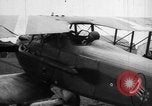
Three ground crewmen work on a SPAD S. XIII and a group of officers of 94th Aero Squadron in Toul, France.
United States Army Air Service (USAAS) 94th Fighter Squadron in Toul, France during World War I. Captain J. A. Meissner climbs out of the cockpit of Eddie Rickenbacker's SPAD S. XIII fighter aircraft and walks away. "Hat in Ring" insignia on side of the aircraft. Three ground crewmen work on a SPAD XIII. 1st Lieutenant Allan Rankin who is an Engineering Officer reads a notice. They pound each other on the back and jump around. Commanding Officer 1st Pursuit Squadron Major Hartney and Operations Officer 94th Aero Squadron Lieutenant Cunningham stand in front of a Fokker V-8 shot down by Lieutenant Rickenbacker. In Toul, France on 18th April, 1918: A group of officers of 94th Aero Squadron including Major J. W. F. M. Huffer, Major Raoul Lufbery, Captain J. N. Hall, Captain Kenneth Marr, Captain D. McK. Peterson, Lieutenant J. B. H. Smith, Lieutenant C. A. Rankin, Lieutenant Reed Chambers, Lieutenant Douglas Campbell, Lieutenant W. L. Loomis, Lieutenant James N. Neissner, Lieutenant M. E. Green, Lieutenant A. L. Cunningham, Lieutenant A. F. Winslow, Lieutenant C. W. Chapman and Lieutenant P. H. Walter, Surgeon, standing in front of a USAAS Nieuport 28 C-l.
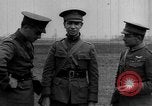
Officers of the 94th Aero Squadron standing beside different airplanes during World War I
United States Army Air Service (USAAS) 94th Aero Squadron in Toul, France during World War I. April 1918 - Commanding Officer 94th Aero Pursuit Squadron Major John W.F.M. Huffer and French-American pilot Major Raoul Lufbery talk with AEF weekly newspaper "Stars and Stripes" editor Major S. P Adams. Captain David M. Peterson stands beside a Nieuport 28c.1 fighter aircraft,with its "Hat in Ring" insignia on the side. 1Lt. Alan F. Winslow stands beside Lt Rickenbacker's Nieuport #12 and starts walking. Jump to November, 1918 - the remaining officers of the 94th Aero Squadron reunite, including Captain James A. Meissner (C.O.147th Aero), 1st Lt Joseph Eastman, Captains Eddie Rickenbacker (now C.O. 94th Aero) and Reed Chambers, and 1st Lt Thorne Taylor (all 94th) standing beside Rickenbacker's SPAD S.XIII #1 parked in front of a hangar at Foucaucourt Aerodrome, France, November 1918. (WWI,WW1, World War One, First World War)
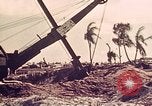
Construction of airstrip by the U.S. Seabees on Tarawa, Kiribati, during the Battle of Tarawa in World War II.
Bucket cranes and bulldozers remove and clear heaps of dirt for constructing an airstrip. Dump trucks spread sand and road scrapers and steam rollers prepare the ground. U.S. F6F fighter aircraft land on the newly constructed airstrip. Pilot poses with marines of the United States 2nd Marine Division.