


 Francais
 Deutsch
 Italiano
Refine Your Search
F-86 stock footage and images
- Showing 1807 to 1812 of 2472 results more
more Hide
Hide
The Cuban Missile Crisis. The Limited Nuclear Test Ban Treaty.
October, 1962, U.S. Air Force U-2 reconnaissance aircraft, tail number 56-6707, of the Strategic Air Command (SAC) 4080th Strategic Reconnaissance Wing, lands at Laughlin Air Force Base, Texas. View of Photographic evidence, brought back by the U-2, showing Soviet missiles being set up in Cuba. President John F. kennedy broadcasts to the nation about the crisis on October 22, 1962, announcing measures being taken by the USA to address the situation. A B-58 Hustler bomber landing. Airmen removing camera from nose of a reconnaissance aircraft. Air Force Sergeant, photo interpreter, reading wet film in a base laboratory. U.S. Naval officers and sailors in Command Center viewing large wall map of the world. U.S. Air Force SAC B-52 bombers taking off. View of United Nations Headquarters building in New York City. On October 25, 1962, U.S. Ambassador to the UN, Adlai Stevenson, confronts Soviet Ambassador Valerian Alexandrovich Zorin about missiles in Cuba.He looks at Zorin, and says,"Don't wait for the translation, yes, or no." Zorin smiles as the room fills with laughter. He then responds. View of a Soviet ship bound for Cuba being monitored by a U.S. aircraft overhead. Pilot in cockpit of the aircraft. View from U.S. aircraft flying low past a Soviet ship. Crew in cockpit of the aircraft. Soviet ships turning away. Helicopter flying over sandy beach area of Hyannis Port, Massachusetts. The helicopter parked and Undersecretary of State, Averell Harriman, steps from the helicopter and is later seen with President Kennedy, and Secretary of State, Dean Rusk, at the President's Weekend White House. Harriman reports on the successful negotiation of a limited nuclear test ban treaty. Glimpse of Moscow. U.S. Secretary of State, Dean Rusk, Soviet Foreign Minister,Andrei Gromyko, and British Foreign secretary, Alexander Douglas-Home, are seen signing the document for their respective nations, August 5, 1963.
United States Navy fighter Sky Ray undergoes take off and landing tests from carrier Coral Sea in United States
Aboard the carrier Coral Sea, United States Navy fighter Sky Ray undergoes take off and landing tests in United States. Sky Ray also known as Douglas F4D takes off and lands back after a short flight.
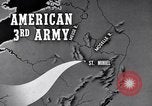
U.S. 3rd Army crosses Meuse River, advances through St.Mihiel, and crosses Moselle River in France, in World War II
Animated map showing American 3rd Army advance toward St. Mihiel, France, during World War 2. Advance elements of General Patton's U.S. 3rd Army cross Meuse River in a French civilian's barge and proceed through town of St. Mihiel. A U.S. Army combat photographer is seen taking pictures at bank of river. U.S. Infantrymen make their way through virtually deserted town of St Mihiel. U.S. field artillery fire on German positions along the Meuse. U.S. infantrymen lying prone beside a large barn.US soldier photographing others as they rest on a sidewalk.Two U.S. soldiers running up and over a wooden bridge.American forces driven back by heavy German resistance and then resume advance after U.S. artillery fire neutralizes defending German forces. However, still under heavy fire, American infantrymen carry small boats to cross the Moselle River. U.S. troops paddle across the river in a boat at Dornot, France, September 1944. Railroad pedestrian crossover bridge visible. (Note: Unit making the river crossing was 5th Division, 11th Infantry Regiment, 2nd Battalion, E and F company.Lieutenant Colonel Kelly B, Lemmon Jr. was battalion commander.)
The Battle of Iwo Jima in World War II
Scenes filmed by Navy and Marine combat photographers, of the Battle for Iwo Jima, in February and March, 1944, during World War 2. View from a boat offshore, of Mount Suribachi, on the Island of Iwo Jima. Warships of the U.S. 5th Fleet attack with naval gunfire, as landing craft manuever near shore. U.S. Marines aboard Landing Vehicles Tracked (LVTs) head for the beach, with the heavy cruiser, USS Baltimore (CA-68) in the background. U.S. Carrier-based Grumman TBF Avenger aircraft drops bombs on Mount Suribachi. Landing craft arriving at a fairly level area of beach. U.S. marines moving cautiously on the beachhead. The USS Baltimore and a Fletcher class destroyer offshore in background. Marines hunkered down with smoke rising near them, and then moving forward again, through the black sands. Closeup of a marine with flame thrower. Several U.S. Chance Vought F4U Corsair aircraft fly overhead, dropping bombs on the mountain. Marines continue to move forward, under constant fire from Japanese small arms. A heavy landing craft Infantry, LCI(H) moves toward shore in background. A DUKW ("Duck") coming ashore. Marines using a crane to offload a 105mm howitzer from a landing craft. As they raise the gun, the landing craft moves away and marines Hook the howitzer to a DUKW to help move it. Next, marines are seen setting up two 105s on the beachhead and firing them. Marines with more artillery pieces stacked on the beachhead. A gunboat, LCI (G), firing from close to the shore behind them. Marines digging in sand that the narrator calls the floor of an active volcano. Smoking sulphur gases are seen rising behind them. The USS Baltimore firing her guns from close to shore. Machine gun tracer rounds crossing the beachhead, as Naval gunfire resumes from offshore. Marines crawling and then occasionally sprinting forward across the sand dunes. (One carries a stretcher.) Four marines carrying one wounded back to the beachhead, on a stretcher. Two marines carry another between them. Marines scrambling over brush and rough ground. View from hillside of marines climbing up from below, as shell bursts only a few yards away. Scene shifts to later in the battle for Iwo Jima. A catapillar tractor is parked near bodies of Japanese soldiers strewn across the landscape. (Narrator notes that more than 14 thousand such dead had been counted by March 6, 1944.) Finally, the iconic moving images of U.S. marines raising the American flag over Mount Suribachi.
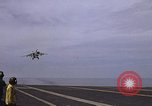
U.S. Navy airplanes land and take off from the deck of the carrier USS Kitty Hawk in the Pacific Ocean.
United States Navy aircrafts F-14A Tomcat, A-6B, A-7E and S-3A land aboard super carrier Kitty Hawk in Pacific Ocean.
U.S. Navy planes take off aboard super carrier Kitty Hawk in Pacific Ocean
United States Navy aircraft E-2C taxis to catapult and unfolds its wings aboard super carrier Kitty Hawk in Pacific Ocean. F-14A Tomcat and A-7E aircraft take off.