


 Francais
 Deutsch
 Italiano
Refine Your Search
F-86 stock footage and images
- Showing 2209 to 2214 of 2472 results more
more Hide
Hide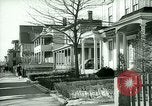
Signs in shops on Pulaski Street in Polish section of Bridgeport, Connecticut (WW2)
Polish American establishments in Bridgeport, Connecticut. Various Polish shops on Pulaski Street. A sign reads ' Frank Roydzoski and son funeral home'. Another sign on a window reads 'Polish Army veterans association of America,' on one window in Polish, and on another window, in English. A sign reads 'F.J. Zilinski custom tailors'. Men walk on a sidewalk in the foreground. A Poster in Polish at a corner shop, advertises a movie, at the Strand Palace, about Thaddeus Kosciuszko (the famous Polish-born engineering genius who was a hero in the American Revolutionary war). The poster states that the film has English subtitles. Next to the poster is a small World War II banner reading: "God Bless America, We are proud to be AMERICANS." A corner of Pulaski Street with a sign that reads 'Pulaski street and Kossuth street'.
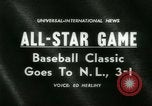
Maury Wills and Willie Mays star as National League wins Baseball's 1962 All-Star Game in Washington
Newsreel clip on baseball's 1962 All-Star Game in Washington -- the first of two played that year. View of new D.C. Stadium packed to capacity for the game. A woman wearing a hat with '1962 All Star Game' written on it. U.S. President John F. Kennedy, a known baseball fan, throws out the ceremonial first pitch. Game begins, scoreless for five innings. In the sixth, Hall of Famer Stan Musial hits a single to right field. Maury Wills comes in to run for him, steals second, then scores on a hit by the Pittsburgh Pirates' Dick Groat. President Kennedy and officials seated near him cheer. Groat scores on an infield hit. Racially mixed crowd watches the action. Billy Moran and Rich Rollins of the American League get hits, then Roger Maris of the Yankees hits a long blast to deep center field -- but Willie Mays catches it against the center field wall. Kennedy, wearing sunglasses and smiling, munches on some peanuts. In the seventh, Wills gets on base, advances from first to third on a single, and scores sliding into home on a fly ball in foul territory. Announcer notes Kennedy stayed until the end of the game. Mays catches the final out in center field. The National League wins the game 3-1.
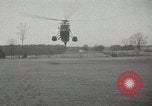
U.S. President Eisenhower, Presidential candidates and their wives and citizens casting votes at the election day in the U.S.
The 1960 Presidential Election in the United States. A helicopter landing on a field in Pennsylvania. U.S. President Dwight Eisenhower with officials disembarks from the helicopter. Photographers taking pictures of the President. The President shaking hands with a few officials. Cars parked outside a building. The Barlow Firemen's Hall building. President Eisenhower standing with the officials inside the hall. Photographers taking pictures. A clock showing 7 O' clock. The President takes a ballot paper from an officer at a polling station and goes inside an area separated by a curtain and casts his vote. The President puts the ballot paper in a ballot box. President's wife Mamie Eisenhower casting her vote in the voting booth. Japanese Ambassador to the U.S. and his wife at a polling booth in Maryland viewing polling procedures. A woman officer showing a voting machine to the dignitaries. Republican Presidential candidate Richard Nixon and his wife Pat Nixon cast their votes at a polling station in a town in California. They put ballot papers in a ballot box. Democratic Presidential candidate John F. Kennedy and his wife Jacqueline Kennedy casting their votes at a polling booth in Boston, Massachusetts. Several reporters taking pictures at the booth. Boards on buildings indicating a legal holiday on the election day. People entering a building to cast their votes. Burmese Ambassador to the U.S. at a polling booth in New York. View of Burmese officials. People in a queue at polling booths on the election day to cast votes. The U.S. flag and people at a polling booth.
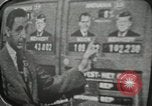
Presidential Election results show Kennedy in the lead and Nixon delivers a speech pledging his support to Kennedy in the U.S.
The 1960 Presidential Election in the United States. A television broadcast showing Presidential candidate John F. Kennedy's lead in the Presidential Election. A correspondent recording figures on a sheet of paper. The returns in a tabulating machine checked by Kennedy's press secretary. The interiors of the press headquarters of the Democratic Presidential candidate in Massachusetts. Men and women viewing a television. The television commentator announces that Republican Presidential Richard Nixon is about to make a statement. A clock showing 3.20 AM. Richard Nixon with his wife Pat Nixon in California, standing behind a podium in front of a tally board which shows Presidential Election summary. Nixon waves at the crowd. His speech being broad casted on television. Richard Nixon talks about the importance of how elections work in the United States, that they are hard fought, but once the decision is made we united behind the man who is elected, and he says that if Kennedy goes on to win the election and becomes the President of the United States then Kennedy will have his whole hearted support. The crowd cheering and applauding. Nixon waving at the crowd. Men and women going out of a building. Vacant chairs in the Republican Party headquarters. A tally board showing figures of the election results. A few men and women in the headquarters.
U.S. and British officers arriving at Luqa for the Malta Conference in Malta, United Kingdom during World War II.
The Malta Conference in Malta, United Kingdom during World War II. U.S. Ambassador to the Soviet Union William Averell Harriman disembarking from an aircraft at Allied Air Terminal in Luqa. Ambassador Harriman talking to an official standing beside the aircraft. U.S. Navy Fleet Admiral Ernest King disembarks from an aircraft. He is greeted by British Army Field Marshal Henry Maitland Wilson and another officer. The officers talking beside an aircraft. Ambassador Harriman with Major General F. M. Anderson Deputy Commander USSTAF (United States Strategic Air Forces in Europe) and other officers. Several officers beside an aircraft in the background.
A tractor tows an aircraft at an air base in Vietnam during the Vietnam War.
U.S. Navy aircraft in Vietnam during Operation Market time of the Vietnam War. Nose of an aircraft parked at an air base. A sign on the cockpit of the aircraft reads 'C.P. LTJG E.J. Hopkins'. Another sign reads 'Lt. Swenson' and 'Lt. Hopkins'. Two flight crew men work on a tow bar. They hook the bar to the nose of the aircraft. A tractor backs down and the men hook up the bar to the back of the tractor. The tractor driver works on the controls as he moves the aircraft out of the turn up area. The tow bar being attached to the tractor. The aircraft being slowly moved to the turn up area. The tractor tows the aircraft. A crew member releases the tow bar from the tractor. The tow bar being released from the aircraft. A pilot climbs aboard the aircraft. Two crewmen stand by as the starboard engine is started. The port engine turns up slowly. A U.S. Navy Lockheed P-2H aircraft taxis out from a line. A U.S. Navy Phantom F-4B taxis down the line with a drogue parachute open.