


 Francais
 Deutsch
 Italiano
Refine Your Search
F-86 stock footage and images
- Showing 2215 to 2220 of 2472 results more
more Hide
Hide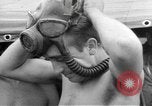
Men wearing diving masks dive underwater in the Pacific Ocean to salvage a Japanese submarine during World War II.
USS Ortolan salvages a Japanese submarine off the coast of the Solomon Islands in the Pacific Ocean during World War II. A man puts on a diving mask. He jumps into water. He removes the diving mask. U.S. Navy Captain Holland and Captain A.F. Loger at Japanese books. Holland thumbs through Japanese code books. The bow of USS Ortolan in the choppy sea.
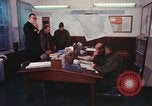
A U.S. Navy P-3C Orion flight crew is briefed before a long range navigational test at a Naval Air Facility in Atsugi, Japan.
A U.S. Navy P-3C Orion aircraft in Atsugi, Japan during a long range navigational test. A flight crew is briefed in a weather briefing room. Navigator Lieutenant R.T. Myers and pilot Lieutenant Commander F.H. Stoodley figure out fuel consumption for the flight. Flight Meteorologist Commander J.E. Koeher speaks to aircraft commander Commander D.H. Lilienthal, flight engineer K.D. Frontz, pilot Captain R.H. Ross and flight engineer H. A. Statti. Commander Koher and Commander Lilienthal discuss weather conditions. A navigational chart depicts the flight path from Japan to Pax River in Maryland, Unite States. Commander Lilienthal stands next to a bulletin board as he points out at the chart.
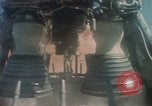
Launches of German V-2 ,Titan II from a missile test center in California, United States.
Rocket engine nozzle at launching. The engine rises slowly from launch pad. An engineer behind control panel. A rocket launches a captured German V-2 rocket/WAC Corporal Bumper 8 from Pad 3 of Cape Canaveral on July 24, 1950. Two United States Air Force Convair F-106As Delta Dart in flight. Aerial view of launch complexes. Titan II missile is launched. The Titan II missile explodes mid-air. A huge ball of fire from Titan II explosion. A scientist uses a tracking camera during a Titan II rocket launch. Footage from camera shows the first stage separation of the Titan II. The booster blasted away at second stage ignition. Various tracking stations covering the Atlantic missile range. A satellite dish recording telemetry data. Observatory dome with telescope rotating. The USS HH Arnold (T-AGM-9) missile tracking ship at sea. A re-entry vehicle is seen re-entering the atmosphere. A United States Air Force Lockheed JC-130B Hercules equipped with a trapeze structure snatching an Aero kite balloon suspended from a ship. Air Force Missile Test Center and its logo. View of Patrick Air Force Base in Brevard County, Florida (840 Falcon Ave. Building 720 Patrick AFB, FL 32925). Various missiles on display in front of the Air Force Missile Test Center Technical Lab at Patrick Air Force Base. Engineers working in the Air Force Missile Test Center Technical Lab. An engineer examines a magnetic tape from an IBM console in the EDP room. An Air Force Missile Test Center report. A Gemini space capsule is being lowered. NASA personnel watch the capsule. Sign reads “Gemini / Titan II Man Rated Complex Martin Company”. Lt. Colonel John G. Albert Chief of the Gemini Launch division, 6555th Aerospace Test Wing at the entering gate. A blockhouse in the background. Colonel Albert inspects Gemini’s boosters. He is at the launch control in the blockhouse.
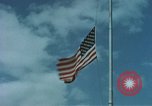
Harry J. Sands Jr. addresses people and the launch of an IMP satellite, Centaur II in the United States.
A film about missile launches in the United States. The American flag at half mast. Troops assembled on a ramp and Brigadier General Harry J. Sands Jr. Vice Commander of the Air Force Missile Test Center (AFMTC) speaks at the memorial services for the late U.S. President John F. Kennedy on 25th November, 1963. The night launch of an Interplanetary Monitoring Platform (IMP) satellite, test no. 6900, using a Delta launch vehicle on 27th November, 1963. The launch of a Centaur II, test no. 5175 on 27th November, 1963. A map of Cape with new name Cape Kennedy.
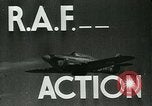
World War I Royal Flying Corps airplanes and flight crews shown during a historical retrospective on the Royal Air Force
Part of a British production, circa 1940, highlighting the work of the Royal Air Force during World War II, and discussing the history of the RAF while showing World War I Royal Flying Corps (RFC) images. The Royal Air Force in the United Kingdom. The flag of the Royal Air Force (RAF) on a mast. RAF personnel from all parts of the commonwealth march in a mass formation during World War II, including mainland Great Britain pilots and Indian RAF pilots and crews. A line of aircraft stationed on an airfield in the UK. History of RAF is discussed by narrator, with images from World War I of Royal Flying Corps (then part of British Army) airmen and their aircraft. Views of several World War I aircraft on an airfield and taking off, including the Sopwith Camel, the Royal Aircraft Factory S.E.5, the Bristol F.2 Fighter. Royal Flying Corps pilots and crews gathered for group photos.
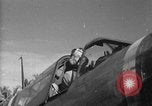
Royal New Zealand Air Force operations on Torokina Air Strip, Bougainville Island in World War II.
Flight operations at Torokina Air Strip on Bougainville Island during World War 2. Pilot of Royal New Zealand Air Force (RNZAF) Curtiss P-40 aircraft signals that he is going to start engine. He dons goggles and goes about starting engine. A group of RNZAF pilots conversing near one of their P-40s. Most of the pilots light up cigarettes. Camera focuses on New Zealand shoulder patch on one of the group. Scene shifts to active runway, where an RNZAF F4U Corsair aircraft takes off followed by an RNZAF Grumman TBF Avenger aircraft landing.