


 Francais
 Deutsch
 Italiano
Refine Your Search
F-86 stock footage and images
- Showing 2257 to 2262 of 2472 results more
more Hide
Hide
Carrier aircraft and Destroyers with other ships underway and en route to Okinawa during World War II.
The U.S. Task Force advances in the Pacific Ocean during World War II. A starboard bow of a ship cut water and en route to Okinawa. U.S. Navy F-6s parked on the deck of a ship. A carrier aircraft underway. A heavy cruiser underway. A aircraft carrier underway. Another carrier aircraft underway with the U.S. task force. Carrier aircraft and Destroyers with other ships underway and en route to Okinawa. A large number of ships off the beach of Okinawa. The Landing Ship Tanks underway. Clouds in the background. A Landing Craft Infantry underway. U.S. Infantrymen aboard the landing craft. Aerial view of invasion fleet off the coast. A U.S. aircraft, flying in support of assault forces, flies low over beachhead. Area covered with smoke from shore explosions.
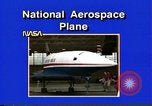
A mock up of the National Aerospace Plane made by the engineering students in rolled out of a hangar in Virginia.
Engineering students prepare a mock up of the National Aerospace Plane in Virginia, United States Animation depicts the National Aerospace Plane (X-30 aircraft) ability to fly anywhere in the world. A group of college engineering students at Virginia Tech in Blacksburg, Virginia, are seen building a half scale mock up of the Aerospace Plane. Faculty advisor Walter F. O'Brien helps a student. A student makes the parts of the plane. A student makes a computer design of the plane. The students making parts of the plane. Walt O'Brien at a desk talks about the design and different aspects of the aircraft model. The students working on the half-scale model. The students work inside a hangar. A half skeleton of the plane. The student assemble the aluminum structure. The airplane is rolled out of the hangar on graduation day. People applaud and take pictures. The students receive awards and recognition for their effort. A truck carrying mock up drives on a highway road. The mock up is loaded into a USAF (United States Air Force) C-5 Galaxy. Side of the the C-5 aircraft as it takes off. The mock up arrives in Paris and is seen on display at the Paris Air Show. Visitors at the show look at the plane. A close up of the mock up. Animation depicts the National Aero-Space Plane in flight.
Excerpt from Kennedy inauguration speech; women kneeling in front of eternal flame at John Kennedy's grave.
The Washington Monument at sunset. The Capitol dome in the background. 35th President of the United States John F. Kennedy giving Inaugural speech, including line "Ask not what your country can do for you. Ask what you can do for your country. My fellow citizens of the world, ask not what America will do for you, but what together we can do for the freedom of man." Eternal flame at Kennedy grave. Two women at grave site. Two women kneeling and one makes sign of cross. A close up flame. Inscription on the grave. The Washington Monument.
Harry S. Truman sails for the Potsdam Conference on cruiser USS Augusta and deplanes in Berlin.
The Berlin Potsdam Conference in Berlin, Germany. USS Augusta underway. U.S. President Harry S. Truman aboard ship USS Augusta. The cruiser underway. Truman stands on a bridge of USS Augusta. Another dignitary stands beside him looks through a binocular. U.S. sailors aboard the cruiser. The sailors salute. Truman climbs down a ladder. People on a dock wave to Truman aboard USS Augusta. A close up Truman seated on a deck with other officials. Truman disembarks in Antwerp with U.S. Secretary of State James F. Byrnes. Truman gets in a car. People crowd on either side of a street and greet him. Cars drive on an airfield. Aircraft parked at the airfield. Truman shakes hands with an officer. The soldiers stand in formation. President Truman boards an aircraft. Other U.S. officials board after Truman. A man looks out from a window of the aircraft. The aircraft taxis. An officer salutes. The aircraft takes off. The aircraft in flight over clouds. The propeller of the aircraft rotates. President Truman and other U.S. officials deplanes in Berlin. They are greeted by an officer in Berlin. The officers stand under a wing of the aircraft in the background. Truman with U.S. officials walks and shakes hands with a delegate. General Marshall reviews a British military parade. The delegates seated at a conference table. The British soldiers parade. Tanks advance during the parade. The military soldiers fire field guns. Harry S. Truman shakes hands with UK Prime Minister Winston Churchill. The field guns in formation and soldiers fire the guns together. (World War II period).
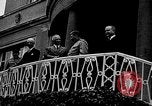
Allied National Leaders hold numerous conferences to plan and coordinate their efforts during World War II
First scene shows President Harry Truman shaking hands with Joseph Stalin on a porch of the Cecilienhof ( home of Crown Prince Wilhelm) in Potsdam, Germany. The two leaders are accompanied by their respective foreign ministers, James F. Byrnes, U.S. Secretary of State, and Soviet Minister of Foreign Affairs, Vyacheslav Molotov. Stalin descends steps from the building followed by Truman. View of the back lawn at Cecilienhof. View of its front entrance. Various views of the house and grounds. American, Soviet, and British flags flying from the building. Cars carrying the leaders on road to the Cecilienhof. President Truman and James Byrnes entering outside gate, followed by other attendees. Then Stalin is seen entering followed by Soviet officers and officials. U.S. General Dwight D. Eisenhower, Supreme Commander Allied Expeditionary Force (SCAEF) in Europea and U.S. Army Chief of Staff. George Marshall are seen walking together in a wooded glade on the meeting grounds. British Field Marshal Bernard Law Montgomery, entering the grounds for the meeting. British Prime Minister Winston Churchill, President Harry Truman, and Joseph Stalin stand on a step before an entrance to Cecilienhof. Truman places their hands together in a mutual handshake, at which Churchill and Stalin laugh. Views of the Kremlin and St. Basil's Cathedral, in Red Square, Moscow, Russia where foreign minsters of the United States, Britain, and the Soviet Union are seen meeting meeting in conference at the Spiridonovka Palace in October, 1943. Closeup of Soviet Prime Minister Vyacheslav Molotov, British Prime Minister, Anthony Eden, and U.S. Secretary of State, Warren Hull, successively signing a document. Scene shifts, to a C-47 transport aircraft flying over great pyramid of Giza in Cairo, Egypt. Next, the front of the Soviet Embassy in Teheran, Iran, is shown. The "Big Three" (Stalin, Roosevelt, and Churchill) sit on the porch of the building. Military officers from their countries stand behind them. Narrator (Franklin D. Roosevelt) says they agreed to launch a gigantic attack on Germany. Scene shifts to Germany, where German military is paraded on public display, showing artillery, Panzer I tanks carried aboard army trucks, Heinkel He 111 bombers in formation overhead, and marching troops giving Nazi salute silhouetted against bright pavement. View shifts to the Livadia Palace, in Yalta, Crimea, Russia. Brief view of the "Big Three" and their staffs sitting around a conference table. Change of location to San Francisco, California, where flags of many nations are displayed along with a United Nations Logo. Representatives of the many nations sign the Charter of the United Nations, founding the U.N. organization on 26 June 1945. Film shifts to Germany where victorious American, British and Soviet troops shake hands and celebrate victory. They share drinks and toast victory.
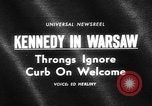
Robert Francis Kennedy visits Jagiellonian University and looks at Jagiellonian globe in Krakow, Poland.
United States Attorney General Robert Kennedy visits communist Poland. Polish civilians crowd on a street at Krakow, Poland. Kennedy with his family in a car. People cheer and greet Kennedy. Robert F. Kennedy arrives at the Jagiellonian University (Gołębia 24, 31-007 Kraków, Poland) in Krakow. He waves to people on the street. Robert waves to the people. Kennedy and his family in the University. He is escorted by the University members. Robert Kennedy looks at a Jagiellonian globe. People crowd outside. Kennedy with his son. Kennedy meets Polish women. U.S. Attorney with his family in a car driven on the street. The crowd follow the car. U.S. Attorney General Robert gives autograph to the people. Kennedy's son gives autograph. The statue of Tadeusz Kosciuszko, a Polish who fought in American Revolution. Kennedy pays tribute to Tadeusz Kosciuszko. The crowd follow Mr. Kennedy and his family. Attorney Kennedy waves to the crowd.