


 Francais
 Deutsch
 Italiano
Refine Your Search
F-86 stock footage and images
- Showing 2251 to 2256 of 2472 results more
more Hide
Hide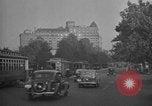
Evening and night scenes with traffic and pedestrians in Washington DC during the Great Depression
A film depicts an impressionistic study of Washington DC on a typical depression day. Traffic on a street. The Lincoln Memorial and a statue of Lincoln. A view of the memorial. The dome of the United States Capitol. 1930's era cars and automobiles on the roads of Washington DC, including some closeup views of automobiles. Car exit a building marked as "Capitol Garage." People on the streets. People gathered in front of a theater box office. Man stands by a taxi cab and pays the taxi driver as he is dropped off. A fast food restaurant with sign White Tower Hamburgers at either 631 F Street NW or 1419 I Street NW Washington DC. Night scenes show traffic on the streets and the dome of the United States Capitol with fountains in front of the building.
Air force cadets from all parts of the British Empire receive training at a Royal Canadian Air Force camp in Canada.
Canada hails the 3rd year of Empire Air Training. A flag and insignia of the Royal Canadian Air Force. Officers seated in chairs. Cadets enroll themselves. Air force cadets from all parts of the British Empire. An officer surrounded by cadets looks into a paper. The cadets stand in front of an aircraft. An aircraft is moved out of a hangar. Airmen walk on a airfield. An airman gets in a cockpit. The aircraft taxis and takes off. Other aircraft parked on the field. The aircraft in flight. Aerial view of a training center. Graduates stand in a formation. A close up of the graduates. A close up of a badge on a uniform which reads 'R.N.Z.A.F. New Zealand'. A graduate student marches forward and shakes hand with an officer. The officer talks to a graduate cadet. The cadets march. Canadian trained airmen on a deck wave.
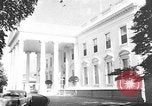
U.S. President Kennedy talks about respecting African American citizens and giving them equal rights during a speech on Alabama in Washington DC.
U.S. President John F. Kennedy's speech on Alabama in Washington DC. The White House. United States President John Kennedy seated at a desk and speaks over a microphone. The President speaks about the discrimination of blacks by whites in the United States. He talks about the University of Alabama not giving admission to two clearly qualified young Alabama residents (James Hood and Vivian Malone) who happened to have been born African Americans. President Kennedy says that the nation is founded on the principle that all men are created equal, and that the rights of every man are diminished when the rights of one man are threatened. The President says that it is possible for the American consumers of any color to receive equal service in places of public accommodation, to register and to vote in a free election without interference or fear of reprisal. President Kennedy talks about respecting African Americans and all Americans and urges people not to discriminate and to uphold civil rights. He says that no city or State or legislative body can prudently choose to ignore them.
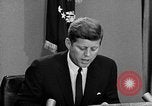
U.S. President Kennedy asks for support of the citizens for ending the discrimination against African Americans, in his speech in the U.S.
U.S. President John F. Kennedy's Civil Rights Address in Washington DC. United States President Kennedy seated at a desk and speaks over a microphone. Following events in Alabama, the President speaks about ending the discrimination of blacks by whites in the United States. He says that it's time for the Congress to act. President Kennedy says that he will ask the Congress of the United States to act, to make a commitment it has not fully made in this century to the proposition that race has no place in American life or law. He talks about the necessary measures that Congress can provide. The President, in his speech, asks the Congress to enact legislation giving all Americans the right to be served the facilities which are open to the public. He talks about his meeting with the business leaders and urges them to take voluntary action to end this discrimination. The President says that he has also asked the Congress to authorize the Federal Government to participate more fully in lawsuits designed to end segregation in public education. He also speaks about giving employment for African American citizens. President Kennedy, in his speech, pays tribute to those citizens of North and South who have been working in their communities to make life better for all. The President asks for support of all the citizens so that the discrimination can be removed and civil rights upheld.
U.S. President Kennedy talks about equal rights for black and white citizens during a speech in Washington DC, United States.
United States President John F. Kennedy's speech regarding racism and racial tensions in Alabama, delivered from Washington DC, the White House. United States President Kennedy seated at a desk and speaks over a microphone. The President speaks about racial discrimination against blacks in the United States. He talks about the University of Alabama not giving admission to two clearly qualified young Alabama residents who happened to have been born African Americans, due to segregation and discrimination practices. View of people crowded outside the University of Alabama (Tuscaloosa, AL 35487, United States). Men take pictures as officials escort entering students Vivian Malone and James Hood into Foster Auditorium of the university. The President says that the nation is founded on the principle that all men are created equal, and that the rights of every man are diminished when the rights of one man are threatened. President Kennedy says that it is right for American consumers of any color to receive equal service in places of public accommodation, to register and to vote in a free election without interference or fear of reprisal. Additional views of Vivian Malone and James Hood walking with crowds and unaccompanied on the University of Alabama campus. A policeman rides a motorcycle on a road at the University. President Kennedy talks about respecting African American citizens and importance of civil rights and equality. The President says that no city or State or legislative body can prudently choose to ignore the rights of any of its citizens. The press record his speech and take pictures.
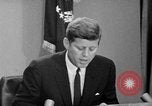
U.S. President Kennedy asks for support of citizens and business leaders to end racial discrimination in the United States
Second part of U.S. President John F. Kennedy's speech in Washington DC following events at the University of Alabama when two African American students, Vivian Malone and James Hood, attempted to enroll. United States President Kennedy seated at desk and speaks over a microphone. The President speaks about ending racial discrimination and importance of equality and civil rights in the United States. He says that it's time for the Congress to act. President Kennedy says that he will ask the Congress of the United States to act, to make a commitment it has not fully made in this century to the proposition that race has no place in the American life or law. The President talks about the necessary measures that Congress can provide. President Kennedy, in his speech, asks the Congress to enact legislation giving all Americans the right to be served the facilities which are open to the public. He talks about, and scenes are shown from his recent meeting with business leaders in the white house, together with Vice President Lyndon Johnson, as Kennedy urged them to take voluntary action to end workplace discrimination. The business leaders in a large room of the White House. The President says that he has also asked the Congress to authorize the Federal Government to participate more fully in lawsuits designed to end segregation in public education. He also speaks about giving employment to African Americans. President Kennedy, in his speech, pays tribute to those citizens of the North and South who have been working in their communities to make life better for all. The President asks for support of all the citizens so that discrimination can be removed. Many television cameras and cameramen. The President gets up from the desk and leaves.