


 Francais
 Deutsch
 Italiano
Refine Your Search
F-86 stock footage and images
- Showing 2305 to 2310 of 2472 results more
more Hide
Hide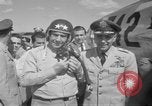
General Hood, Cuban officers and civilians watch air show as USAF pilots give an aeria1 demonstration in Cuba.
USAF Major General Reuben Columbus Hood Jr. visits Cuba during his goodwill tour. General Hood and VIP's. VIP has General Hood's helmet on. USAF Lockheed T-33 Shooting Star, a jet trainer aircraft in the background. Several views of dignitaries preparing for demonstration flight. Flight tower in the background. Written on tower: 'Aeropuerto Batista'. Tail section of Cuban B-45. Written on the tail section: Fuerga and Aerea Jercito de Cuba. USAF F-84 Thunderbirds making a fly-by. A group of personnel. Photographers in the foreground. Several of General Hood and Cuban officers exchanging greetings. Severa1 of officers and civilians during the air show.
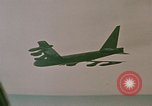
Film principally about the use of Strategic Air Command B-52 bombers supporting American ground forces during the Vietnam War.
The film begins showing an airborne B-52 bomber and then a copilot in the cockpit. View down through the bomb bay of a B-52. View from another Aircraft of a B-52 dropping numerous conventional bombs on enemy positions in Vietnam. The open bomb bay is shown again, only this time clusters of bombs are seen dropping from it. Aerial view of the ground as the many bombs strike creating a line of explosions and smoke. Closeup of a crew member wearing an oxygen mask. Another view of bombs being dropped and exploding on the ground. Bomb bay on a bomber being closed after it has finished a mission. More aerial views of bomb strikes and damage on the ground. View from cockpit of a B-52 following another that is leaving condensation trails. An Air Force officer working on the ground with mechanics. An Air Force sergeant working with a Navy technician in a headquarters. Strategic Air Command (SAC) crew members in flight suits descend from an aircraft upon arriving at an Air Force Base. An Air Force General presenting a major with some type of an award. A B-52 taxiing on an airfield. An F-104 Starfighter aircraft taxiing on an airfield. War supplies for American forces being offloaded from a ship in Vietnam. An Air Force drill team marching. A mechanic replacing a bulb on a large high outdoor light. Brief glimpse closeup of some school children. Air force personnel rescue a person from a flooded house. The Air Force drill team, seen earlier, spinning their rifles. Air Force ground crews moving a thousand pound bomb on a trolley and installing it into a B-52. View from a Boeing KC-135 Stratotanker as it refuels a B-52 in flight. View of the tanker hooked up to the B-52.
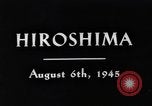
Effects of the atomic bombing of Hiroshima, Japan, in World War II, and early international efforts to control atomic weapons
Film showing city of Hiroshima, Japan, before and after the August 6, 1945 dropping of the atomic bomb over the city in World War 2. Sequence opens on what the narrator says is August 5, 1945, the day before the event (but the footage is likely from before that date). Camera pans over the city of Hiroshima before the atomic bomb destroyed the city. Japanese air raid lookouts are seen on watch for allied bombers. View of atomic bomb detonation as seen from aircraft high overhead (this is actually a view of the Nagasaki blast, not the Hiroshima blast despite narrator's comments). Next, the complete destruction of the city of Hiroshima is seen from camera at low altitude showing the four and one half square miles of the city flattened and burned. A Japanese hospital still functioning, with red cross flag on it. Hospital workers retrieving wounded victims of the bombing. Ambulatory victims clustered in doorways and halls. Shadow image of a large industrial valve wheel burned onto wall behind it. Similar image of a ladder burned onto a wall. The decorative pattern on a woman's dress burned onto skin of her back. Japanese physicians treating victims of thermal and radiation burns. Views of various victims, including some children, and their respective injuries. Scene shifts forward one year, to August 6, 1946. Children are lined up outside a school building, and then seen inside their classroom. Disfiguration and wounds on children resulting from injuries are still evident on the children at their desks. Sequence shifts again, this time to an early United Nations meeting with delegates grappling with the issue of controlling nuclear power and atomic weapons. Closeup view of American delegates, including James F. Byrnes (Secretary of State)and James B. Conant, President of Harvard University in the assembly. Closeups of representatives from South Asian nations. Closeup of USSR delegation, headed by Foreign Minister, Vyacheslav Molotov. Signs identifying delegates from Colombia, Egypt, Iraq, Bolivia, China. Final sequence shows several U.S. atomic scientists in their respective laboratories, including Enrico Fermi and Vannevar Bush. United States representative to the UN, Warren Austin, speaking about the so-called Baruch Plan, for international control of atomic weapons. (Principal author, Bernard Baruch, is standing behind speaker's left shoulder.) USSR delegation, headed by permanent representative, Andrei Gromyko, who is seen presenting the Soviet plan. View of explosion and mushroom cloud during U.S. Operation Crossroads atomic bomb test in the Pacific.
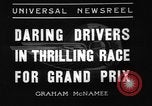
Formula One motor cars skid on slippery automobile race course; Rudolf Caracciola wins Grand Prix in Monte Carlo, Monaco.
Formula One car Grand Prix motor racing in Monte Carlo, Monaco. Motor race starts. Auto racers drive F1 motor cars on automobile race course. Spectators watch the race. Race course turns into slippery one due to rain. Motor cars collide and skids. Rudolf Caracciola wins the race. Large crowd standing around him.
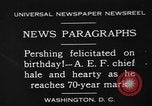
John Joseph Pershing is congratulated on his 70th birthday in Washington DC.
John Joseph Pershing is congratulated on his birthday in Washington DC. John Joseph Pershing (Former General of the U.S. Armies) is congratulated on his 70th birthday. He is greeted by A.E.F. (American Expeditionary Force) chief. He speaks.
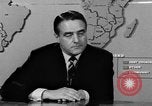
Sargent Shriver speaks about equal enthusiasm of Kennedy and Johnson for the Peace Corps during an interview in Washington.
Robert Sargent Shriver is interviewed by Frank Reynolds in Washington. Television journalist Frank Reynolds interviews Robert Sargent Shriver Jr. , Director of the Peace Corps. A world map on a wall in the background. Sargent Shriver talks about enthusiasm of former U.S. President John F. Kennedy (JK) and U.S. President Lyndon B. Johnson for the Peace Corps. Frank Reynolds questions whether the people of Vietnam can serve in the Peace Corps.